They Don’t Want to Be “Hollywood-ized”: Simona Širvydaitė-Šliupienė on the Ainu, Creating for Children, and When Words Become Flesh
2026 05 06
For Simona Širvydaitė-Šliupienė, head of the House of Histories at the National Museum of Lithuania, this year has been defined by firsts: her first curated exhibition and her first children’s book. That book – “A Soul Between Worlds: The Ainu People of Northern Japan and Ethnographer Bronisław Piłsudski”, illustrated by Reda Tomingas – has already drawn attention from readers and professionals alike, even earning a diploma in a national book art competition. We spoke with the author about the Ainu, storytelling for children, and the delicate balance between accessibility and respect.
– How did your interest in the Ainu people begin?
“My first encounter with the Ainu dates back to 2012. I had long been interested in Japanese culture and history, and I learned about the polyphonic songs of the Ainu in northern Japan—that they bear a striking resemblance to Lithuanian sutartinės. Ethnomusicologist Prof. Dr. Daiva Vyčinienė has written about this. I was fascinated by that unexpected connection and invited the Ainu group ‘Marewrew’ from Hokkaido to come to Lithuania and perform together with our own concert singers ‘Trys keturiose.’ From that point on, my interest in the Ainu only grew.”
– You are not only the author of the book, but also the initiator and one of the curators of the exhibition A Human Between Worlds. How did the exhibition come about?
“This year marks 35 years of diplomatic relations between Lithuania and Japan, so we wanted to organize an exhibition dedicated to Japan at the House of Histories. We spoke with colleagues at the museum and with Lithuania’s cultural attaché in Japan, Gabija Čepulionytė, considering what we could present—what connects our countries. There were ideas about geishas or samurai, but such exhibitions have already been done in Lithuania and across Europe. We were looking for different, untold stories that would link Lithuania and Japan.
“And then the idea emerged to tell the story of Bronisław Piłsudski—a museum professional and world-class researcher of the Ainu—who was born in the Švenčionys region, identified as both Lithuanian and Polish, yet remains little known in Lithuania. The ethnographic theme also felt very close to the House of Histories, and everything came together naturally.”
-
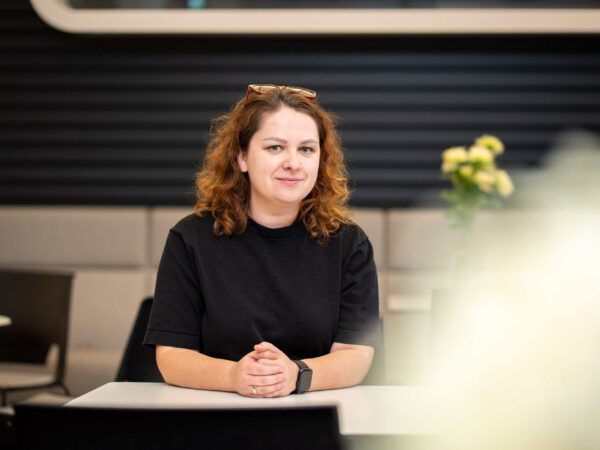
- Simona Širvydaitė-Šliupienė. Photo: Silvestras Samsonas, NML

– How did the idea arise to write a children’s book about the Ainu?
“Also very naturally. When we create exhibitions at the House of Histories, we always think about children—what we can offer them, how to tell a story in an engaging and understandable way. The idea emerged to prepare a book with a character who would accompany visitors through the exhibition. Since the exhibition concept was already developed, all that remained was to translate it into language appealing to children.
“I had in mind my son’s favorite book—a visually beautiful one, with little text and everything easy to grasp. That’s what I wanted: for children to learn about the Ainu people, their culture and traditions, and for the book to be visually captivating—something a child would want to pick up again and again.”
– Illustrations are especially important in this book. What was your collaboration with the artist like?
“Reda Tomingas was suggested by a colleague, the book’s designer Justina Brukštutė-Šimkė, and I’m very glad we worked together. Reda is a top-level professional in her field. She’s very busy, but the topic intrigued her, so she immediately began immersing herself deeply in Ainu culture.
“There were also sensitive moments. Naturally, the Ainu we collaborated with on the exhibition asked: how is it that a book about them is being created by people who are not from their community? We understood that and consciously involved Ainu representatives in the creative process. They carefully reviewed all the texts and illustrations, offered feedback, and we coordinated every detail with them.”
-
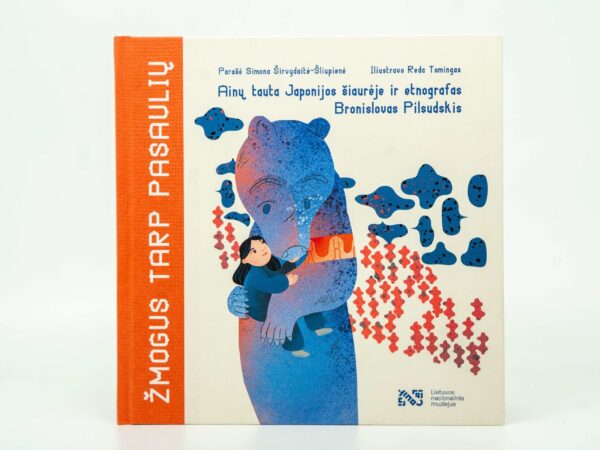
- The children’s book “A Soul Between Worlds”. Photo: Silvestras Samsonas, NML

– What did they emphasize most strongly?
“That Ainu culture should not be reduced to simply beautiful patterns. They made it very clear: the most important thing is their relationship with nature—their respect for plants, animals, and the environment. They do not want to be ‘Hollywood-ized,’ turned into some simplified exotic spectacle—which, unfortunately, often happens to Indigenous peoples.
“And I completely understand them. There is a slippery boundary—how to tell the story of another culture in a way that is engaging and understandable, without trivializing or distorting its essence. I think that through collaboration we managed to maintain a strong balance and respect for Ainu culture, and I’m very happy about that.”
– The book has already received international attention. How did that happen?
“Everything happened quite quickly. The book was noticed right away—readers shared it on social media, and interest came from other countries. It’s now being translated into Polish, as the exhibition will travel to Poland this autumn. I’ve also been encouraged from Scandinavia to translate it into Swedish and Finnish, since education about Indigenous peoples is highly relevant there, particularly in connection with the Sámi. I even saw it appearing in social media stories from the Bologna Children’s Book Fair. Each time I notice something like that, it gives me renewed energy to keep the book alive.
“The greatest recognition for me was that the Ainu themselves agreed to have the book translated into Japanese and published in Japan. I cautiously asked Prof. Dr. Hirofumi Kato from the Ainu Research Center at Hokkaido University what they would think. He consulted with colleagues and decided—yes, let’s do it. So I’m happy to say the book will be published in Hokkaido, read by the Ainu themselves as well as by Japanese readers. I think that’s a huge success.”
– Why is international visibility important for the Ainu?
“Because recognition from outside can shift perspectives within Japan itself. Today, outside Hokkaido—where most of the Ainu population lives—there are not many large exhibitions presenting them. Yet elsewhere in the world, there are. That means their culture is sometimes more visible globally than at home.
“When the Ainu are discussed internationally—when they appear in exhibitions or books—they become more visible and more valued in Japan as well. And for the Ainu, being recognized and valued in Japan is especially important. That’s why I’m so glad the book will be translated into Japanese.”
– You mentioned your children. Did they take part in creating the book?
“Oh yes, very actively. They eagerly awaited each new illustrated spread, commenting and reacting. My older daughter Liepa made sure the book would appeal to children—she even voiced the main character, Paykar, in the exhibition’s storytelling stations. My younger son Joris prepared the book’s first presentation for children in his class. I believe involving children in the creative process is essential, both for those writing for them and for those designing children’s content.”
-
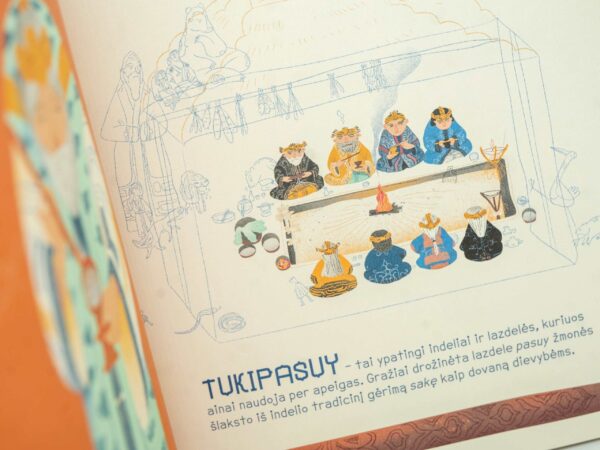
- The children’s book “A Soul Between Worlds”. Photo: Silvestras Samsonas, NML

– Why do you think that?
“Because what adults think will appeal to children or teenagers doesn’t necessarily align with reality. Today’s children are not the same as we were. If you want to create something that truly resonates with them, you have to involve them—not imitate their slang or behavior, but genuinely listen and include them in the process. Children can easily detect adult imitation, and that makes things even less appealing.”
– How do you feel about becoming an author for the first time?
“Still a bit strange. Sometimes I think, what kind of writer am I? Recently it was Writers’ Day, and my mother congratulated me. I was surprised—but then I thought: actually, yes, I am a writer. That’s pretty great.
“This year, in general, has been full of firsts for me. My first exhibition where I’m not just a coordinator but a curator deeply involved in the creative process. My first book. And it’s wonderful that even after five years of working at the museum, I’m still experiencing so many firsts.”
– What is the most powerful moment in the creative process for you?
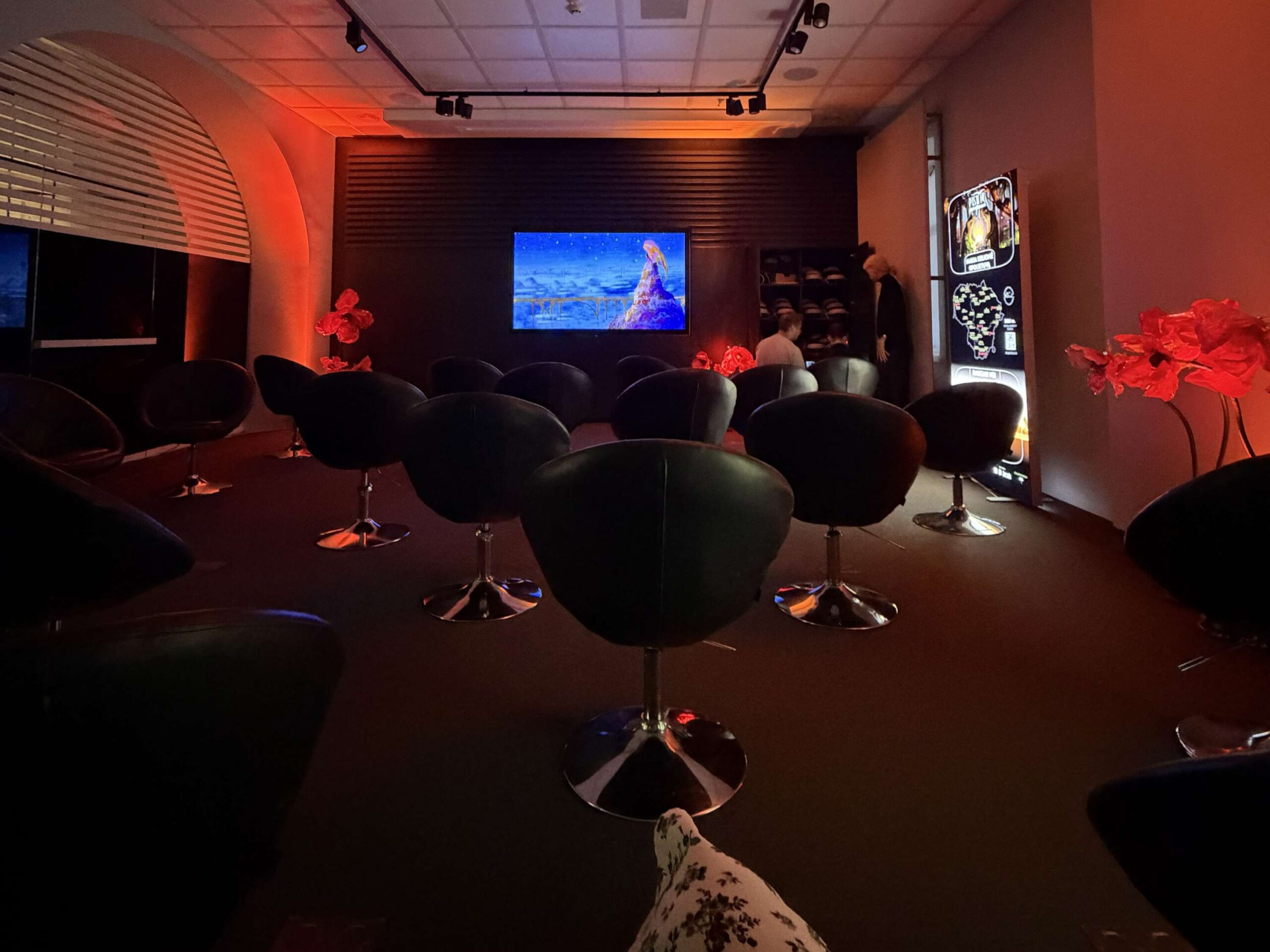
“When the word becomes flesh. That’s probably one of the most powerful moments in exhibition-making. It doesn’t matter whether you’re a curator or a coordinator—about a month before opening, when the architecture starts going up and the exhibits fall into place, when the concept leaps out of Word documents and Excel spreadsheets and becomes physical reality—that’s an incredible feeling. To see something you’ve lived with for one or two years come into being in just a couple of weeks.
“It’s the same with a book. You think, you write, you create. Then you wait for the spreads. The moment a spread is born—when your words become embodied through the illustrator—is one of the best moments.”
-
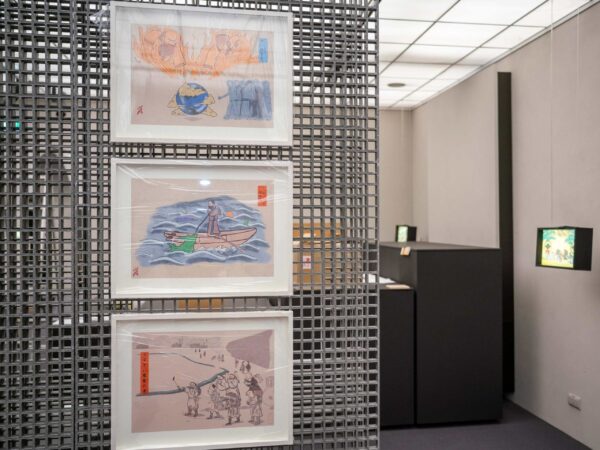
- Installation of the exhibition “A Soul Between Worlds”. Photo: Silvestras Samsonas, NML

– What would you wish for readers of the book?
“That they read and love books. And I would wish for the book itself to live its own life—to find its way into children’s hearts, and for as many of them as possible around the world to read it.”
The book “A Soul Between Worlds: The Ainu People of Northern Japan and Ethnographer Bronisław Piłsudski” is available through the Lithuanian National Museum’s online store and at the House of Histories (T. Kosciuškos g. 3, Vilnius).
The international exhibition “A Soul Between Worlds: The Ainu People of Northern Japan and Ethnographer Bronisław Piłsudski” runs at the House of Histories until August 2.
The exhibition is organized by the Lithuanian National Museum and the Józef Piłsudski Museum in Sulejówek, with support from the town of Biratori in Japan, the Japan Foundation, the Lithuanian Ministry of Culture, the Polish Institute in Vilnius, and the Embassy of Poland in Vilnius. More information can be found at lnm.lt.
-
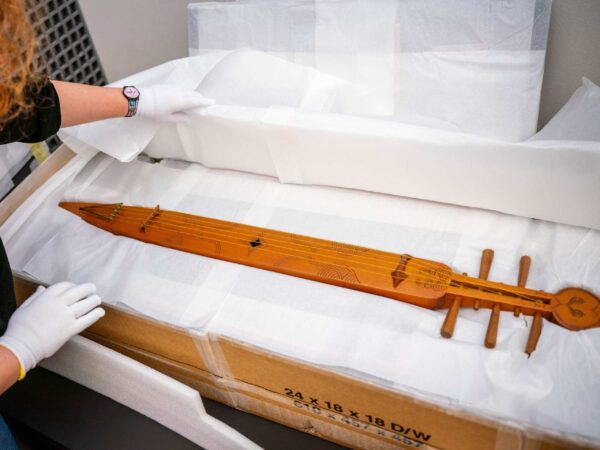
- Installation of the exhibition “A Soul Between Worlds”. Photo: Silvestras Samsonas, NML