Restorer on the “Madonna of Laukžemė”: the abundance of layers of paint helped preserve the Gothic style
2025 11 04
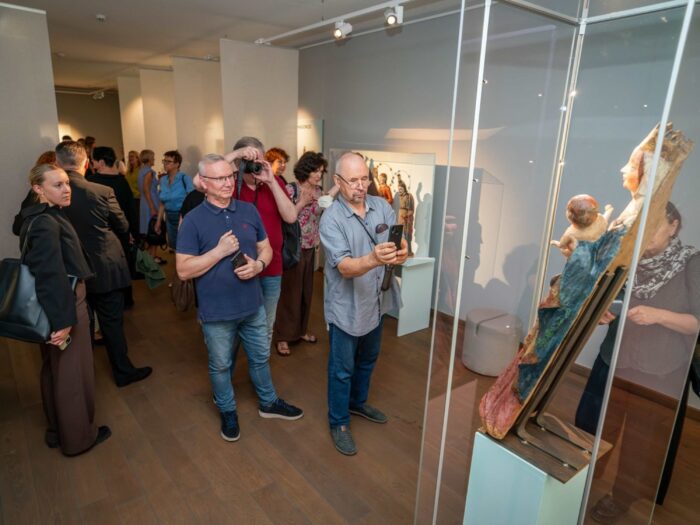
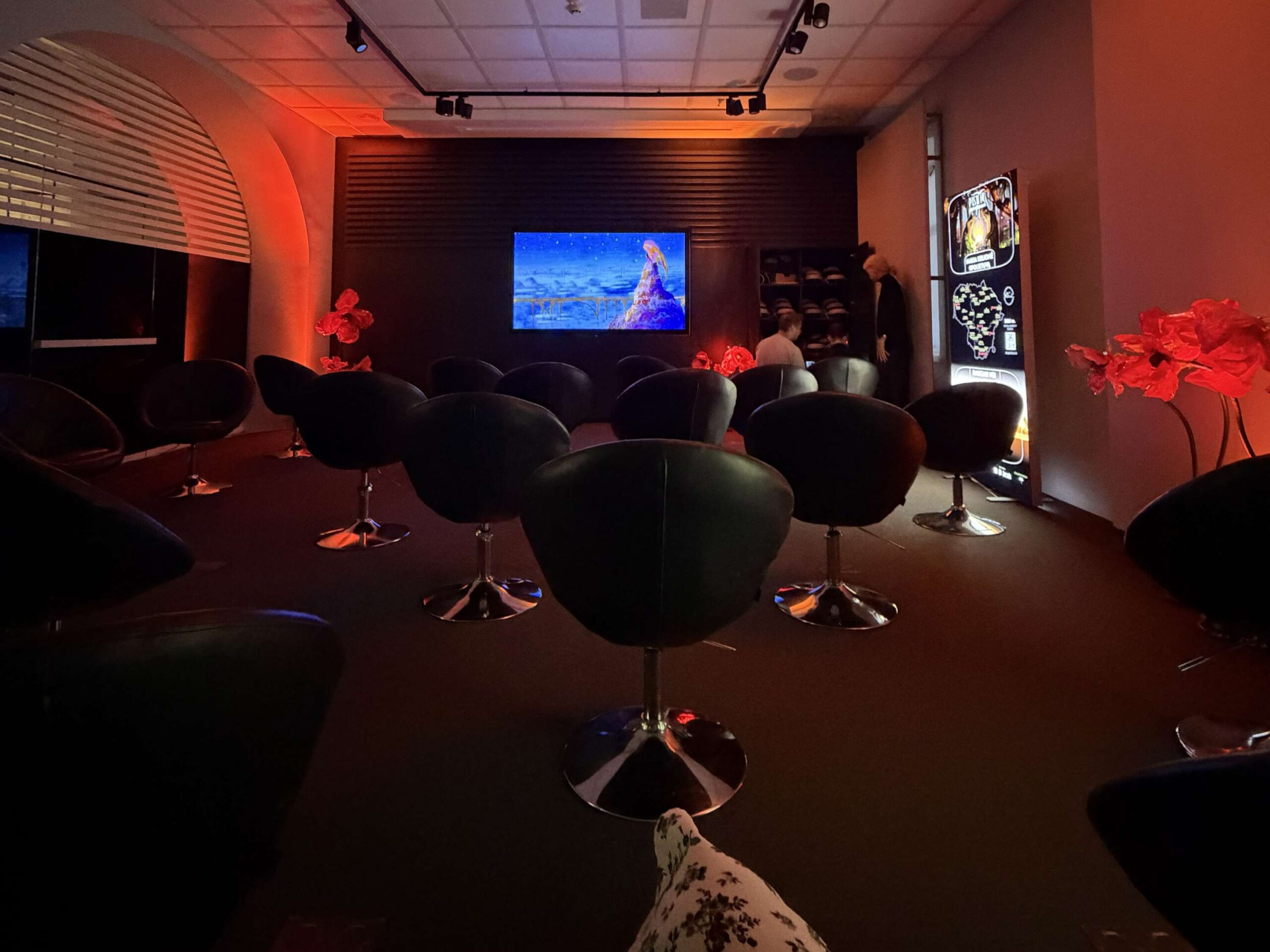
At the Kazys Varnelis House–Museum of the National Museum of Lithuania (LNM), an exhibition titled “The Madonna of Laukžemė: Revealing 600 Years of Secrets” is currently on view. Over the course of six centuries, the Madonna of Laukžemė has been “improved” many times—repainted either completely or in parts. The layers of paint covering the sculpture have concealed the original carving details and Gothic polychromy. “We couldn’t use any traditional restoration methods because the upper paint layers were hard and thick, while the underlying ones were fragile,” explains Vita Blažiūnienė.
We spoke with one of the exhibition’s curators—former head of the LNM Restoration Centre and restorer Vita Blažiūnienė—about the restoration of this exceptional Gothic artwork and about how modern technologies are transforming the field of restoration.
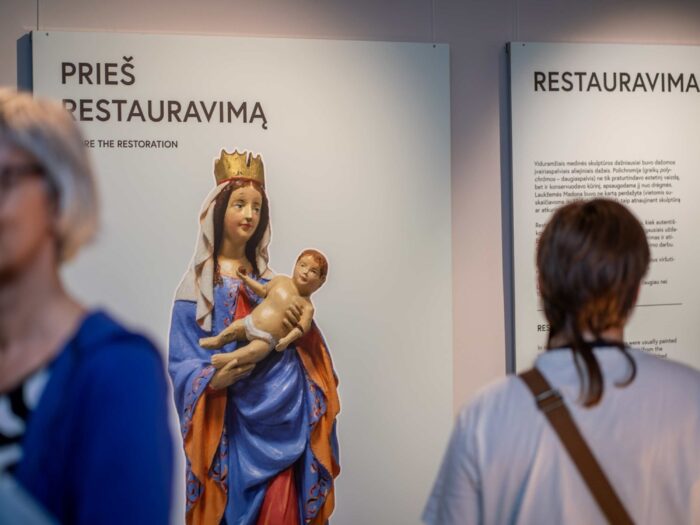
In 1990, art historian Marija Matušakaitė (1924–2016) discovered a richly decorated sculpture of the Virgin and Child in the porch of the Church of St. Andrew the Apostle in Laukžemė, hidden inside a wall clock cabinet. The sculpture, named The Madonna of Laukžemė, was created in Central Europe around 1420 and is one of the earliest—and exceedingly rare—Gothic sculptures in Lithuania.
It took ten years to remove the many paint layers that had accumulated and altered the Madonna’s appearance. What were these layers? On what occasions was Mary repainted?
Repainting sculptures was a common and ongoing practice. Sculptures were important and visible objects, often damaged mechanically when moved or touched—the paint would wear off or the polychromy would chip. Therefore, they were frequently renewed. Sometimes the old layer was scraped off before repainting, but often the new paint was simply applied on top.
-
- The Restoration of the “Madonna of Laukžemė”Photo by H. Sakalauskas
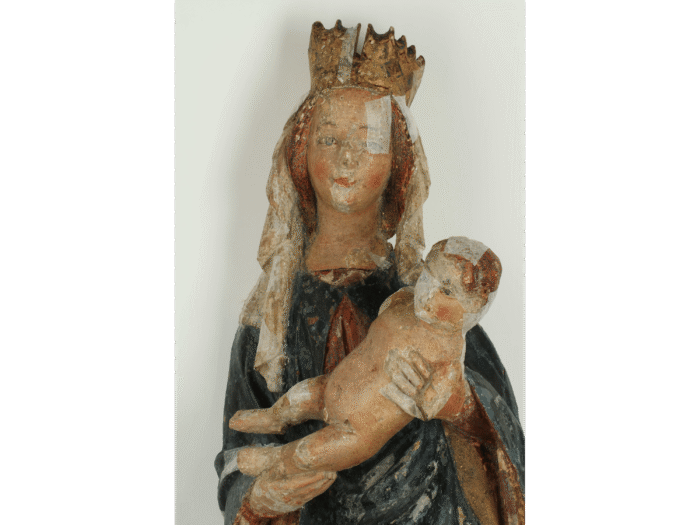
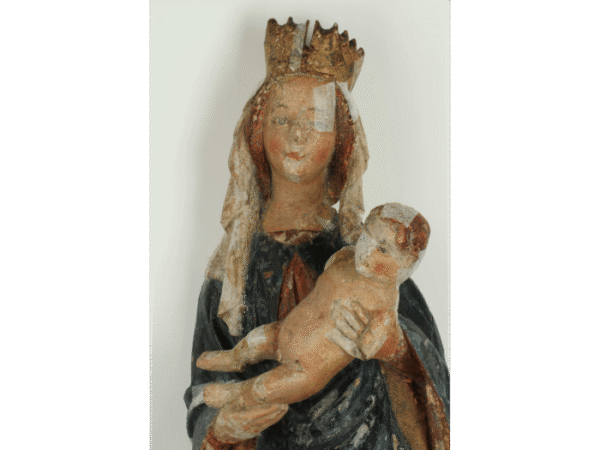
The Madonna of Laukžemė was not repainted entirely each time—sometimes only one or several parts were renewed. Her robe and cloak were primed and repainted in the 16th–17th centuries, and that work was done quite professionally. Later repaints were less skilled—the newer the layer, the less professional it tended to be.
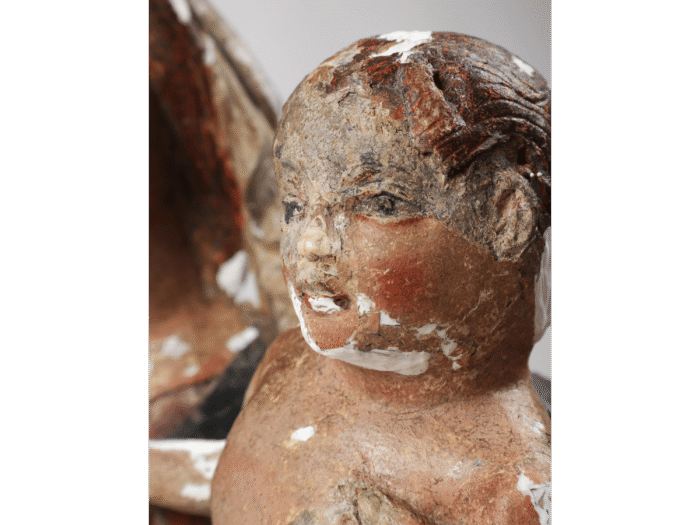
The final repainting took place in 1979, using a thick coat of floor paint. The colors did not fully conform to church canons, and the fine carving was obscured, greatly distorting the original appearance. However, these many layers actually helped preserve the Gothic polychromy, effectively sealing and conserving it. The survival of such early paintwork is rare—a true sensation.
Is such a long restoration typical? What takes the most time?
Such a lengthy process is unusual—it’s even a kind of luxury. None of the standard methods worked here: the upper layers were hard and thick, while the lower ones were fragile. Usually, restorers use scalpels and solvents, but in this case those would have destroyed the original layer.
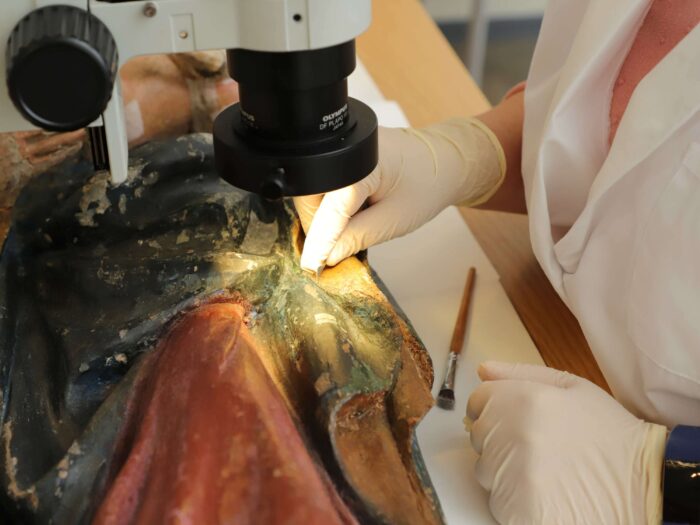
Ieva Stanionienė was the lead restorer. Using a microscope and a needle scalpel, she exposed the layers micron by micron. That’s why the process took so long. Two people worked seasonally, from spring to autumn, when the microclimate was suitable.
What is polychromy?
Colored sculpture painting has existed since Antiquity. Wooden sculptures were coated with a preparatory layer to help the paint adhere to the surface, followed by a ground layer for smoothing, and then the coloring. Pigments varied depending on the period. The differences between 15th- and 17th-century polychromy even help to date artworks.
Masters followed strict canons—they didn’t invent colors on their own. For example, Berlin blue didn’t exist in the 15th or 16th century. Typical pigments for skin tones included lead white, red earth pigments, and cinnabar. Hair was gilded or painted brown, and crowns were gilded. Every detail followed established conventions and the materials available at the time.
-
- The Restoration of the “Madonna of Laukžemė” Photo by H. Sakalauskas
When did it become clear what was hidden beneath the paint?
Discovering what lay beneath was the main challenge. After removing the most recent layer—which covered an even cruder repaint—cracks revealed traces of yet another layer below.
In the Restoration Centre’s laboratory, samples showed many layers, but it was impossible to tell exactly how many. The restoration program had to be adjusted multiple times. Testing and uncovering happened simultaneously.
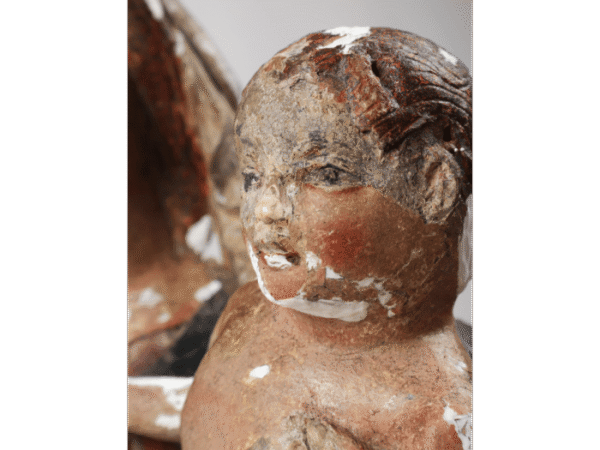
At one point, we realized we had reached the Gothic layer—a thrilling discovery. Its delicate red cheeks, chin, subtle eye polychromy, eyebrows, and flesh tones unmistakably revealed Gothic craftsmanship. We compared it with other Gothic polychromy and confirmed the finding—this was the greatest joy and surprise.
What was restored or reconstructed?
This is always a key question. Our goal was to change as little as possible. Since the object is so rare, we aimed to preserve rather than recreate. Most of the original layer was simply uncovered. Only a few areas were delicately retouched to unify the overall appearance—some losses were intentionally left visible, as they highlight the sculpture’s age and authenticity.
Restoration aims for balance: from afar, the object looks complete, but up close, small losses and retouches can still be seen.
-
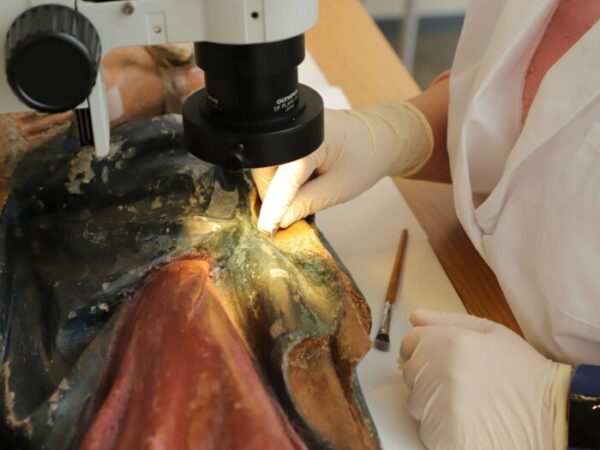
- Restoration of the “Madonna of the Countryside”. Photo by A. Blažys
What analysis methods were used?
Two analytical methods were employed: microchemical qualitative analysis and Fourier-transform infrared spectroscopy (FTIR). These are standard in restoration practice—FTIR is especially useful for identifying varnishes and binding media.
Why include these studies in the exhibition?
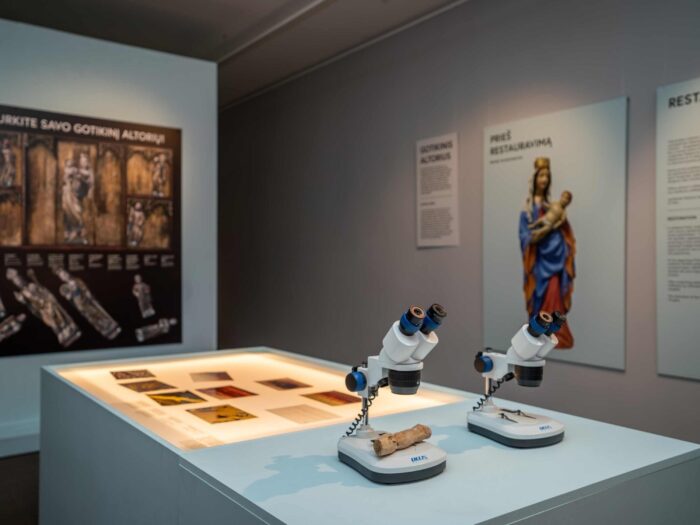
We wanted visitors to first feel like detectives, historians, or art scholars—and finally, in the last hall, like restorers. The exhibition includes a recreation of a restorer’s workspace: visitors can sit at a desk, look through a microscope, examine paint cross-sections, and evaluate layer thickness and damage.
On the worktable are photos of microchemical reactions—showing crystal formation as seen by a chemist. We wanted visitors to appreciate how multidisciplinary art research is. Since the restoration was carried out under the microscope, this display reflects the restorer’s everyday reality—and helps explain why the process took ten years.
Is the oldest layer always the most valuable?
This is always open to debate. There are usually differing opinions, and much has been written on the topic. These are delicate decisions.
In this case, the choice was clear: both the sculpture and its original polychromy are Gothic. The Gothic paint survived partly—the faces, hair, and the Child’s body—while the robe, cloak, and crown date from the 16th–17th centuries. Later layers were much rougher and even differed in color.
But in general, this is one of the most difficult dilemmas restorers face. The older the object, the more skilled the restorer must be. We don’t always uncover the oldest layer; sometimes later overpaintings also have value. In easel painting, one often wants to see the first layer, but overpaintings can themselves be historically significant. In my 30 years of experience, these are the hardest decisions.
-
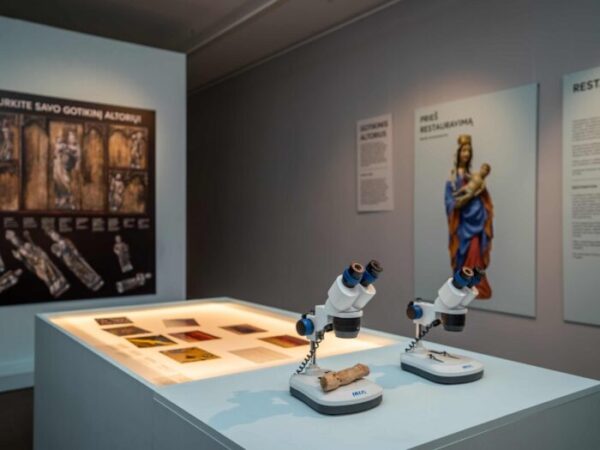
- Exhibition “Madonna of the Countryside. Revealing 600 years of secrets”. Photo: S. Samsonas
Has the approach to restoration changed?
Yes—there are even “fashions” or trends. In the early 20th century, cleaning off overpaint was very popular because new technologies made it possible to identify layers. Today, there’s more emphasis on sensitivity and subtlety, considering aesthetic and philosophical aspects.
In the 19th century, “renewing” a work—by repainting or emphasizing details—was common practice. Such “updates” would be unthinkable today. Moreover, as church art iconography changed, artists were sometimes ordered to repaint certain details. That, too, is part of the artwork’s history.
Today we distinguish between conservation (preserving what exists) and restoration (recreating lost details using analogies)—a much more deliberate intervention.
-

- Exhibition “Madonna of the Countryside. Revealing 600 years of secrets”. Photo: S. Samsonas
How are technologies changing restoration?
As technology advances, we can study artworks more thoroughly and treat them more gently. Previously, microchemical analysis required taking several millimeter-sized samples—20 or 30 fragments.
Now, non-invasive techniques allow us to examine works without taking any samples. Infrared and X-ray imaging can reveal underdrawings or hidden layers. X-ray studies have long been used, much like medical equipment.
Today there’s a wide range of such methods—scanning, imaging, even artificial intelligence plays a role. The most important thing is that technology ensures the safety of the artwork—modern, non-invasive methods are constantly improving.
Guided tours of the exhibition “The Madonna of Laukžemė: Revealing 600 Years of Secrets” will take place on November 9, 16, and 23. click here.
Educational workshops for adults and families, “The Brilliance of the Madonna of Laukžemė,” will be held on November 22 and 29.click here.
Interview and text by Austėja Mikuckytė-Mateikienė.
More information about exhibition: click here.
-
- Exhibition “Madonna of the Countryside. Revealing 600 years of secrets”. Photo: S. Samsonas