Not a Trend but a Necessity: What Prehistory Teaches Us About Sustainability Today
2026 01 22
Sustainability is often presented as one of the key challenges of the contemporary world – a modern ambition that calls for new technologies and innovative solutions. The new archaeology exhibition “Reusable” at the National Museum of Lithuania invites visitors to look instead at the everyday practices of prehistoric communities: repairing, reusing, and adapting objects. These practices lost their importance in the era of modernity, yet today they are once again becoming highly relevant.
The exhibition features artefacts of significant cultural and historical value – objects that were reused, repaired, or adapted by changing their original function. They allow visitors to take a closer look at the principles of (sus)tainable living and reveal how communities adapted, while also telling stories about people’s relationships with objects in a world where every item had value, history, and continuity.
Everyday Life of the Past – A Necessity of the Present
Sustainability as a value-based system is a modern construct, yet practices that reflect it existed already in prehistory – although for very different reasons. For people of the time, repairing and reusing objects was a practical necessity shaped by limited resources, high labour costs, and the technological possibilities available to them.
-
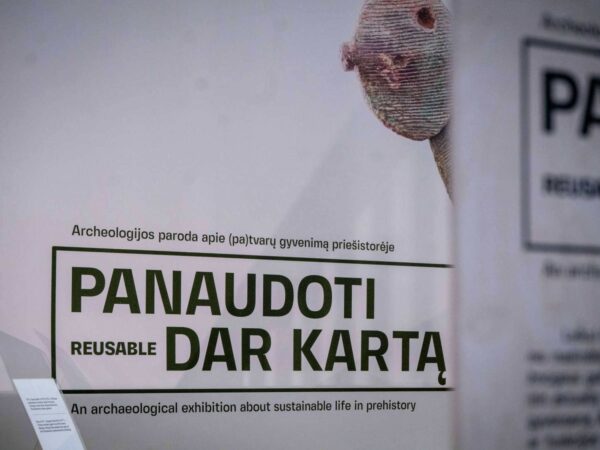
- Exhibition “Reusable”. Photo by Silvestras Samsonas, National Museum of Lithuania

“Prehistoric communities lived in a world where resources were scarce and objects were valuable. Repair, reuse, and reworking objects were not alternatives but the norm, enabling people to adapt to their environment and everyday needs,” says exhibition curator Dr Šarūnė Valotkienė.
Archaeological finds testify to a wide range of practical solutions related to the use of objects – solutions that today appear strikingly relevant. Broken items were not discarded but repaired and used further, or adapted for another purpose. This helped extend the “life” of objects and conserve hard-to-obtain raw materials, especially metal.
This approach is illustrated by one of the most striking narratives presented in the exhibition – the story of the Staldzene bronze hoard, discovered on the Baltic Sea coast near Ventspils.
-
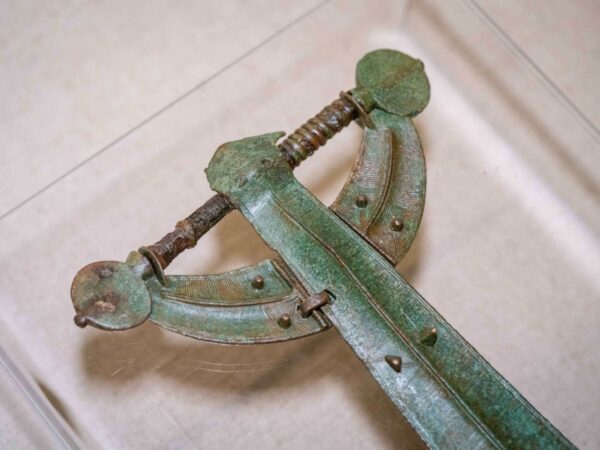
- Exhibition “Reusable”. Photo by Silvestras Samsonas, National Museum of Lithuania

“Producing a tool, a piece of jewellery, or a household object required a great deal of time and effort, so repairing them was self-evident. The exhibition shows how people adapted while working with limited resources. For example, artefacts typical of Scandinavia were transported to the eastern coast of the Baltic Sea, where they were most likely intended to be remelted and turned into new objects – a process that required ingenuity and cooperation,” emphasises exhibition curator Dr Lijana Muradian.
The hoard, dated to approximately 2,500–3,000 years ago, consists of long-used, repaired, and broken objects characteristic of the Scandinavian region, from where they likely reached the eastern Baltic coast – a region without sources of non-ferrous metal ores.
“It is believed that the objects found in this hoard were intended specifically for remelting, testifying to a rational approach to metal as an extremely valuable and reusable raw material. Bronze artefacts made of copper and tin were not only repaired. This is one of the largest hoards on the eastern Baltic coast, where bronze objects were rare during the period in question. Perhaps the relatively small number of such finds today is linked to the widespread practice of remelting in the past,” says L. Muradian.
-
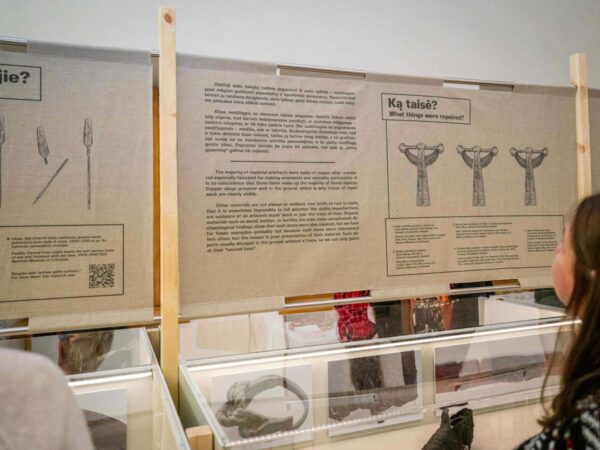
- Exhibition “Reusable”. Photo by Silvestras Samsonas, National Museum of Lithuania

The “Biographies” of Objects and Their Histories of Use
All archaeological artefacts displayed in the exhibition have been reworked or repaired. In some cases, the repairs are clearly visible – rivets, added plates, or re-drilled holes can be easily identified. The exhibition also presents more subtle examples of repair, which would be difficult to notice without additional drawings and photographs.
According to exhibition curator Dr L. Muradian, these objects are important not only because they are visually striking or well-preserved archaeological finds, but also because they tell broader stories: “Such artefacts allow us to trace the ‘biographies’ of objects – what they were originally, how they were repaired, and how their function and meaning changed. A pin could become a pendant, a token could turn into an ornament, and the transformation itself marked the beginning of a new story.”
The exhibition reveals that repairing objects was not limited to practical purposes alone – items were also repaired for emotional or ritual reasons. Objects worn for a long time and passed down from generation to generation acquired special value, encouraging people to preserve, repair, and continue using them.
-
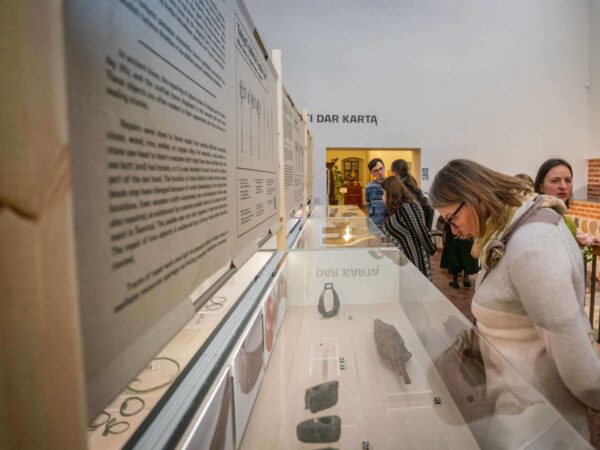
- Highlights from the exhibition opening. Photo by Silvestras Samsonas, National Museum of Lithuania

“Some objects were specifically prepared for certain occasions, such as burial rituals. They were repaired or adapted even when they were no longer suitable for everyday use,” says Dr Š. Valotkienė.
The deceased were often buried with a specific set of objects – tools, weapons, and ornaments. Among these were bracelets.
“In some graves, an exceptional phenomenon has been observed – bracelets placed on the wrists of the deceased that were reworked from neck rings. This suggests that bracelets were an important part of burial attire, and when necessary, they were produced ‘on the spot’ by cutting the ends of a neck ring and adapting the metal hoop to fit the wrist. This practice is illustrated by a grave where not only two bracelets worn on the wrists were found, but also an unused end of a neck ring,” explains Š. Valotkienė.
The exhibition invites visitors to view the past as a source of experience capable of reshaping our understanding of the present – through tangible objects and the stories of their use.
“This is the first archaeology exhibition of its kind in Lithuania to address sustainability not through contemporary solutions, but through cultural memory. It is not an invitation to turn back to the past – modernity offers more advanced solutions – yet it is certainly worth exploring the past and reflecting on what we can take from it today. The exhibition encourages reflection on how much we truly need, what it means to repair, to use things for a long time and responsibly, and whether we are capable of rediscovering our relationship with objects in a world where discarding has become the norm,” says Dr Rūta Kačkutė, Director General of the museum.
The archaeology exhibition “Reusable”, dedicated to (sus)tainable living in prehistory, opens on 21 January at 6 PM at The Old Arsenal (Arsenalo St. 3, Vilnius) and will be on view until 8 November.
-
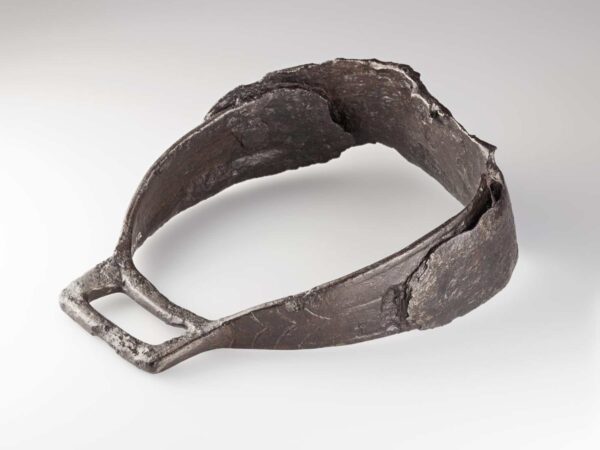
- Stirrup. Loop and tread fastened with rivets. Iron. 10th–12th century. Photo by Gediminas Trečiokas, National Museum of Lithuania