International Conference in Vilnius Invites a New Look at Dispersed Cultural Heritage
2026 04 27
At the upcoming conference of the National Museum of Lithuania (NML), titled “Scattered, Rediscovered, Connected: New Approaches to Dispersed Heritage,” museum and heritage professionals will gather to discuss how cultural heritage fragmented by historical and political circumstances can be identified, interpreted, and reconnected using contemporary methods. The conference will take place on April 29–30 in Vilnius, at the NML Old Arsenal spaces (Arsenalo St. 3).
The event will bring together museum professionals, collection curators, historians, art historians, heritage researchers, and digital solutions specialists from Lithuania and abroad to address questions of dispersed cultural heritage. Discussions will explore how museums and other memory institutions today identify, interpret, and reconnect heritage in order to restore links between objects that have ended up in different places and contexts.
“Heritage can be dispersed due to war, colonisation, political regimes, the art market, or institutional decisions. Yet even when scattered, it does not lose its narrative power—today these objects are increasingly being reconnected through digital collections, hybrid exhibitions, open data, and international networks of cooperation,” says Rūta Kačkutė, Director General of the National Museum of Lithuania.
According to Deputy Director General for Research and Dissemination Giedrė Milerytė-Japertienė, the conference serves as an important platform for meeting other professionals in the cultural heritage field, learning from their experience, and sharing one’s own.
“We initiated this conference last year, when the Lithuanian National Museum marked its 170th anniversary. Over time, the museum’s collections have suffered significant losses—for example, after the 1863–1864 uprising and during the First World War, the most valuable objects were taken to Russia. In other countries, the reasons for heritage dispersal differ, but it is important and interesting for us to understand how such heritage is searched for, traced, and reassembled.
Today we have digital possibilities for increasing accessibility to heritage, but are we able not only to digitise it, but also to connect it into narratives—and what are the best examples of doing so? We hope that the connections formed during the conference will encourage new research, joint projects, and long-term partnerships between institutions,” she says.
More Than Fifty Researchers From Around the World Will Gather
The two-day programme includes more than 30 presentations and discussion sessions covering archaeology, art history, archival studies, museology, and digital heritage.
Keynote lectures will be delivered by leading experts in their fields: Mathilde Daussy-Renaudin (UNESCO, France), who will present the implementation of the 1970 UNESCO Convention in the digital age and the initiative of a virtual museum of stolen cultural property, and Ewa Manikowska (Polish Academy of Sciences), who will speak about the importance of provenance research.
Among the conference speakers are Sherri Berger (Smithsonian National Museum of American History, USA), who will explore how museums can transform everyday practices to open up collections; Anna Yanenko (National Preserve of the Kyiv-Pechersk Lavra, Ukraine), who will present the dramatic history of the fragmentation of the Pechersk Lavra collections shaped by historical upheavals; Peter Sjökvist (Uppsala University Library, Sweden), who will discuss the fate of books dispersed during wartime and the possibilities of reconstructing collections; and Stephen Gray (University of Bristol, United Kingdom), who will present the experience of the University of Bristol’s virtual museum in connecting geographically dispersed collections.
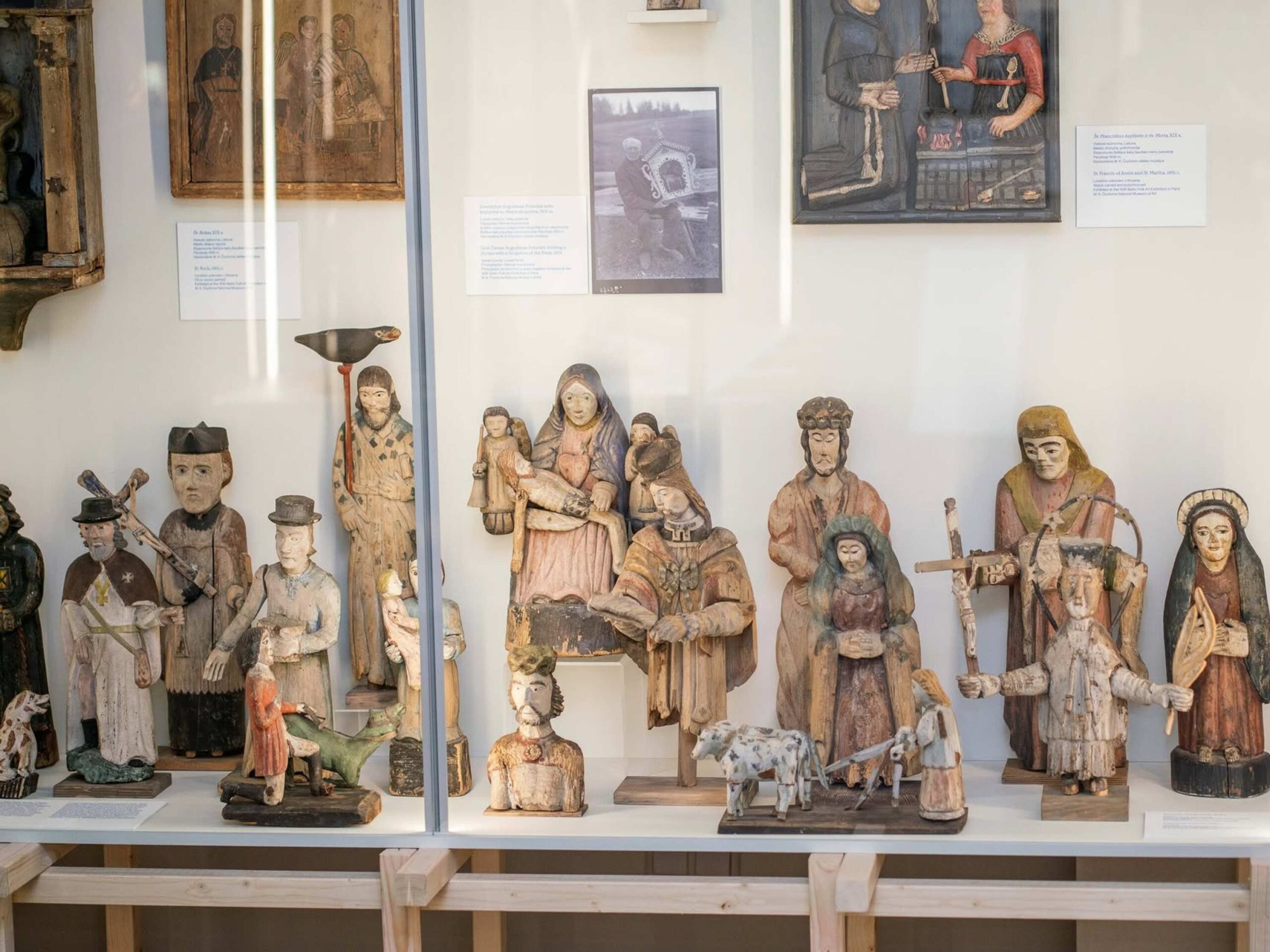
Researchers from the Lithuanian National Museum will also participate in the conference. Dr. Miglė Lebednykaitė, together with Raphaël Bories (MuCEM, France), will present research on Lithuanian ethnographic collections held in France and Lithuania. Their results are currently on display at the NML branch House of Histories in the exhibition “Riding the Wave of Paris Exhibitions: Ethnography, Cultural Diplomacy and Identity,” which brings together surviving objects from the 1900 Paris World Exhibition preserved in Lithuania and France.
The event will also feature researchers from the United Kingdom, Germany, Italy, Poland, Israel, the Netherlands, Greece, and other countries, presenting case studies on restitution, provenance research, digital reconnection of heritage, and ethical issues in working with sensitive objects.
Conference languages will be English and Lithuanian, with simultaneous interpretation.
The conference is organised by the Lithuanian National Museum together with partners: the Lithuanian Institute of History, the Faculties of History and Communication at Vilnius University, the Lithuanian National Commission for UNESCO, and the Baltic Audiovisual Archival Council. The event is supported by Mabre Residence Hotel and Hotel Artagonist.
Full conference programme: click here.