The Role of a Guide Became an Opportunity for Kotryna to Break Stereotypes
2025 12 22
For several years now, the National Museum of Lithuania (LNM) has been developing educational activities together with various communities. This story, which began back in 2023, grew into far more than the implementation of social responsibility. It became a meaningful friendship between the museum, children with disabilities and the association of their parents and guardians “Mirabilia”, and Kotryna – a young woman living in Alytus who has cerebral palsy and confidently leads guided tours for visitors while using a wheelchair.
Are There Simply No Activities for These Young People?
“Even a few years ago, we kept encountering the same situation: young people with more severe disabilities really had nowhere to go. Not because they didn’t want to – but because there is a lack of activities in the country, and individual needs often become a barrier. For many years now, our museum has been striving to adapt as many services as possible for different communities. Today, we can be glad that the museum offers services for blind and partially sighted visitors, children with intellectual disabilities, and children on the autism spectrum,” says Agnė Putelytė, Coordinator of Community Projects at the National Museum of Lithuania.
The first connection between the museum, the Alytus-based association “Mirabilia”, and Alytus resident Kotryna Molevičiūtė was made at the 2023 conference “susiPAŽINIMAI”. “It was there that the idea was born: perhaps a museum can offer more than traditional education? Perhaps it can become a place where new experiences, empowerment, and self-discovery emerge,” A. Putelytė shares.
-
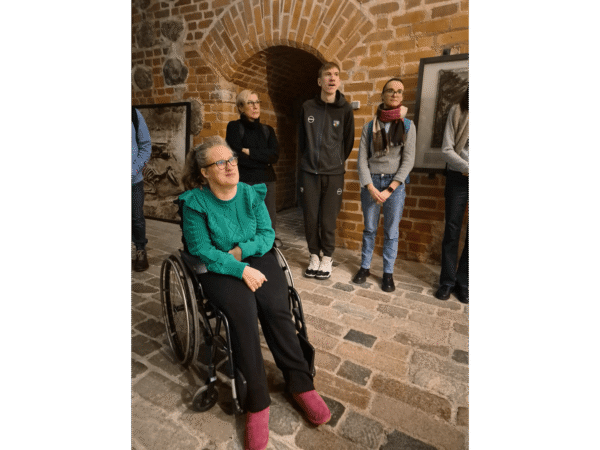
- Kotryna leading a guided tour at the museum. Photo by LNM

Kotryna’s Debut: Joy and Responsibility
The first proposal for Kotryna to try herself in the role of a guide brought great joy, but also a sense of responsibility.
“When I was offered the opportunity to become a guide, I was very happy – after all, this role brings together my favourite fields: literature and history. I thought that such an opportunity comes very rarely, especially for a person with certain limitations. But after the initial enthusiasm, anxiety followed – I realised how much preparation would be needed, how important public speaking skills are, and how essential it is to sense the needs of the audience,” Kotryna says.
The LNM team sincerely supported her decision. “I received a great deal of help from the educators of the Bastion of the Vilnius Defensive Wall, Rūta and Adomas, as well as from the author of the idea, Agnė. We met at the Bastion many times, discussed topics and the target audience – young people with intellectual disabilities. Museum staff helped prepare texts in easy-to-understand language, shared their professional experience, and most importantly, encouraged and supported me. I felt an equal approach, and we often overcame challenges with humour.”
The First Guided Tour at the House of Histories
In the summer of 2024, young people from “Mirabilia” visited the House of Histories of the National Museum of Lithuania. There, Kotryna appeared as a guide for the first time, presenting the exhibition “A Worldwide Lithuania: Our Migration Story” which was on display at the time.
After the tour, the group took part in a museum educational activity about old Lithuanian folk music traditions – they sang, played instruments, and listened to stories. Later, everyone climbed Gediminas Hill together, had lunch at the social restaurant “Pirmas blynas”, admired the capital’s panorama from the bell tower of St John’s Church, and ended the day in Bernardine Garden.
“It was a day of experiences – from music to flavours, from stories to new challenges. And most importantly, togetherness,” says A. Putelytė.
What Matters Most: Connection and Understanding
When leading tours, Kotryna places particular importance on her connection with visitors and the ability to adapt to their needs. “It was very important for me to clearly understand the audience, so I paid a lot of attention to easy-to-understand language. I wanted this experience to be accessible and meaningful. Just as important was the connection with the educators – it was warm, human, and supportive.”
-
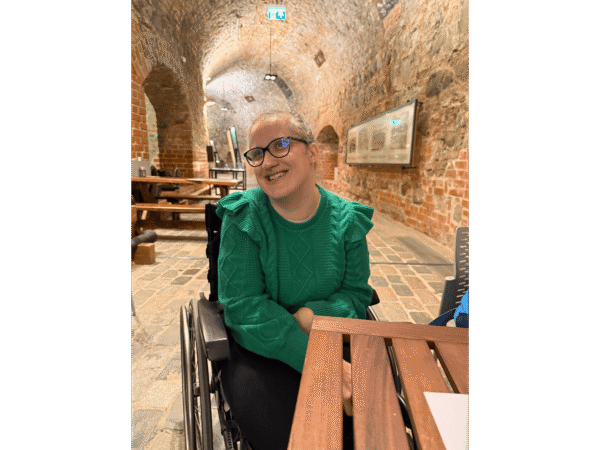
- Kotryna – a young woman living in Alytus who has cerebral palsy and confidently leads guided tours for visitors while using a wheelchair. Photo by LNM

There was no shortage of nervousness during the tours either. “Of course I was nervous, but preparation helped a lot – I knew what I was saying and why. We had agreed with the educators that everyone feels anxious, and the only way to overcome it is to try and do the best you can. Everything is an experience.”
The Friendship Continues
In December 2025, Kotryna led another guided tour at the Bastion of the Vilnius Defensive Wall of the National Museum of Lithuania – this time together with museum educators.
For several years now, the Bastion team has been purposefully creating accessible experiences for people with various disabilities: visitors can find adapted exhibits, special educational programmes, and tactile objects.
“We have become convinced that no disability is an obstacle to fulfilling one’s wishes and dreams. Kotryna is a wonderful example of this,” say educators Adomas Gricius and Rūta Tolkačevskienė.
“The Most Important Thing Is to Show That You Are Welcome Here”
Kotryna says that this activity has changed her personally as well: “I have gained more courage and self-confidence. I made a promise to myself to step out of my comfort zone more often. I also feel an even stronger desire to read – not only fiction, but historical literature as well.”
She believes that such projects have a broader meaning: “I want to encourage museums and society to pay attention to different communities, to listen to their needs, and to find suitable, achievable tasks together. And to young people with disabilities, I would like to wish not only that they dream, but that they pursue their goals. Everyone can find a niche that suits them. You can reach a dream not only by walking, but also by rolling.”
A. Putelytė emphasises that the most important thing is to give a voice to the community itself: “Our goal is not to create for people, but together with them. When activities are led by a member of the community, the museum becomes their space. This is neither therapy nor a social service – it is the same cultural experience as for everyone else. It is important to highlight a person’s strengths, not their weaknesses.”
Kotryna’s journey from her first guided tour at the House of Histories to educational activities at the Bastion is not only a personal success. It is also a clear signal: when museums open up to communities, new ways of empowering people open up as well. “The museum plans to continue its friendship with Kotryna next year as well – we are planning several more guided tours for visitors with intellectual disabilities,” shares the plans of the Coordinator of Community Projects at the National Museum of Lithuania.
-
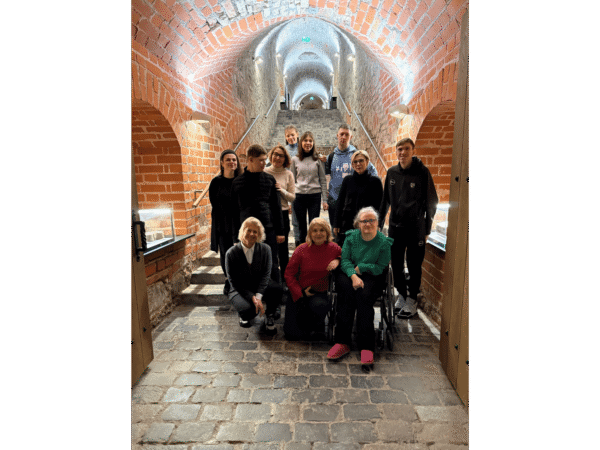
- Kotryna and tour participants at the Bastion of the Vilnius Defensive Wall of the National Museum of Lithuania. Photo by LNM