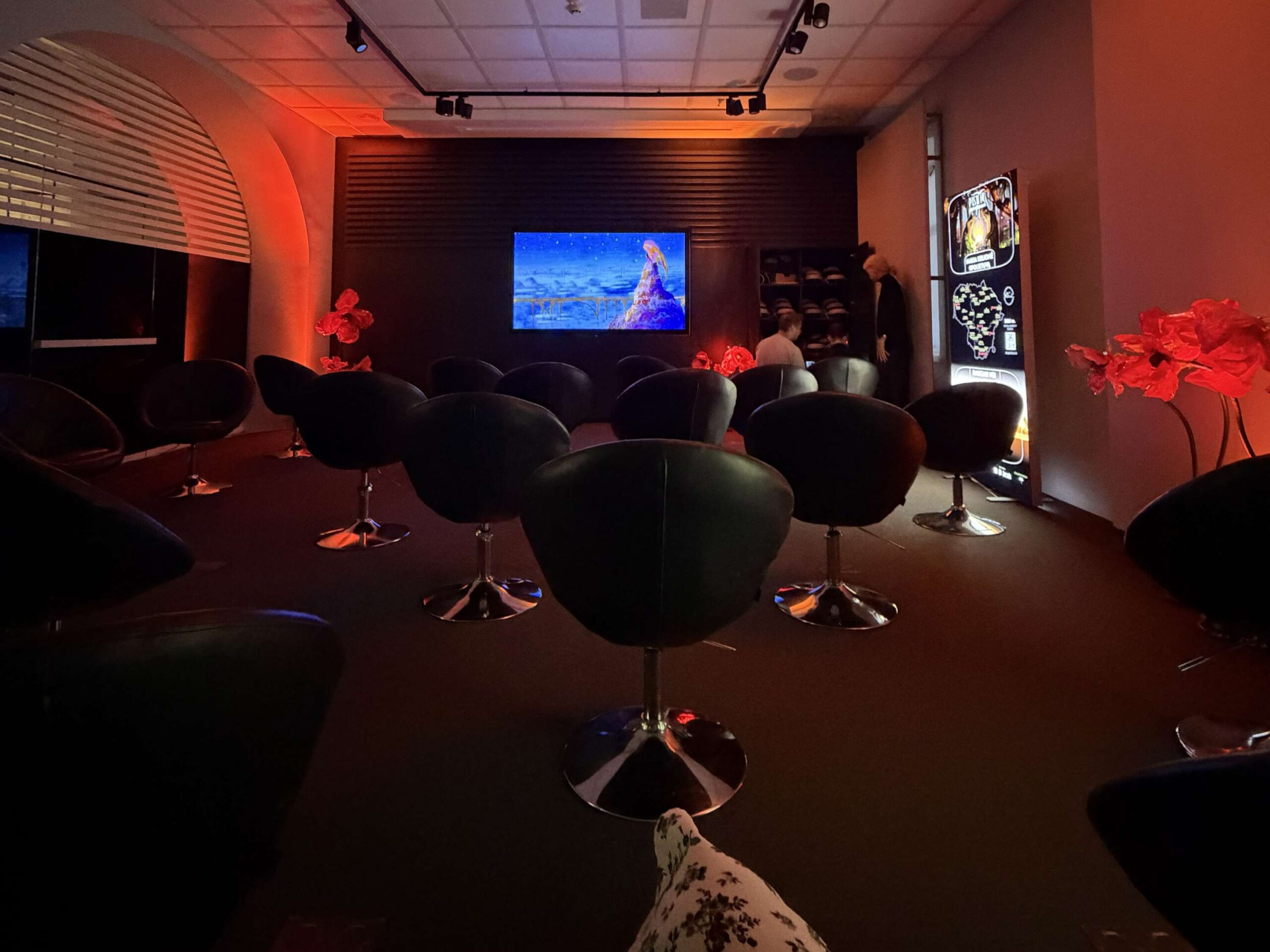
From Panorama to Detail: An Album That Reveals the Unseen Everyday Life of a 19th-Century City
2026 02 24
The largest and most ambitious publication of the National Museum of Lithuania in recent years, “19th Century Lithuanian Art on the Margins: Overlooked Everyday Life in the City”, has seen the light of day. The images of 19th century cities are presented here not as representative panoramas, but as lively, detailed everyday life, often unnoticed. The book was prepared in collaboration with the Lithuanian Art Enlightenment Centre “Tartle”.
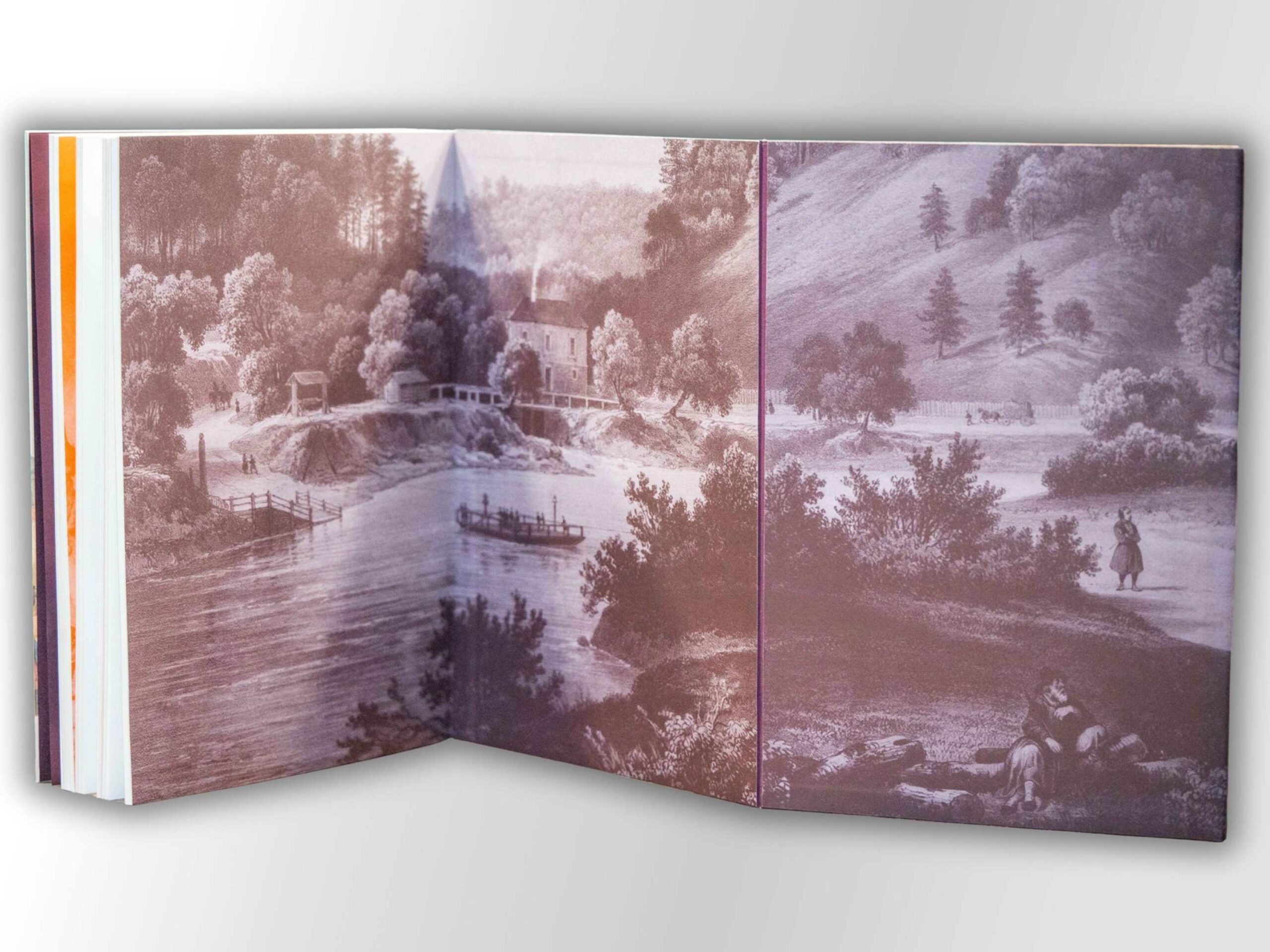
The publication surprises with its unusual construction and exceptional design. Two independent volumes are combined into one publication in such a way that they can be read together, and when spread out on a table, they take up almost a meter. Such a decision required special ingenuity of the designers and printers and turned the book not only into an exceptional album, but also into a physical experience that dictates a different way of reading – slow and attentive.
The book’s compiler, Diana Streikuvienė, Senior Collection Curator of the Iconography Department of the National Museum of Lithuania, tells how this publication allows us to read works of art as historical sources, follow background plots, and recognize the city not in its architecture, but in the life that took place in it.
-
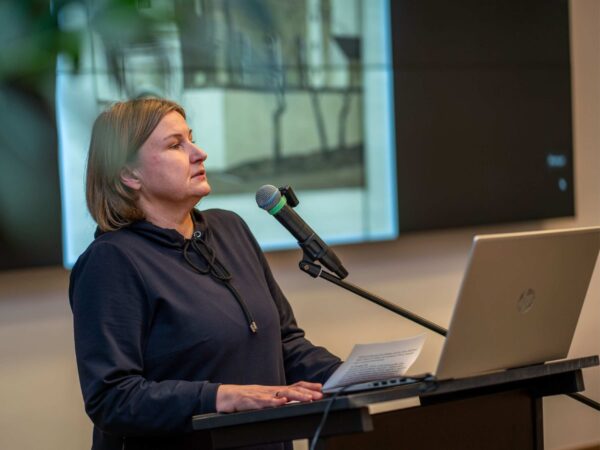
- The book was compiled by Diana Streikuvienė, Senior Collection Curator of the Iconography Department of the National Museum of Lithuania. Photo: Silvestras Samsonas, NML
What Is the Main Idea of this Publication?
A few years ago, at a lecture given by Professor Irena Vaišvilaitė at the museum, I presented Jonas Kazimieras Vilčinskis’ lithograph “Roman Catholic Cathedral” from the “Vilnius Album”. It was both a very simple and difficult task: what new and interesting to say about an image that has already been seen and discussed so many times? I simply started looking at it more closely, enlarging it, “travelling” around the image on the screen, and, having looked not at the general picture, but at the small, background details, I realized how much was happening there. Then I thought that in the future it would be possible to make something interesting out of it. So, when the opportunity arose, we tried to apply this principle of “reading” works of art in preparing a book about the everyday life of cities and townspeople. This book invites you to engage in a kind of game, encourages you to look at cityscapes as iconographic sources that hide a lot of interesting and valuable information that is not always revealed immediately. This requires stopping, looking and slowing down your gaze.
Did the journey of compiling the book – selecting works, researching, searching for information – become a game of discovery for you too? Maybe there are images or details that stuck out the most?
In general, the entire journey through the works was somewhat related to magic for me, because I certainly did not notice everything right away. Some of the necessary figures “jumped out” only much later, already halfway through the preparation of the book, when I began to delve into specific topics. One such very striking discovery was in the work “Atlaidai” (“Indulgencies”) by the artist Konstantinas Tyzenhauzas from the first half of the 19th century. Having already started writing about the clothing of national minorities, I suddenly saw a Tatar woman immortalized. At first, of course, I had doubts – was it really? But when I started reading the sources, it became clear that at that time Tatar men had already lost their distinctive identity and dressed quite normally, while women still retained it. And then you look – one braid, specific clothing accents… and even the obligatory yellow and orange colors are there. It was one of those moments when you realize that the painting begins to speak.
You get the impression that in this publication you are inviting the reader to see works of art as an extremely important, telling historical source – like a book. Was that the idea?
Indeed, yes. Looking more broadly, a work of art as a historical source is no less valuable than a written one – it also contains a lot of interesting and valuable information. This is exactly how the idea was born not only to present works of art, but also to highlight the silent, nameless figures or other objects that “live” in their background, to help readers see and read them.
When preparing the book, we very consciously tried to compare as many different sources and historical research as possible, and we sought to “activate” as many ego-documents as possible: diaries, memoirs. Historians are cautious about such sources, as they are subjective, but such comparisons allow one source to be checked against another. It is especially valuable when a direct link between the image and the text is found.
Can you give an example of a time when such a comparison of image and text was particularly successful?
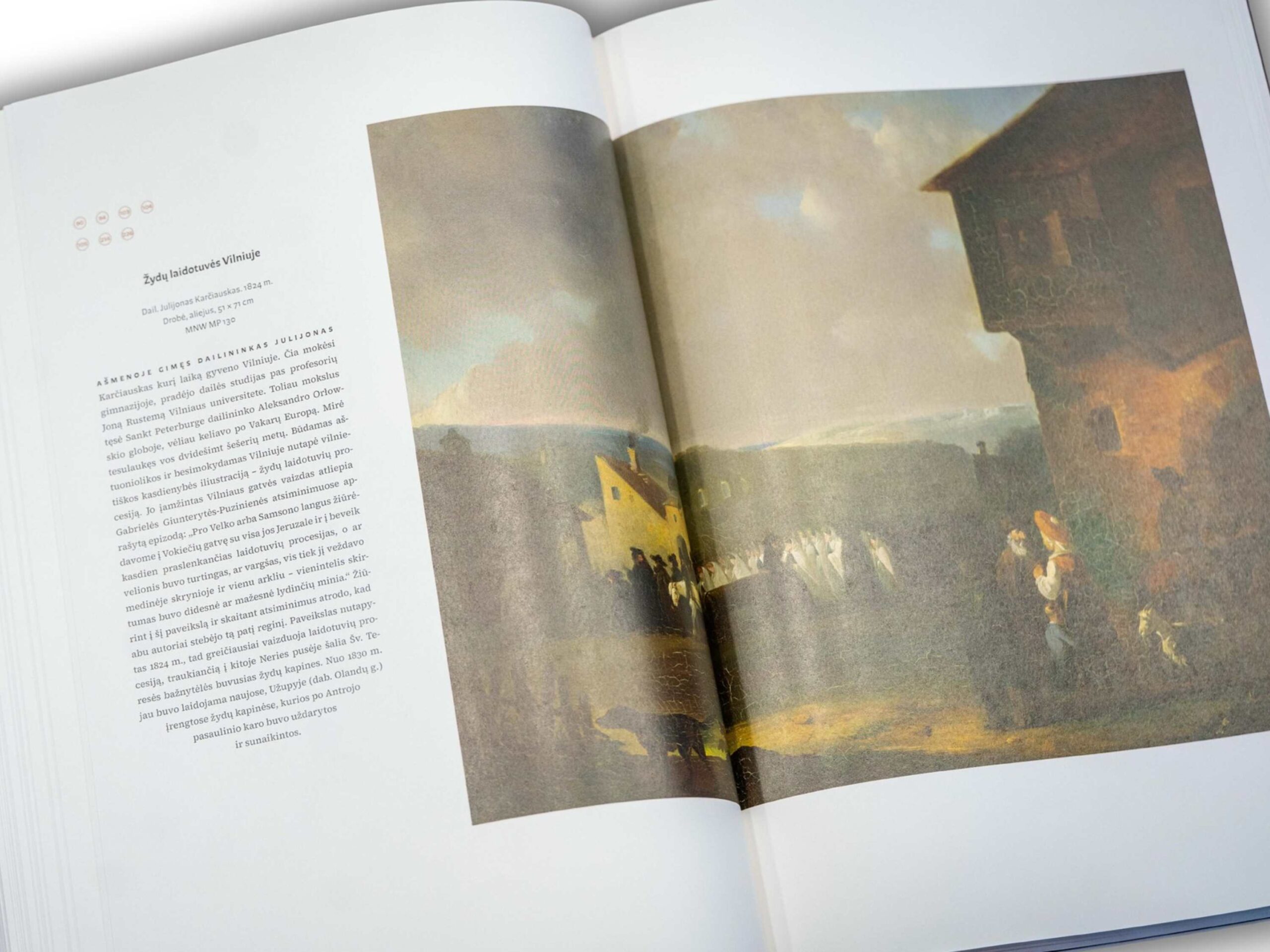
One of the most striking examples is the painting of everyday life in Vilnius by the artist Julijonas Karčiauskas in 1824, depicting a Jewish funeral procession. This work very accurately corresponds to the episode described in Gabrielė Giunterytė-Puzinienė’s memoirs: “Through the windows of Velkas or Samsonos we used to look at Vokiečių Street with all its Jerusalem and at the funeral processions passing by almost every day…” Looking at the painting and reading these memoirs, one gets the impression that both authors observed the same scene. They are separated by only one year, and the image and the narrative coincide almost identically. In such places, you can clearly feel how the work of art and the written source begin to talk to each other and at the same time allow you to feel the everyday life of that time much more accurately.
-
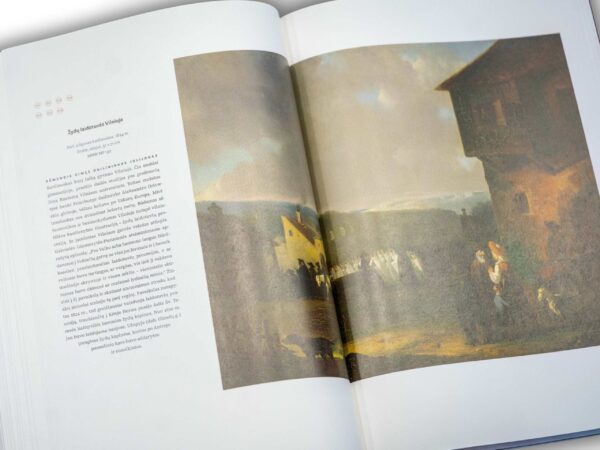
- Fragment of the album. Jewish funeral in Vilnius. 1824. Artist. Julijonas Karčiauskas. National Museum of Warsaw, MP 130. Photo. Silvestras Samsonas, NML
Why are these seemingly secondary figures so important in works of art?
Whether it is a painting, a graphic work or an architectural drawing, the figures in it fill the void, in a way “warm” the visual source, giving it coziness and fullness. But even more important is that these figures cannot go unnoticed, because they reflect the reality hidden in cityscapes, capturing the everyday life of city dwellers. They allow the viewer to move into the world of that time – especially since the buildings captured in the cityscape often look the same or very similar today as they did a hundred or even several hundred years ago.
How much can we trust the realism of these figures – are they more invented or taken from real life?
Of course, the image itself could have been constructed: this is not a moment frozen like in a photograph. Maybe the artist remembered something from yesterday, maybe the bell was not necessarily ringing at that time, and the carriage was standing in a different place. However, all these details were taken from reality. That is why these figures are so valuable – they allow us to trust what we see. Even if the scene is composed, it is made up of real people, real objects and real situations that the artists themselves had experienced.
It is also interesting that it often happened that the main composition was painted by one author, and the figures were drawn by other artists.
Were there any details among all the images studied that particularly stopped or surprised you?
Well, for example, the watercolor “Parochial Church of Iškaldzis in the Novgorod District” by the artist Edvardas Pavlovich, painted in 1848. Here I was particularly interested in the figure of the bell ringer. Today we hardly think about the significance of bells, but at that time, a person who operated this instrument lived near every church, and the townspeople recognized the sound of the bells. From it they understood what was happening – whether a call to prayer was being made, whether a disaster was being announced, or whether a deceased person was being escorted. In addition, this image captures a sensitive moment – a baby wrapped in a “cocoon” being brought to the church for baptism. A very interesting carriage element typical of the region southeast of Vilnius is also captured here – a headboard woven from willow twigs or roots, the so-called palukačka. Such small details allow us to very vividly imagine what people’s daily lives looked like.
What figures should we look for in the images of our cities and what historical contexts do they reveal?
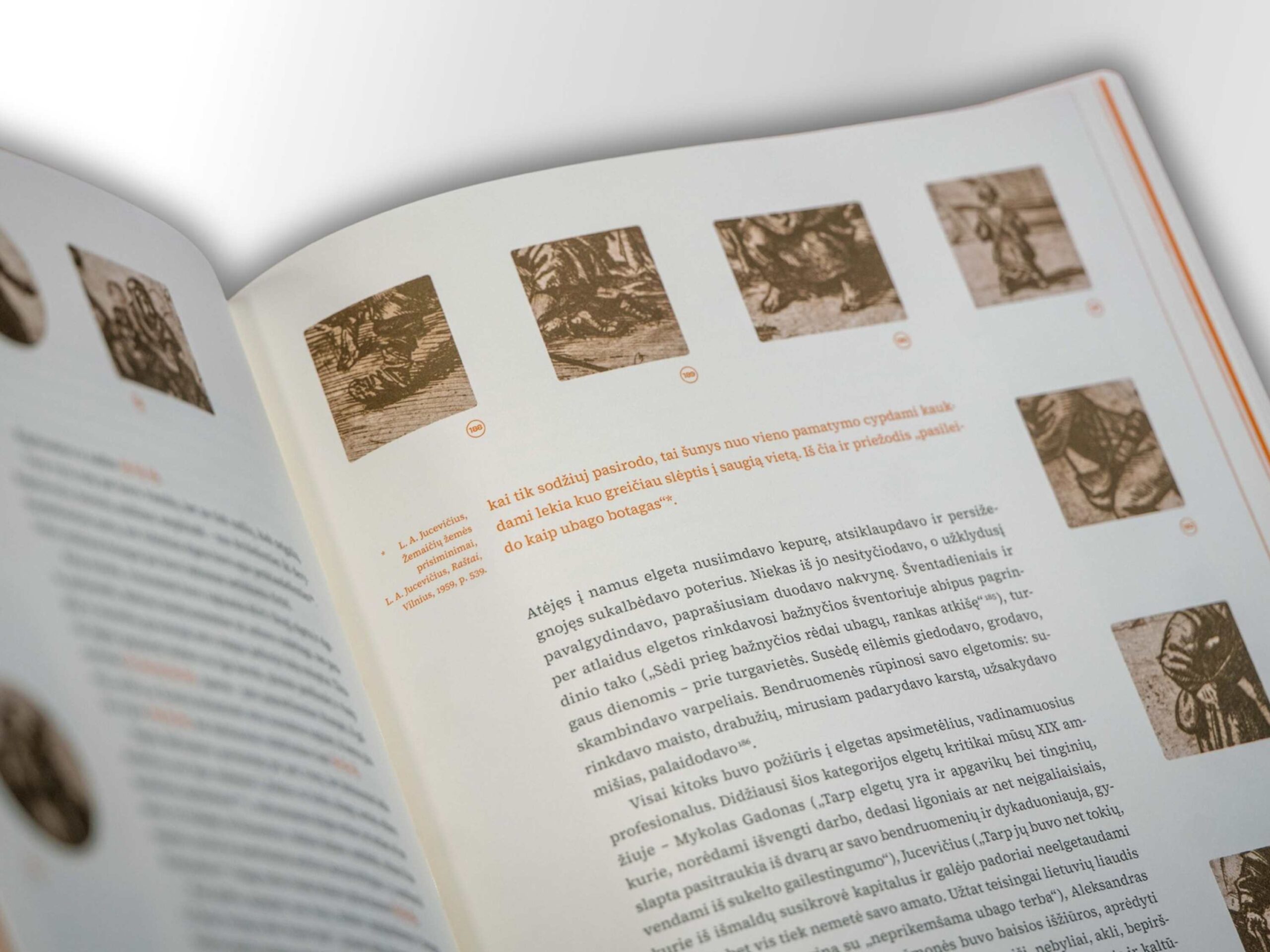
The first part of the publication consists of articles about the everyday life of townspeople, which invite us to look deeper – from the panorama to the details. The help of professional researchers is very important here, because it is not always easy for today’s reader to correctly read the reality of life at that time encoded in the figurines.
It is also important to note that the stories in the first part of the book are not arranged in random order. First, we symbolically pass through the barriers – as if we are entering the city. Fashion and clothing naturally follow, because this is the first thing you notice when looking at the townspeople. Only after that do you begin to see a broader picture of what is happening on the streets: your eye catches the children, beggars, merchants, musicians, animals; you notice the lighting installed on the streets for the convenience and safety of the townspeople; the paved boulevards; a variety of means of transport – from golden carriages drawn by four horses to simple single-horse peasant carts. And when you visit a catering establishment, you fully get acquainted with the everyday life of that time, the culture of eating and drinking, even exceptional objects of culinary heritage, such as March beer.
-
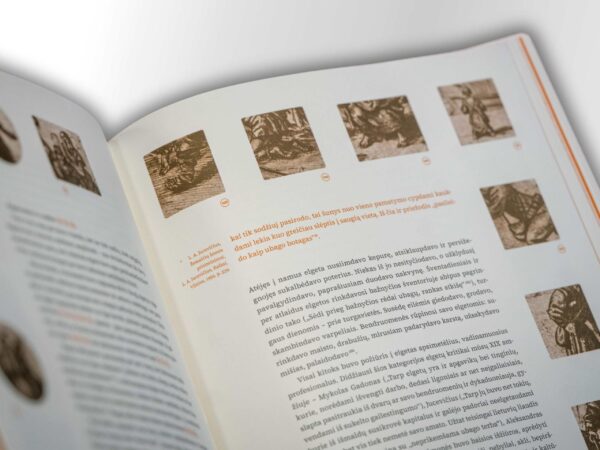
- 19th century city views are presented here not as representative panoramas, but as living, detailed everyday life. Photo: Silvestras Samsonas, NML
Finally, the story ends in cities and towns located near water bodies. In such areas, everyday life is inevitably connected with other landscape elements: here you will see water transport – boats, ferries, steamers; you will notice passing ships, cargo ships; you will meet representatives of specific professions – fishermen, ferrymen, shipwrights, whippersnappers. This is another dimension of city life, which is revealed precisely through the images and the details hidden in them.
It is also important that not all figurines are anonymous – scientific research shows that some of them depict specific historical figures. This gives these images even more authenticity and liveliness.
Can we recognize people we know among these figurines?
Yes, of course. The chromolithography depicting the exposition of the Vilnius Museum of Antiquities features the founder of the museum, Count Eustachijus Tiškevičius, and the author of this work, Albertas Žametas. Kazimieras Bachmatavičius, when creating the lithograph album “Memories of Vilnius”, inserts well-recognizable figures to Vilnius residents into the scenes depicted on its sheets, such as businessman Antanas Fiorentini, which gives these works even more realism.
What works make up the visual narrative of the second part of the publication – the album?
The basis of the album is the graphic works kept in the collections of the National Museum of Lithuania and the Lithuanian Art Enlightenment Centre “Tartle”. The majority of them are images of Vilnius, which immortalize buildings, squares, streets, church interiors, and suburbs beloved by the townspeople. Along with graphic works made in various techniques, canvases and watercolors by painters who worked in Vilnius are also presented.
These works expand the theme of the city life of that time and allow us to look at it from different perspectives. Each work published in the album is accompanied by a commentary, which provides information about the author, the circumstances of the creation of the work, the depicted building, square or urban space. If the first part of the book offers a look at small details, then the album is like a panoramic view, allowing you to understand what and why we see.
The images in the album are arranged as a kind of journey. The reader is first invited to one of the busiest places in Vilnius – Dominikonų Street, then travels through the streets and squares of the city, visits shrines of different denominations, stops in the suburbs, and finally sets off to smaller cities and towns. The journey ends in Kaunas – the largest city of the Kaunas Governorate at that time. By the way, the album can be turned from both sides: start the trip in Kaunas and end in Vilnius or vice versa.
The publication is truly impressive – more than a meter of art stories. How did such an unusual book structure come about and why was this particular form chosen?
The book is unique in its construction – it consists of two separate books connected into one, which can be read at the same time. This solution, which reflects the idea of the publication, was proposed by the book designer Kotryna Šeibokaitė. It allows you to follow texts and images in parallel, and using a specially printed index tab, you can easily connect the figures mentioned in the texts with specific works of art. However, this will require a sturdy table. The volume, weight, and format of the book itself seem to make you slow down – it is impossible to rush through it. It is a kind of brake, inviting you to pay attention and give it time. And time is a great luxury today. Such a book is also a kind of luxury – both literally and figuratively.
Živilė Stadalytė (National Museum of Lithuania).
The latest book of the National Museum of Lithuania “19th Century Lithuanian Art on the Margins: Overlooked City Everyday Life”, published in cooperation with the Lithuanian Art Enlightenment Centre “Tartle”, is available for purchase on the museum’s online store and at the museum’s ticket offices. The book will also be presented at the Vilnius Book Fair on February 28 at 14:00 in Conference Hall 1.3 of the Lithuanian Exhibition and Congress Centre LITEXPO.
The book was published by the National Museum of Lithuania in cooperation with the Lithuanian Art Enlightenment Centre “Tartle”. The publication was supported by the Ministry of Culture of the Republic of Lithuania. The book was compiled by Diana Streikuvienė, the texts were written by Žygintas Būčys, Ieva Burbaitė, Karolina Glinska, Reda Griškaitė, Rūta Janonienė, Laima Laučkaitė, Diana Streikuvienė. Designer Kotryna Šeibokaitė-Ša, layout by Edita Gužaitė. Editor Nijolė Deveikienė. Summary translated into English by Monika Kisliakovaitė-Čaplikienė. Reviewers – Dr. Virgilijus Pugačiauskas, Dr. Birutė Rūta Vitkauskienė.
-
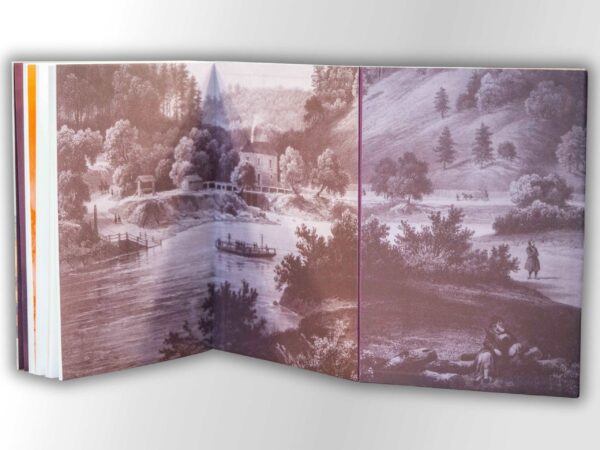
- Two independent volumes combined into one publication so that they can be read together. Photo: Silvestras Samsonas, NML