From Love Tokens to Straw Gardens – Treasures of the LNM Ethnography Repository
2025 04 01
Spaces adorned with straw mobiles, intricately carved distaffs, and traditional dowry chests — these are silent witnesses to how our ancestors lived, worked, and loved. Now celebrating its 170th anniversary, the National Museum of Lithuania invites visitors to explore the richness of Lithuanian heritage through the Ethnography Repository-Exhibition, located at the House of Histories.
“Ethnographic artifacts speak not only of domestic life or craftsmanship but also of values, worldviews, and what was considered sacred, important, or beautiful. Our duty is not only to preserve these objects but also to let people see and hear their stories. Only then does heritage become alive and relevant today,” says Simona Širvydaitė-Šliupienė, head of the House of Histories. According to her, the newly opened Ethnography Repository is not merely a collection of exhibits — it is an invitation to journey through the cultural layers that shaped Lithuanian identity.
Preserving for the Sake of Memory
The collection of old objects in Lithuanian villages began as early as the 19th century and intensified significantly during the national revival movement in the early 20th century. A major contributor to this effort was the Lithuanian Scientific Society and its chairman, Jonas Basanavičius.
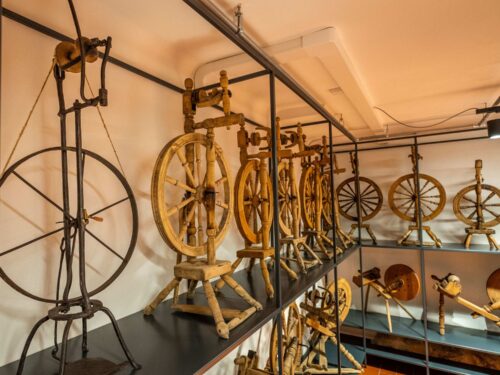
A significant portion of the items collected by the society is now preserved in the archives and repositories of the National Museum of Lithuania. As Dr. Audronė Daraškevičienė, educator at the House of Histories, explains: “Interestingly, the collections representing different Lithuanian regions reveal quite distinct characteristics. For instance, distaffs mainly come from Aukštaitija and Dzūkija, while the carved boards attached to spinning wheels — prieverpstės — are typically found in Samogitia (Žemaitija) and Suvalkija. This reflects the reality that by the time artifact collection began, traditional distaffs had nearly disappeared from Žemaitija, having been replaced by the more modern spinning wheel technology introduced via Lithuania Minor. In contrast, in Dzūkija and Aukštaitija, distaffs were used well into the early 20th century, which explains why most were collected from those regions.”
-
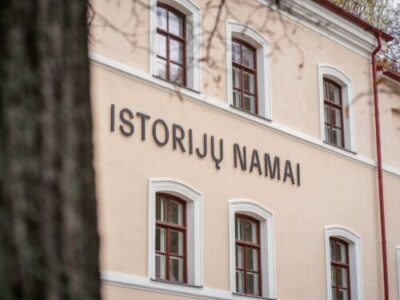
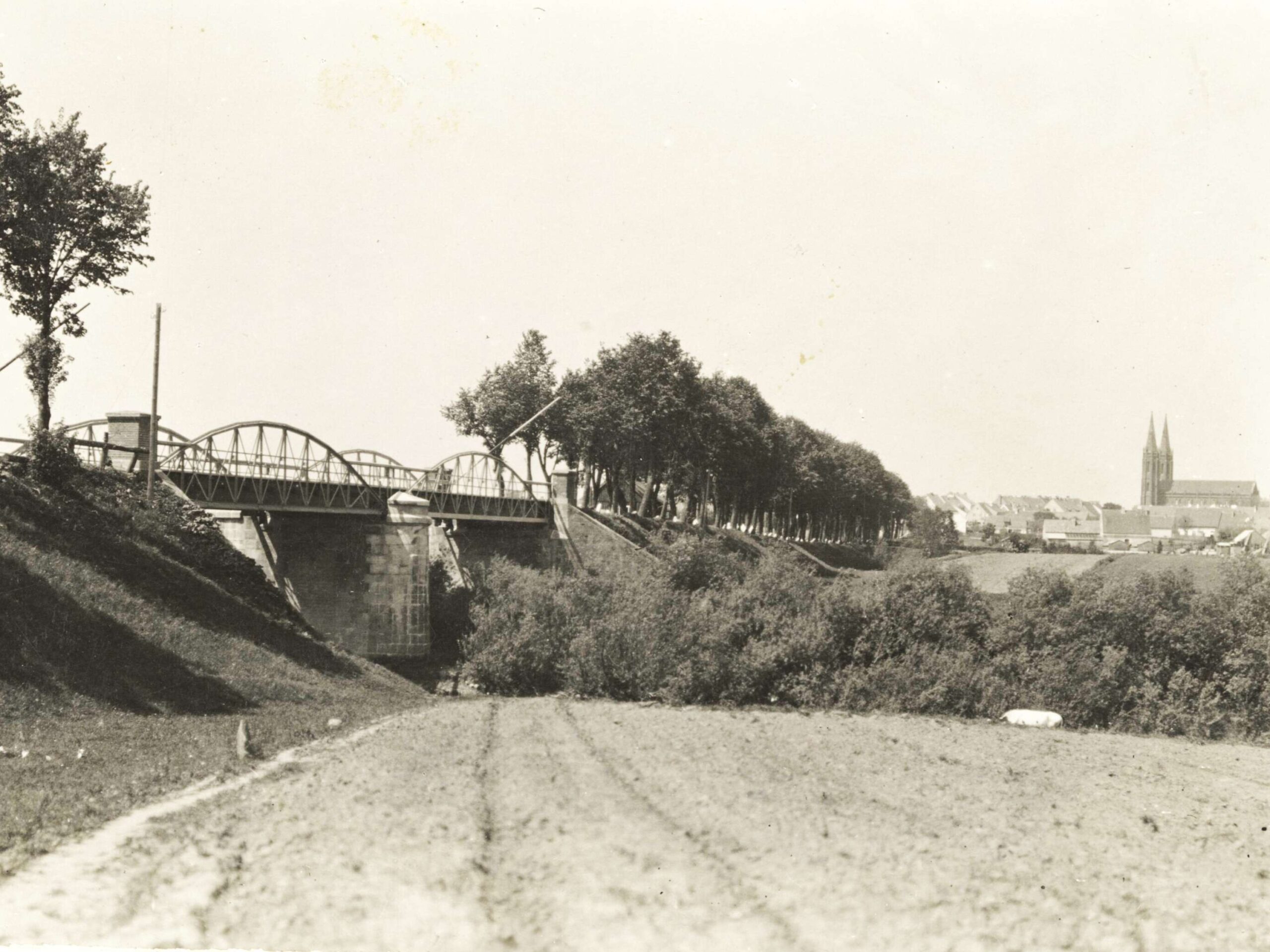
- House of Histories of the National Museum of Lithuania. Photo by Silvestras Samsonas, LNM
-
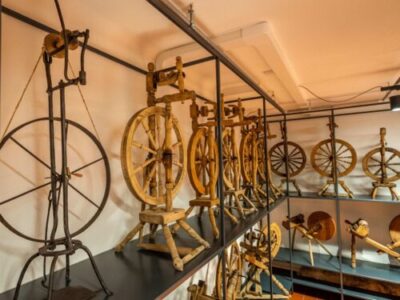
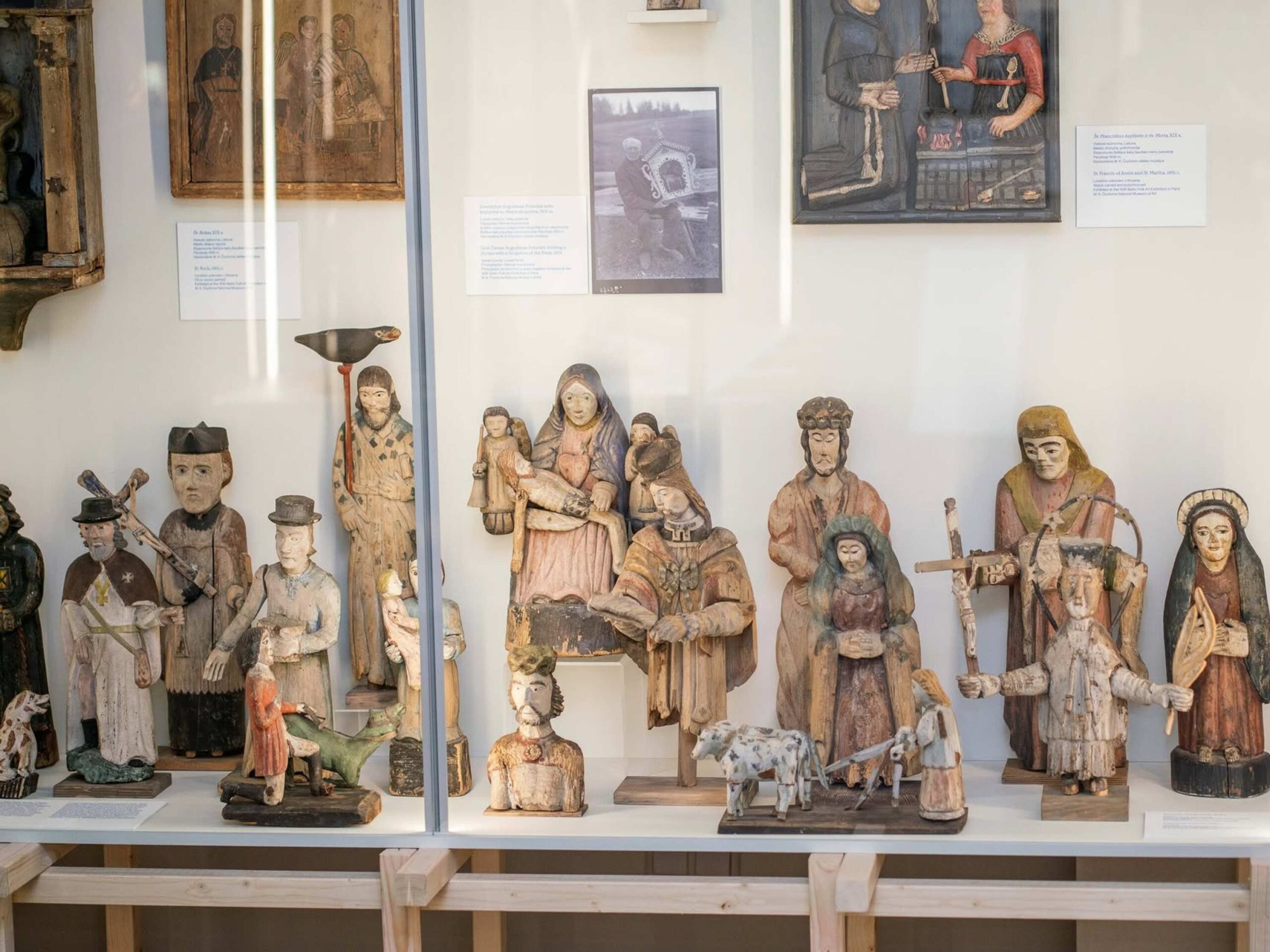
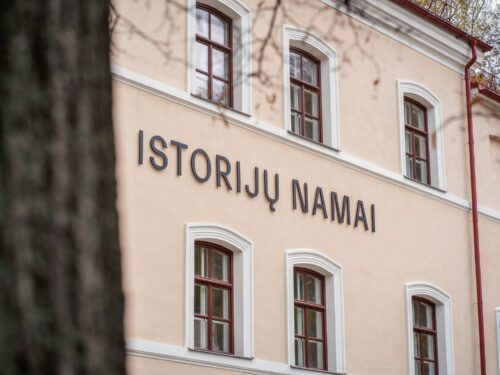
- Ethnography Repository at the House of Histories, National Museum of Lithuania. Photo by Silvestras Samsonas, LNM
While exploring the Ethnography Repository, one’s eye is drawn to the varying painted decorations on chests and wardrobes. According to the educator, this is also closely tied to the regions from which these objects originate. In the western regions, the colors are darker and more subdued, reflecting a northern aesthetic and natural environment. In contrast, the eastern regions feature brighter colors and more intricate patterns. It appears that northern and western Lithuania were more influenced by northern European tastes, while southeastern regions were shaped by the styles of neighboring southeastern cultures.
The repository is fascinating not only for highlighting regional distinctiveness. The collection of old village artifacts was also driven by a desire to document a disappearing way of life — one rooted in ancient traditions, worldviews, and technologies.
“With the rise of industrial production, handcrafted items and the skills needed to make them began to vanish. Throughout the 20th century, ethnographic collectors managed to capture a way of life in which people made everything themselves, rather than purchasing mass-produced goods. This repository allows visitors to experience that lifestyle and the values it embodied. So, those who appreciate values like sustainability, originality, and authenticity will find much to admire here,” says A. Daraškevičienė.
Love Tokens and the Importance of Work
As you walk through the repository, it becomes clear that every object carries traces of a human life — its experiences, emotions, dreams, and aspirations. For instance, a single distaff can tell many stories, reflecting how central it once was to the daily life of a village woman. Among the exhibits in the Ethnography Repository at the House of Histories is also a distaff made for a young girl. According to educator A. Daraškevičienė, such items testify to how early children were introduced to household tasks and traditional crafts.
“Girls didn’t need to be forced to spin. They gladly took up this activity, as they saw all adult women engaged in it and understood how highly respected it was. Let’s not forget that in traditional narratives, spinning is associated not only with women but also with goddesses: in Lithuanian mythology — the goddess Laima, and in ancient Greek mythology — the Moirai. And they don’t just spin any thread — they spin the thread of a person’s fate! So spinning is a practice elevated to the realm of the divine, encompassing the great questions of human destiny,” explains A. Daraškevičienė.
According to her, distaffs speak not only of daily chores — they also hold encoded love stories.
-
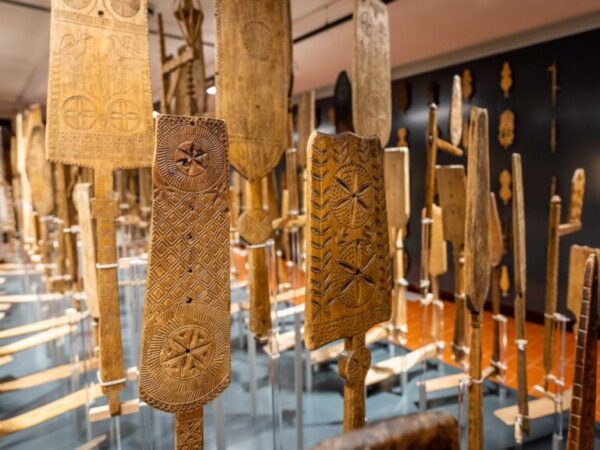
- Ethnography Repository at the House of Histories, National Museum of Lithuania. Distaffs. Photo by Silvestras Samsonas, LNM
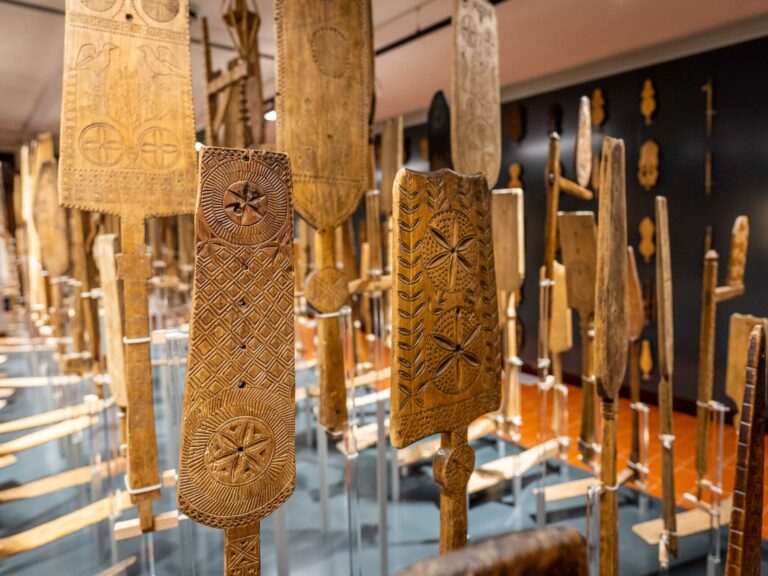
“Though it might seem unusual to us today, in the past, the distaff was a common love token — a young man would gift a distaff to a girl as a sign of affection and interest. Interestingly, some girls would receive several of them. However, there are also stories where a girl would publicly break a distaff after the suitor married someone else,” shares the educator.
The distaff exhibition features many such artifacts, each one unique, decorated with distinct carvings. Yet some of the symbols are archetypal, expressing a mythical view of the surrounding world. For example, birds — frequent motifs in distaff ornamentation — are considered messengers of the sky; the sun represents light and life; and the tree of life symbolizes the axis of the world. Occasionally, even the image of a church appears on a distaff — not surprisingly, as the gift may have hinted at marriage intentions.
The hope chests (kraitinės skrynios) on display also speak to the concerns of young women preparing for marriage.
“A bride’s chest had to contain many gifts, which she would distribute among the groom’s family and relatives. A large and heavy chest was seen as proof of the girl’s industriousness. Sometimes, a few stones were even placed at the bottom to make it seem heavier,” A. Daraškevičienė adds with a smile.
Protection Against Evil Spirits
The Ethnography Repository holds a wide array of traditional architectural elements — from window frames adorned with decorative carvings to the corner of a foundational log beam bearing a carved cross meant to protect the home. Windows decorated with motifs such as serpents or other ornaments were not only aesthetic but also carried symbolic meaning. People believed that these symbols helped guard the home against evil spirits and misfortune. Likewise, many other decorative architectural elements were believed to serve a protective purpose in addition to their decorative role.
According to A. Daraškevičienė, this belief was likely influenced by the reality that people in the past — even as recently as the early 20th century — lacked many of the protections we now take for granted against illness, crop failure, and other disasters.
“Child mortality was very high at the time. In other words, losing a child was far more common than it is today — though no less painful. Today, most people don’t worry about hail, thunderstorms, or droughts, because they no longer pose a direct threat to survival. But for people back then, such natural events could mean famine. So, from their perspective, seeking magical protection from natural forces and evil spirits was entirely understandable,” explains Daraškevičienė.
-
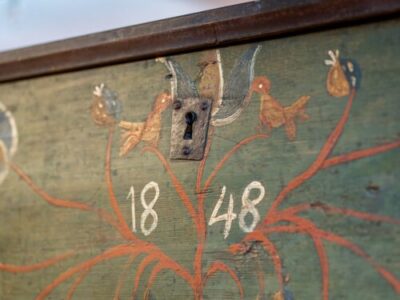
- Ethnography Repository at the House of Histories, National Museum of Lithuania. Photo by Silvestras Samsonas, LNM
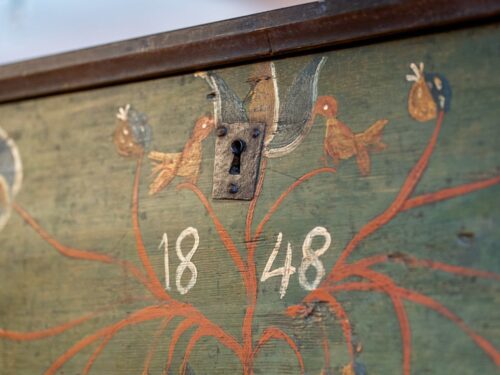
-
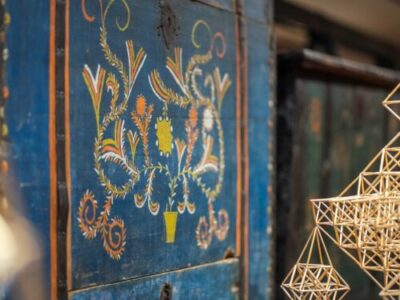
- Ethnography Repository at the House of Histories, National Museum of Lithuania. Photo by Silvestras Samsonas, LNM
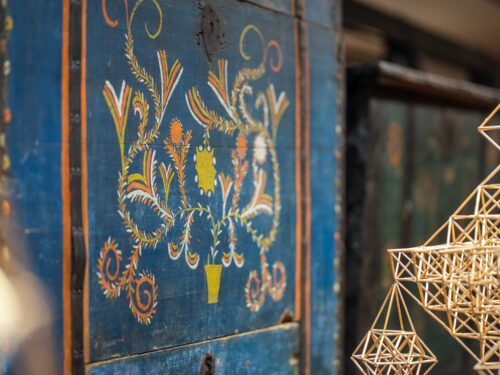
The tradition of the krikštasuolė — the sacred corner of the home — is also easy to understand. “This was considered the most beautiful corner of the house, where the most honored guests would be seated. Holy images were hung there, along with an embroidered towel holder (rankšluostinė), and sacred objects were kept. In the Vilnius region, records show that even in the early 20th century, food was still left in this corner for the souls of the deceased. One could say that the krikštasuolė was a kind of household altar unique to our region. It’s a beautiful tradition — one that is certainly worth considering reviving,” shares Audronė.
Straw Gardens and Hollow Trees
The Ethnography Repository of the National Museum of Lithuania also holds a rich collection of artifacts reflecting rural crafts from the 18th to the early 20th century — from fishing tools to beekeeping equipment. Among them are items illustrating the oldest form of beekeeping — drevė beekeeping, where bees were kept in naturally hollowed-out tree trunks. Alongside these exhibits are stories that show people of the past, just like today, weren’t always honest — and disputes often arose.
“You’d have a bee hollow in the forest and mark it as yours. But then someone else would come along and carve in their own mark… Disagreements like these often ended up in court — after all, honey and beeswax were valuable assets,” says A. Daraškevičienė, standing in the wood-scented section of the exhibition.
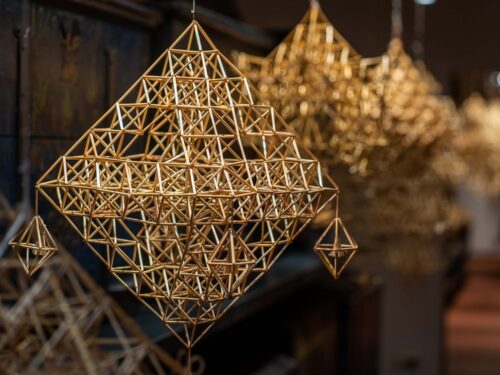
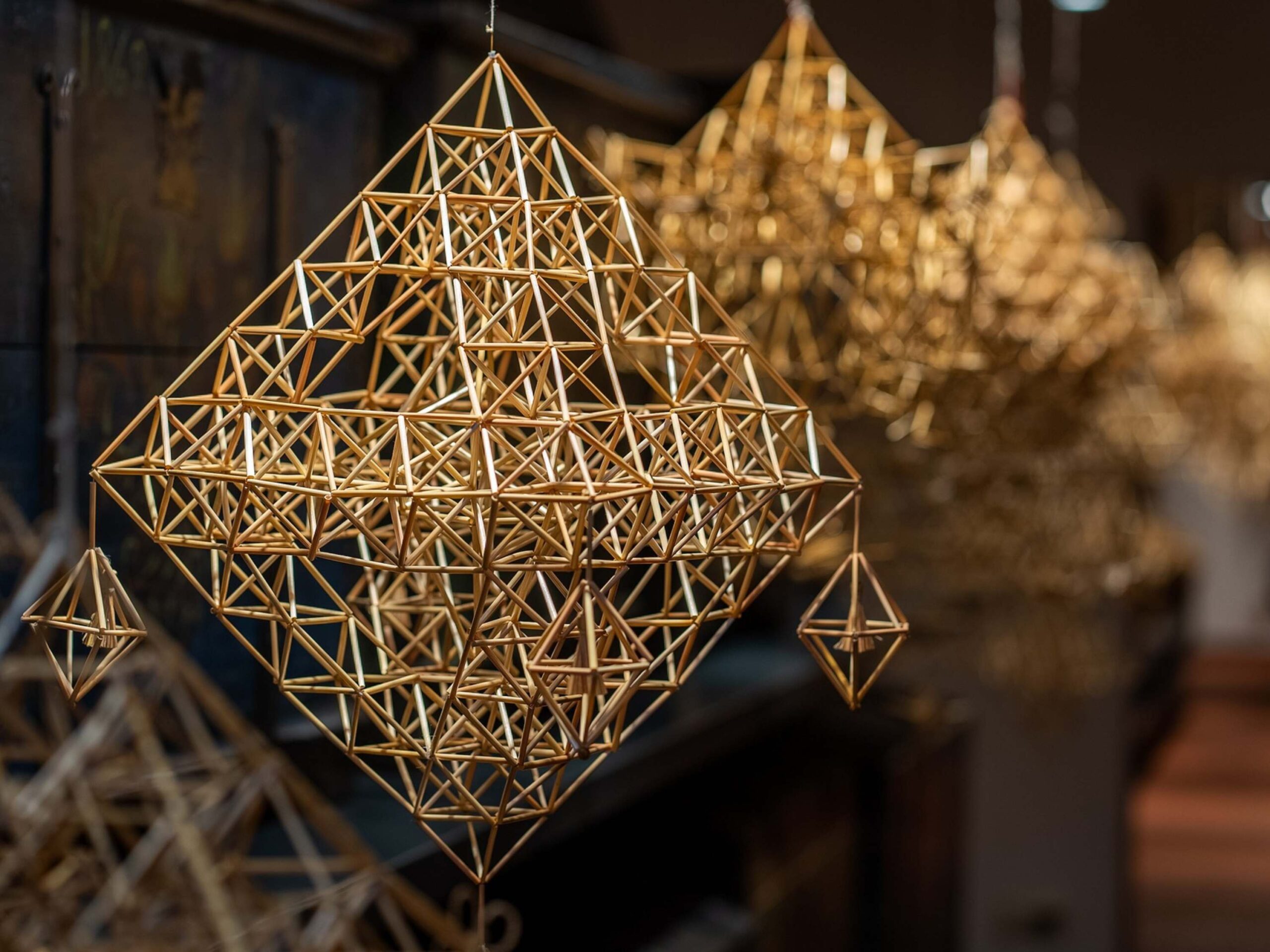
Also eye-catching is the impressive collection of straw gardens (sodai) — intricate geometric mobiles. In 2023, this tradition was inscribed on UNESCO’s Representative List of the Intangible Cultural Heritage of Humanity. The oldest sodas on display in the repository is 70 years old. No less valuable are the pieces created by contemporary sodų rišėjai (straw garden weavers), also included in the exhibition.
“A sodas would be hung above the table during major calendar or family celebrations. After their wedding, newlyweds had to ‘buy out’ their sodas and then bring it to the groom’s house. It was a magnificent sight when the sodas, adorned with fluttering ribbons, was ceremoniously carried away. But it wasn’t just decoration. According to ancient beliefs, its spinning motion warded off evil spirits, and during holidays, souls of ancestors returning home would perch upon it,” explains Audronė.
The Ethnography Repository–Exhibition at the House of Histories of the National Museum of Lithuania can be visited with a guide. On the last Sunday of each month, admission is free.
More information: click here.
-
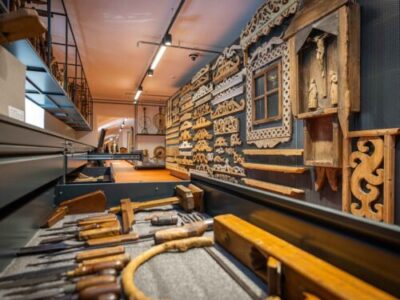
- House of Histories – Ethnography Repository, National Museum of Lithuania. Photo: Silvestras Samsonas, LNM
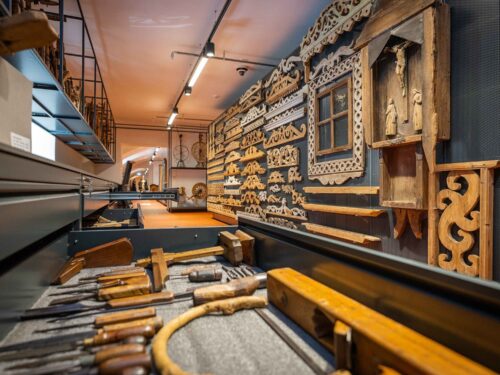
-
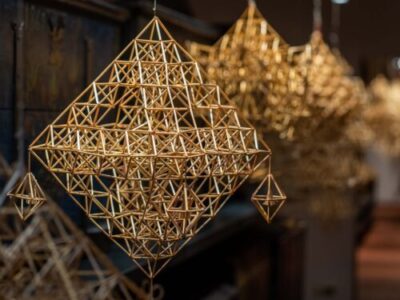
- Straw Gardens at the Ethnography Repository, House of Histories, National Museum of Lithuania. Photo by Silvestras Samsonas, LNM