From a Foreign Gaze to One’s Own Voice: What Do Exhibits in French Museums Tell Us about Lithuania?
2026 04 09
There are periods when a country is not spoken about by its inhabitants, but by others – foreign travelers, scientists, and imperial officials. They describe the land, classify its people, and explain its history, because the people of that country themselves have no way of saying who they are. This is precisely the situation Lithuania found itself in in the 19th century. Having lost its statehood at the end of the 18th century and becoming the western outskirts of the Tsarist Russian Empire, it had no political voice in Europe. Therefore, its image was created from the outside – often by associating it with Poland or Russia or by portraying it as a romanticized Eastern European country.
The international exhibition of the National Museum of Lithuania “Riding the Wave of Paris Exhibitions: Ethnography, Cultural Diplomacy, and Identity” features cultural treasures from French museum collections, allowing us to understand how others saw Lithuania, and how Lithuanians themselves began to shape their voice in the world.
“In the 19th century, Lithuania was more an object of imagination than of knowledge in Europe,” says one of the exhibition’s curators, Raphaël Bories, Head of the Religions and Beliefs Department at the Museum of European and Mediterranean Civilisations (Mucem), who has researched collections of ethnographic objects of Lithuanian origin in France.
Glimpses from France Into 19th-Century Lithuania
Lithuania was little known to Europe in the 19th century. It only gained greater attention in the middle of the century, when news of the uprisings against the Russian Empire reached Europe, and after they were suppressed, a number of participants in the uprisings and political emigrants fled to France, especially to Paris. They told stories about their country and its history, but often did so through a common narrative of the Polish and Lithuanian political tradition.
“At the same time, a different interest in Lithuania began to emerge in France. Some intellectuals, linguists and writers discovered the Lithuanian language, folk songs and stories. This land seemed to them almost untouched by modernity. In the texts of French authors, Lithuania was depicted as an archaic world – a land of forests, old beliefs and folk traditions, where traces of old Europe could still be found,” says R. Bories.
-
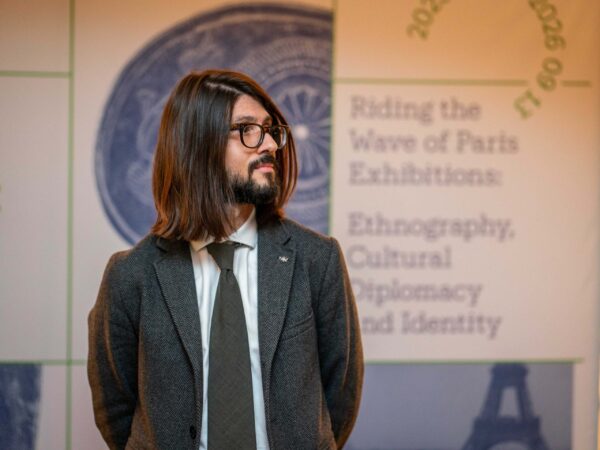
- Raphaël Bories, Head of the Religions and Beliefs Department at Mucem. Photo: Silvestras Samsonas, NML

The writer Prosper Mérimée described Lithuania as mysterious, pagan, closely connected to nature and old myths. The historian Jules Michelet imagined it as inaccessible, surrounded by forests and swamps – like a natural border of Europe in the east. Other authors compared Lithuania to Brittany, a region in western France, also considered a land of ancient traditions and strong regional identity.
According to R. Bories, such comparisons helped Lithuania emerge in the French cultural spotlight, but at the same time created a rather romanticized image of it: “To French intellectuals, Lithuania seemed like a relic of old Europe – a world little touched by modernity.”
Lithuanians Through the Eyes of a French Photographer
In the 19th century, another new idea spread across Europe – the quest for scientific knowledge of humanity. Anthropologists and ethnographers believed that different peoples could be studied and classified by determining their physical features, clothing, customs or lifestyle. Photography, a relatively new technology at the time, became an important tool for such knowledge.
In 1860–1870, French photographer Jacques-Philippe Potteau, working on a project for the National Museum of Natural History in Paris, which aimed to document the “types” of various nations, created a series of standardized frontal and profile portraits in order to compare the facial features and other physical characteristics of the photographed people and thus collect scientific data for anthropological research.
“Among these photographs, Lithuanian portraits unexpectedly appeared. In 1864, Potteau photographed twelve young Lithuanians in Paris. It is believed that they were emigrants who arrived after the suppressed uprising in the Russian Empire,” says the exhibition curator, Head of the Ethnography and Anthropology Department of the Lithuanian National Museum, Dr. Miglė Lebednykaitė.
-
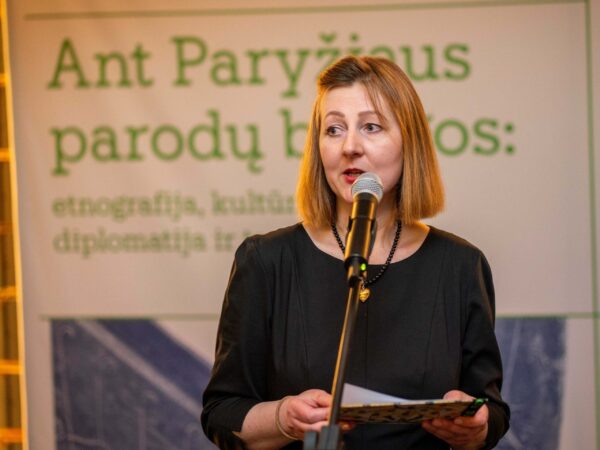
- Head of the Ethnography and Anthropology Department of the Lithuanian National Museum, Dr. Miglė Lebednykaitė. Photo: Silvestras Samsonas, NML

Very little is known about the lives of these people – they remained almost anonymous in history, but one other detail has survived. On one of the photos, the photographer’s handwritten comment reads: “The faces of all these Lithuanians are green, covered with live hair. That is why there are small shadows in the photo.” This comment shows that the photographer was primarily interested not in the stories of the people, but in their physical features, important for anthropological research.
Lithuania as an Exotic Land: Joseph de Baye
Lithuania was also discovered at the end of the 19th century by travelers – aristocrats, archaeologists, collectors, who were interested in the regions of the Russian Empire and their culture. One of them was the French traveler and archaeologist Baron Joseph de Baye, who visited Lithuania several times at the end of the 19th century, first in 1893, and later returning in 1904.
“During his first trip, he visited Vilnius, collected photographs and postcards. When he returned for the second time, he spent more time in the villages – he observed weddings and dances, and wrote down stories about storks. He brought back a small but symbolic ethnographic collection from these trips: two wooden clogs, a spoon, a colander, a jug, a pipe, and a wooden bird. Such seemingly simple objects became peculiar symbols of Lithuanian village life,” says R. Bories. De Baye transferred some of this material to the Trocadéro Ethnographic Museum in Paris. Some of the objects still kept in French museums are presented in the exhibition today.
-
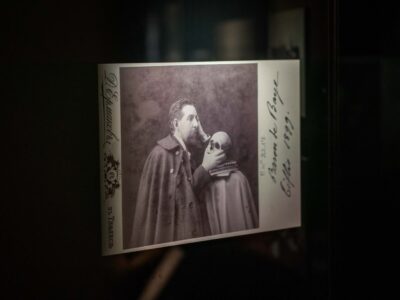
- Baron Joseph Berthelot de Baye. Photo kept in the National Library of France. Photo: Silvestras Samsonas, NML

-
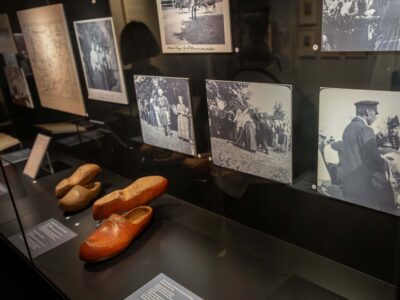
- Photographs taken by Baron de Baye in a Lithuanian village and an ethnographic collection are on display. Photo: Silvestras Samsonas, NML

De Baye described his impressions of Lithuania in his memoirs published in French, in which he tried to correct the widespread belief in France that Lithuania was part of Poland.
“De Baye saw the uniqueness of Lithuanian culture, the activation of the national movement, and even noticed the consequences of political oppression, but his story was not completely neutral. He sought to present its belonging to the Russian Empire in a rather favorable way, whose policy he almost did not criticize. This is not surprising, since de Baye maintained close ties with the Russian aristocracy, especially with Prince Pyotr Sviatopolk-Mirsky, whom he considered his friend. Thus, Lithuania remains for him an exotic land that a researcher can observe,” notes R. Bories.
Others Speak For Us: an Imperial Gaze
The image of Lithuania in the 19th century was also created by the Tsarist Russian Empire, to which Lithuania belonged at that time. One such example is the collection of figurines donated to the Natural History Museum in Paris in 1853 at the initiative of the Russian prince Anatoly Demidov. This collection consisted of fifty-nine small statues depicting various peoples of the Russian Empire.
Miglė Lebednykaitė points out that the figurines on display at the exhibition allow us to directly see how Lithuania and the Baltic region were inscribed in the imperial worldview: “These figurines were intended to show the ethnic diversity of the empire, its appearance, clothing, customs and beliefs. However, a more important goal was to define and systematize the peoples in order to make them easier to govern. At the same time, this also meant another important step – these peoples were symbolically attributed to the Russian Empire, defined in their own terms and recorded in the collections of French museums as a self-evident, almost indisputable reality.”
-
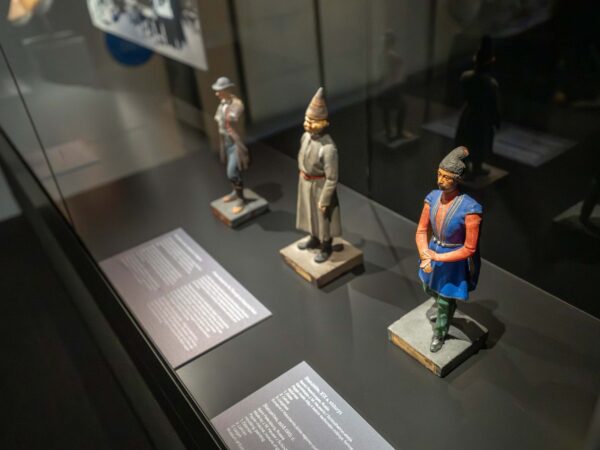
- Figurines depicting various parts of the Russian empire from the collection kept at the Natural History Museum. Photo: Silvestras Samsonas, NML

The Baltic region was depicted in a rather chaotic manner in the collection.
“There were no Lithuanian figurines at all, although a Jew and a Roma from Vilnius Governorate were depicted. Some nations were misidentified in the catalogues – for example, one figurine depicting a Caucasian Lezgin was recorded as Lithuanian,” M. Lebednykaitė remarks.
Such errors may seem strange today, but they very well demonstrate how little Western Europe knew about the Baltic region at that time.
The Turning Point: the Paris Exhibition of 1900
One thing was missing from all these perspectives – the voice of Lithuania itself. The Lithuanian intelligentsia, increasingly aware of this gap, began to look for opportunities.
“One of these opportunities was the world exhibitions, where states and nations presented themselves to an international audience. It was a kind of platform to tell about themselves. Lithuanians, using art, traditions and cultural symbols, began to shape their image in the world – appearing not as part of other empires, but as a unique cultural community,” says Lebednykaitė.
The World Exhibition of 1900 in Paris became one of the most important moments. That year, a small exhibition with the inscription “Lithuanie” appeared in the Ethnographic Museum located in the Trocadéro Palace. The name Lithuania did not exist on the official political map at that time, so such a secretly organized exhibition became a bold political declaration.
“The exhibition was set up with the funds of private sponsors and presented Lithuanian culture through ethnographic objects, textiles and customs. It recreated an episode of a peasant engagement – a scene with life-size mannequins wearing national clothes. The showcases displayed handmade embroidery, jewelry, various household items, and clothes, fabrics and carpets hung on the walls,” recalls M. Lebednykaitė.
In 1935 and 1937 – more than three decades later – the exhibitions held in Paris already spoke of the ambitions of an independent Lithuanian state. Participation together with Latvia and Estonia symbolized the unity of the Baltic States and their place in Europe. Folk art here acquired a new meaning – it became no longer a sign of survival, but an expression of aesthetics and creative maturity.
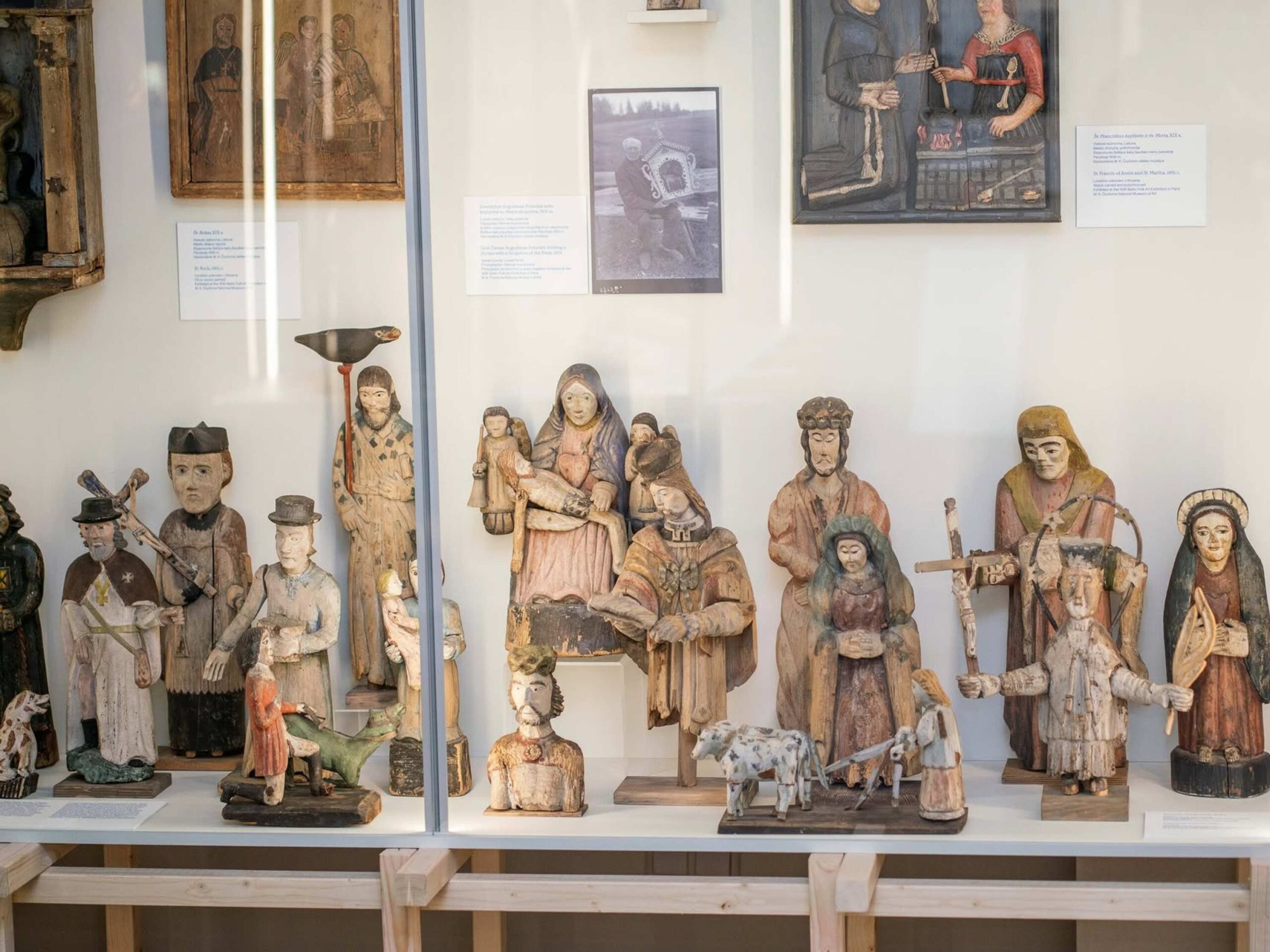
The exhibits, documents and photographs of these historical exhibitions in Paris, today kept in museums in France, Lithuania, Latvia and Estonia, are collected in one place for the first time in many decades and presented at the international exhibition of the National Museum of Lithuania “Riding the Wave of Paris Exhibitions: Ethnography, Cultural Diplomacy and Identity”. The exhibition is organized jointly with the Museum of European and Mediterranean Civilizations (Mucem) in Marseille and the National M.K. Čiurlionis Art Museum. The exhibition will be open until August 2, 2026 at the House of Histories, T. Kosciuškos g. 3, Vilnius.
-
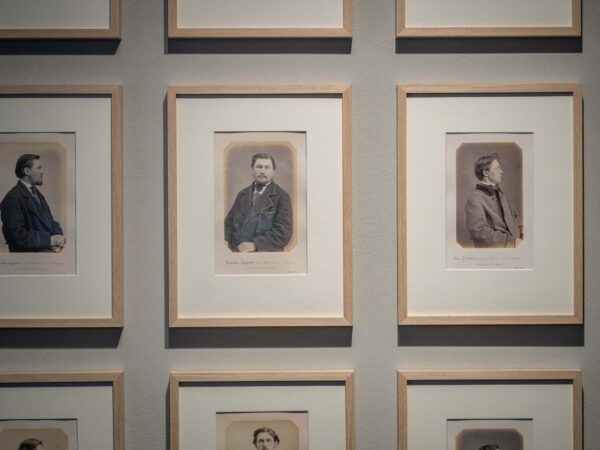
- In 1864, Potteau photographed twelve young Lithuanians in Paris. Photo: Silvestras Samsonas, NML