“Not a Day Without Robotics”: How a Humanoid is Being Created for a Museum in Lithuania
2026 04 22
A project is being born in Lithuania that until recently seemed like a distant future. A humanoid robot is being created for an exhibition at the National Museum of Lithuania that will be able to communicate in Lithuanian, respond to visitors, and tell the story of our country’s high-tech history. At the same time, it is an attempt to create a new relationship with science – one that would engage, interest, and perhaps for the first time encourage a child or teenager to think: “maybe I could create this too?”. In order for this idea to become a reality, the museum’s crowdfunding platform is collecting public support (link).
We talk to the scientist who created it, Linas Aidokas, about what it really means to create a Lithuanian-speaking robot and what opportunities it opens up.
In short, what is this robot and what will it do?
This robot is being created for education, the popularization of technology, and the involvement of visitors in a lively knowledge of science. We are creating it specifically for the exhibition at the National Museum of Lithuania. The most unique thing is that the robot will be controllable with Lithuanian voice commands. It will be able to understand hundreds of Lithuanian words, perform movements, answer questions, and present technology and science topics to visitors. Communication will take place like a dialogue: the visitor will ask a question, the robot will answer, and the conversation can continue.
-
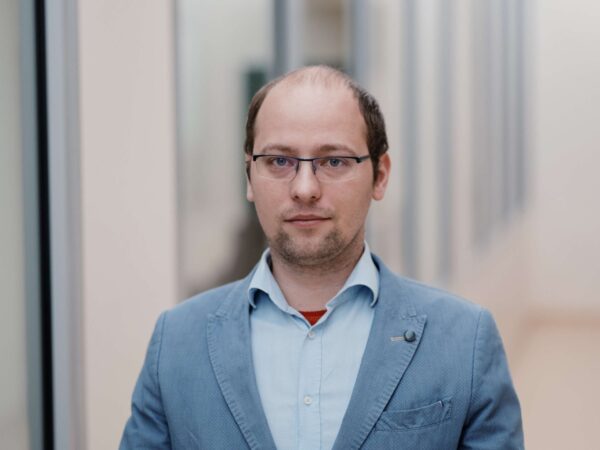
- Linas Aidokas, creator of the robot for the museum. Photo: personal archive

How freely will visitors be able to communicate with the robot – will there be certain limits?
The robot can be programmed in various ways, but the most important thing in this project is the perception of the Lithuanian language based on pre-prepared content. If the robot were to respond completely freely to the interlocutor, the system would become much more complex and would require constant, uninterrupted maintenance. At the same time, this is also related to risks – it is important to ensure that the robot works reliably and the visitor does not find himself in a situation where it does not work. It is also necessary to consider how the robot would respond to inappropriate or provocative questions. Therefore, completely uncontrolled and unrestricted communication is not an aspiration in this case.
To what extent is the Lithuanian language a challenge for the robot – is it “more difficult” than for other language technologies?
The biggest challenge is the processing of the Lithuanian language. The Lithuanian language is particularly rich, with many sounds, meanings and nuances that need to be understood accurately. For example, the same word “kurti” can have several meanings: “light” a fire, “create” a robot, “deaf” people. We have a word that is spelled the same way, it can be spelled and stressed in exactly the same way, but depending on the context, it can have completely different meanings. There are certainly many such words and situations in the Lithuanian language, it is difficult for a robot to understand and comprehend what exactly is being said.
It is very important to distinguish exactly what is actually being said, because a misunderstanding or perception of the meaning can offend or hurt someone. Stress is also particularly important in the Lithuanian language. Sometimes even a small difference can change the meaning. For example, you want a robot to say and properly stress “šaunu” (“great”) at an event, but a different stress position turns the same word into something completely different, related to shooting, fighting or war. It seems curious – the same word can be used both to praise a person or their work and for the complete opposite – destruction, annihilation, struggle. Mistakes about the place of the accent can easily lead to misunderstandings.
How is a robot taught the Lithuanian language?
This is a long-running project in which we teach artificial intelligence the Lithuanian language from various sources – television and radio programs, media content, telephone conversations. The most important thing is that they hear natural language – different accents, people from different regions, children, seniors. There are dialects from various regions of Lithuania, as well as modern youth colloquial speech with “bitten” endings and various loanwords and foreign words. This helps the robot learn from real, living language today, because the biggest challenge is to teach artificial intelligence to understand all this. At the moment, it still makes a lot of mistakes – as if a person does not hear every second word.
-
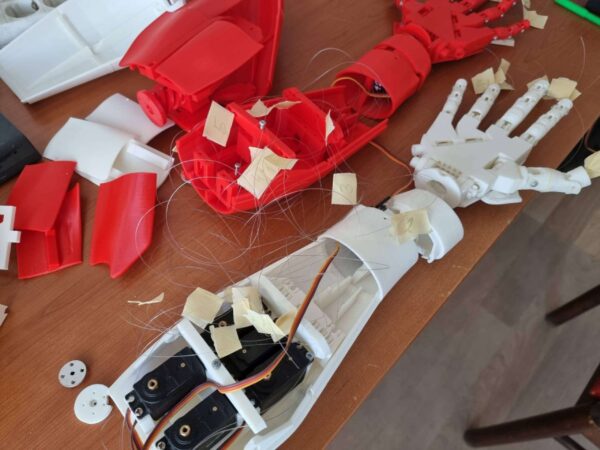
- The robot will consist of more than 500 parts. Photo: Linas Aidokas

What is the level of robotics in the world today?
The latest robots can be indistinguishable from a living person. Japan is clearly the leader here. The Japanese cover them with silicone, even heat them so that they are not cold to the touch. There, it is already on a completely different level, not only in terms of appearance. You can talk to a robot on any topic. The conversation starts with “where are you from” and ends with questions about what love is, what kind of feeling it is and why it is needed. This is high class. You not only hear what the robot is saying, but also see its “thinking” – it always guesses in real time and analyzes what a person will ask, what they might want, what they mentioned before, how to even steer the conversation slightly by manipulating the person and extracting some important information for them or confirming their hypothesis. If you say something unexpected, the robot rethinks everything. It also monitors the environment – where you are standing, whether you are looking at it, who is talking. There may be ten people in the room, but it knows who is communicating with it at that moment, so he ignores the others, even if the other people in the room are chatting among themselves.
200-300 scientists have been working seriously on such solutions for several centuries. And the funding is adequate for such high-level scientists to maintain themselves and push further towards more advanced robots. This is why we wanted to have such robots in Lithuania.
The robot currently being developed will also depend on how much funding is raised. If there were no such limits, where would you see the greatest value for robotics?
I see great value in using robots to solve social problems – most of all in the area related to seniors. This could be exercise, conversations, and maintaining emotional well-being. In Japan, this is a particularly acute problem. There, seniors have small robots that cost about 500 euros; some interact with them as much as 50 times a day.
This compensates for the lack of communication – often friends have already left, children and grandchildren live elsewhere, and the person himself remains very lonely, isolated, often in a more remote place. The robot can not only maintain a conversation. It can voice messages sent by grandchildren, describe photos to people with visual impairments – tell what is seen in them. A senior can ask the robot to send a message or photo to their relatives – dictate everything by voice and not touch a single button, which are usually too small and difficult for very elderly people to see.
There are also real stories when a robot helped save a life. For example, a lonely person fell, broke his pelvis, asked the robot to take a picture of the situation. This is how an ambulance was called.
Do you also see robotics as a way to address inclusion challenges, especially when working with children?
Yes, even with smaller robots, we have noticed that children really like them. Sometimes it is even easier for them to communicate with a robot than with a person – because of emotions, facial expressions, which can be difficult to understand or frightening for children.
My own son, who has developmental challenges, was already trying to establish a connection with a robot when he was two years old – he would laugh at its movements, try to imitate them and teach the robot how to walk correctly, without swaying like a penguin. He did not do this with adults.
There are also broader examples. In Italy and France, systems were developed where the robot became a kind of intermediary – through it the child’s progress, language, logic are monitored; the data can be independently viewed by the doctor, parents and teachers. In Japan, robots are also used to work with adolescents with psychological difficulties. There are people who do not want to communicate with others at all, but communicate with the robot. There are not enough psychologists for everyone, and robots can be mass-produced. Creating a good robot psychologist is difficult, but once it is created, it can be adapted to many people. It is expensive, but in the long run, a robot can be cheaper than a person’s time.
What does your daily life look like when creating this robot?
Not a day without robotics. When I teach robotics at a university, I always say that a good roboticist must know a lot of different things. It is essentially a multidisciplinary field – mechanics, electronics, programming, control. However, everyday life is usually quite monotonous – a lot of programming, long hours at the computer, problem solving. This is about 90 percent of the total work. And the remaining 10 percent is the interesting part: turning screws, connecting parts, doing something physically. After sitting for a long time with the code, it becomes refreshing. Especially when the robot starts moving and everything works as it should.
-
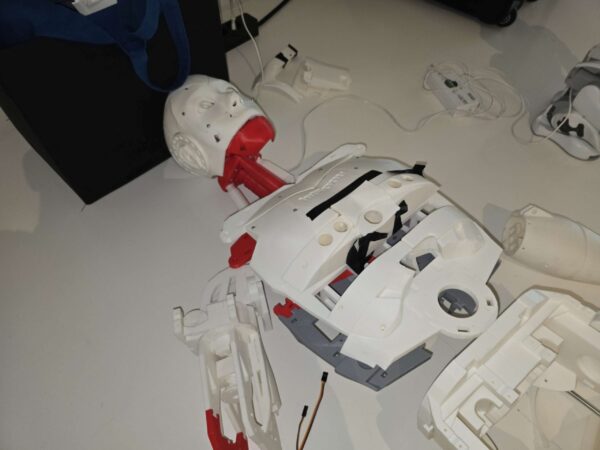
- The human-sized robot is almost assembled. Photo: Linas Aidokas

How much engineering is there in this project, and how much creativity and maybe even… fantasy? Where do you allow yourself to improvise?
In fact, there is not much creativity here. Most of the solutions are based on fairly strict mathematical models, especially when it comes to movements and their trajectories. A little more freedom appears when programming movements – you can choose not only the exact, but also the aesthetically “more beautiful” option. Also – when shaping what the robot understands and how it responds. Everywhere else, quite strict logic prevails. There is almost no creativity in electronics, and in code – the same. You can look more creatively at the appearance or details, but this is very time-consuming.
What is the purpose of the robot – to show the progress of high technologies or to interest children in them? How would you yourself see the meaning of this robot?
It is interesting that the Japanese started this path precisely with museums. Later it developed into close cooperation between business and science. It turned out that this interested children and attracted them to technical fields – to study engineering and technology. Many robotics museums allow children to visit for free, and they have no problem attracting young people to these areas.
Such things are very attractive to children, so our goal in Lithuania is to both interest them and show the possibilities of technology. In general, robotics is oriented towards the future, as is artificial intelligence. Theoretically, it can do a lot, but it still needs time to develop. Now it already does a lot of things, but not everything works as we would like. But in the future, robotics will definitely become an important part of our lives – a developing transformation with artificial intelligence in our everyday lives.
How do you imagine a child who meets this robot for the first time, and what would you like them to take away from that meeting?
First of all, a good emotion. Although not all children react to robots in the same way. There are some who are a little afraid of them or avoid them. We would like that meeting to interest them and encourage them to become interested in technology themselves. Not necessarily just robotics. The most important thing is for the child to understand: such things are created by people, and they can be created. Everything consists of small steps.
In order to make this idea a reality, the museum’s crowdfunding platform is collecting public support: link. The exhibition “Trajectory of the Future. History of Lithuanian High Technologies” of the National Museum of Lithuania will open in September this year at the House of Histories in Vilnius.
Interviewed by Živilė Stadalytė, National Museum of Lithuania