“What is joy if you never experience fear?” – a psychologist about the fears she confessed at the exhibition “History Wags Its Tail”
2025 09 23
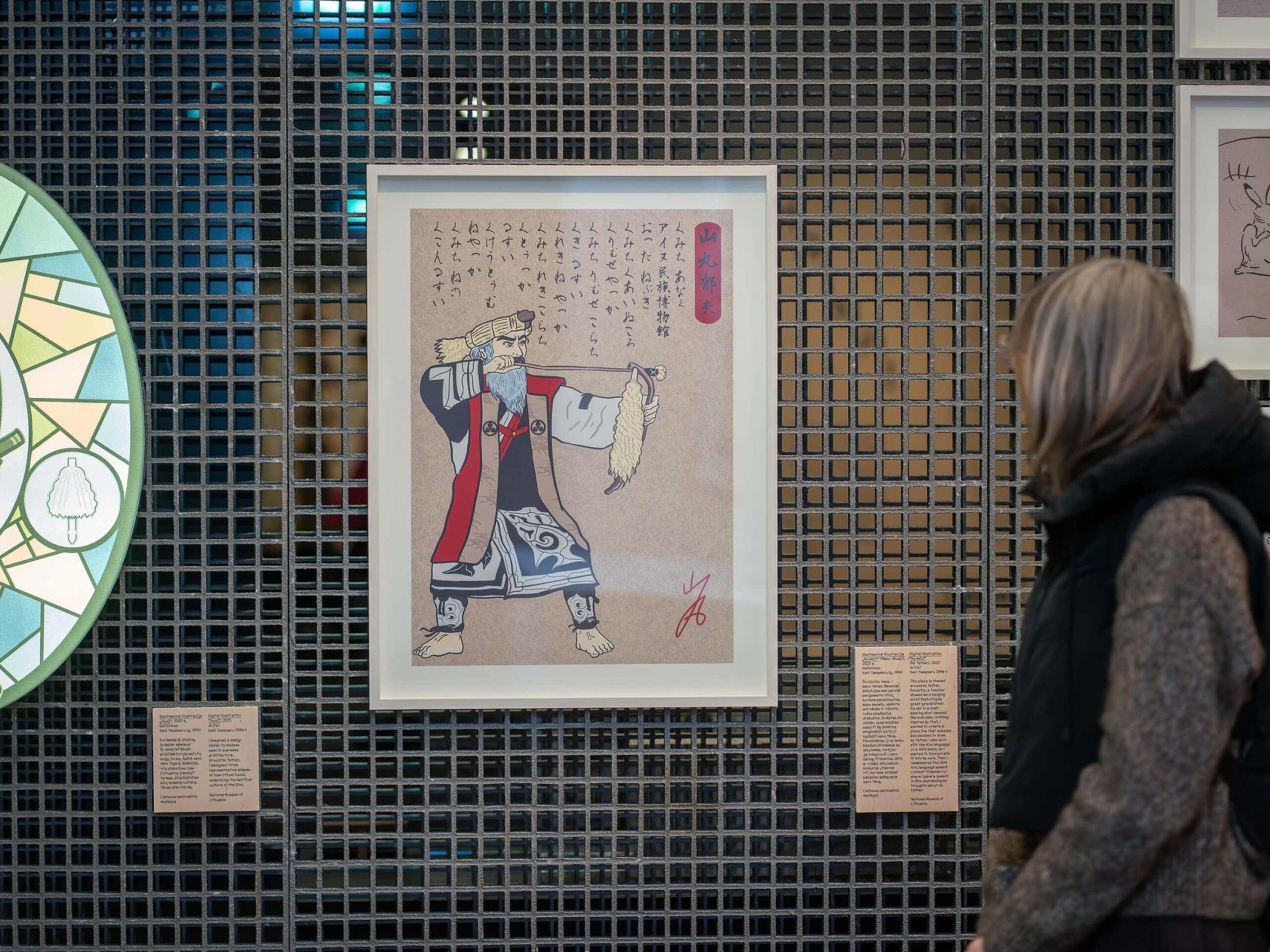
The exhibition “History Wags Its Tail” of the Lithuanian National Museum, which is open at the House of History, invites visitors to look at the history of dogs and their connection with people – today we are increasingly discovering the therapeutic power of animals. One of the parts of the exhibition has become a kind of confessional place: visitors wrote their fears on pieces of paper and threw them into the jaws of the “monster dog”, hoping that this symbolic ritual will help them overcome them. Over the course of five months, hundreds of responses have been collected – from everyday anxieties to unexpected, deep-seated confessions.
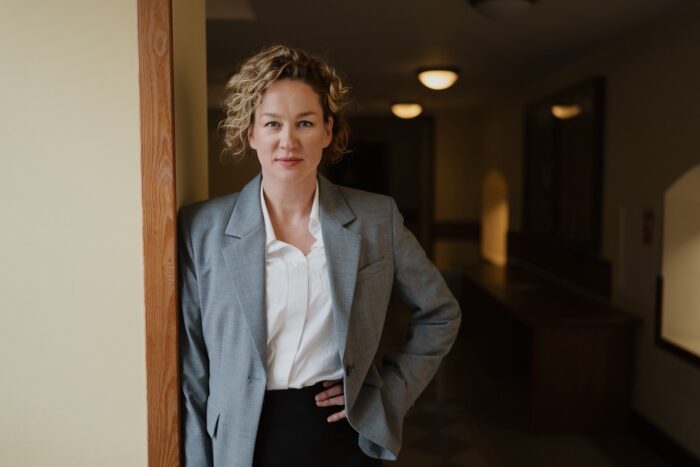
What do these pieces of paper reveal about our society, fears and their change? We talk about this with psychologist, associate professor at the Institute of Psychology of Vilnius University, Dr. Vita Mikuličiūtė.
What did the answers written down by the visitors and entrusted to the “monster dog” show – were individual fears more dominant, or was there a more general, recognizable anxiety for everyone?
Two groups emerged. Some answers were very typical, as if from a psychology textbook – the kind you would expect. Others were completely unexpected, strange, sometimes even funny or original. I kept thinking: were people consciously trying to be so exceptional, or is the spectrum of fears simply so wide? For example, one child admitted that he was afraid that his dog would eat other dogs’ feces. Another wrote that he was afraid of not earning 20 million in 2.5 years. There were also very specific fears that surprised with their unexpectedness.
What did the visitors’ written fears reveal about different age groups? Can we “draw” a kind of map of childhood, adolescence, or youth fears from them?
Although people did not indicate their age, we can more or less guess from the writing or wording. Preschool children are usually afraid of very specific things: the dark, spiders, dogs, snakes, or monsters. Children up to 11–12 years old write more about fears related to school: the teacher, mathematics, homework, swimming. These are still specific things, but they are already related to their first social experiences. The fear of social rejection is most evident in the responses of teenagers – they worry that they will not have friends, will not build a successful future. Young people are afraid of not getting into university, failing exams, not finding an apartment, not being able to get back on their feet financially. And the fears of adult visitors move on to other topics – health, the well-being of loved ones. Everything reflects the natural challenges of development, and this was clearly visible in the responses.
Today’s young people are being formed against the backdrop of war, pandemics, the Internet and social networks. What trace do you think such a flow of information and events leaves on their fears and well-being?
I think that the youngest generation today is most affected not so much by individual events as by the enormous flow of information. We discussed with colleagues how much the pandemic had an impact – we decided that maybe not even as much as it seemed at first. People got back on track quite quickly. Then why do you really see that young people who grew up with computers are afraid to communicate, to speak out? I would think that they are simply overwhelmed by the amount of knowledge, information, and they also lack discussion skills. At school, knowledge is emphasized more, but not learning to discuss or express themselves, so naturally there is a lack of communication skills. And this, I think, is one of the most important challenges for this generation.
Were there any fears that stood out for their unexpectedness or unusualness?
I was surprised by the small but clearly visible group of people who wrote that they were afraid not of specific things, but of the emotions themselves: anger, sadness, even fear itself. Psychology adheres to the principle that all emotions are appropriate, so such answers seem strange at first. In fact, the scale of emotions is dominated by negative emotions: sadness, anger, fear, disgust, contempt. There are only a few positive ones – basically only joy and surprise. And if people do not want to feel negative emotions, the question arises: how can they experience joy at all? After all, it becomes meaningful only because of the contrast with fear, sadness or anger.
How can we explain the emergence of such fears directed at emotions themselves?
I think this indicates two things. First, a lack of emotional literacy. People often do not want to accept their negative emotions, as if they were something inappropriate. Second, the pressure of the modern world to be happy all the time. On social networks, everyone demonstrates a perfect, joyful life, and this gives the impression that this is how everyone’s everyday life should look. But in fact, negative emotions are an inevitable part of life, they make up a large part of our experiences and have an important function. If they were unnecessary, they would simply have disappeared in the course of evolution. Fear, anger or sadness signal to us that something is wrong, that the situation needs to be changed, they provide resilience. And if a person is afraid of emotions themselves, he remains to live in eternal stress and tension, because he will inevitably experience them, even if he really does not want to.
Do people’s fears reflect more the changes in today’s society?
People’s fears change only partially. There are some that can be explained by evolution – we are genetically inclined to fear things that have long represented danger. For example, the dark, because threats lurked in it, or spiders, snakes, wolves, heights. These are classic fears that persist to this day, even if in reality they no longer affect us as much. But at the same time, new ones appear, more related to modern life. In the visitors’ notes, there were completely unexpected examples: fear of stupid robots, accidents, clown puppets, even the dishwasher door or kidnapping, and the geopolitical situation, the fear of war are also very noticeable. All this reflects what surrounds us now. So we can say that some fears are eternal, but some appear along with the new era.
How can parents find a balance: how much to protect a child from fear-inducing information, and how much to let them face real experiences?
Children very easily adopt their parents’ fears, so I think the most important thing is for parents to set a good example themselves. They should instill a sense of security in their children, and not create an atmosphere of a threatening world around them. On the other hand, there is no need to overdo it – to hide or deny problems. It is not easy, but the principle is simple: in order to help a child, you must first help yourself. If parents themselves do not know how to deal with their fears and do not seek help, the child very quickly adopts this. It happens that parents bring their child to a psychologist and say: “He is afraid.” But in fact, often the fear comes from their own fears. If they themselves do nothing about it, it also becomes very difficult to work with the child.
This part of the exhibition has become a place of confession and has attracted a lot of attention from visitors. Does this indicate that people today are more courageous in talking about their fears than previous generations?
This is a really good question. On the one hand, it seems that people today are more courageous in talking about their fears and difficulties – we hear about them publicly, we discuss them more, and there are opportunities to seek help. But there is also a paradox here. Recently, a study was presented at a developmental psychology conference, which showed that although the availability of psychological help is increasing in Western countries, prevention is improving, at the same time the number of diagnoses of mental disorders is increasing. It can be said that the more people talk about it, the more people focus on their difficulties and highlight them. This does not mean that they are making something up, but simply that a lot of attention is being paid to it.
Or are we just finally starting to see and name what has always existed?
There are two sides to this. On the one hand, when mental disorders or difficulties are talked about more, it becomes easier for people to open up. Openness encourages openness – someone says they are depressed, and this encourages others to share their experiences. The same thing happened with the “Me Too” movement – one person’s disclosure encouraged many others to speak out, and this gave them relief. On the other hand, we also see another phenomenon in practice: some people start to stretch their minor difficulties into more serious diagnoses simply because they are talked about a lot. In this case, their problems are not necessarily that big in reality, but when you focus only on them, it seems like a huge tragedy. So the answer is not straightforward: openness helps, but at the same time it can strengthen the focus on the problem itself.
Do you have any specific examples of when talking about mental disorders or fears becomes more of a problem?
I had a patient who presented herself as if she had bipolar disorder, even though neither I nor her psychiatrist thought so. It later turned out that she had been watching the TV series “Euphoria,” which portrays the disorder in a very romanticized way. Another example is the so-called Werther effect, when the media dramatically covers the suicide of a famous person, and then more such cases are recorded. Therefore, journalists are advised to speak as restrained as possible. This clearly shows that the line between normalization and romanticization is very slippery, and the responsibility when talking about such things is enormous.
If the visitors to the exhibition have already written down their fears and “gave” them to the “monster dog”, what else could they do to make friends with them?
It seems to me that all people have fears, and this is completely normal, as long as they do not interfere with their lives. One of the most important things is to acknowledge their fear. A common mistake is avoidance. When a person avoids what scares them, they never have a positive experience that could reduce that fear. This is especially visible when working with children – for example, if a child is afraid of a teacher or school and stops going to it, that fear only grows stronger. But if he goes and sees that not everything is so scary, a negative experience can be replaced by a positive one.
What do you think of the decision of the organizers of this exhibition – to write down your fears and give them to the “monster dog”? Can such a playful ritual become the beginning of a more serious conversation about a person’s inner experiences?
It seems to me that this idea is valuable simply because it gives you an opportunity to stop and think about your fear. This in itself has a therapeutic effect. For some, the ritual itself helps – you throw a piece of paper into the “monster dog”’s jaws, and it seems as if the fear has been eaten. Anonymity allows you to answer more openly, which is why there were some very sad confessions. Of course, this will not work for everyone – some may be disappointed if the fear does not disappear. However, such playful forms are used in psychology, especially when working with children, because through play it is easier to approach serious topics.
The exhibition talks about the therapeutic benefits of dogs. How, in your opinion, does communication with pets help reduce anxiety and overcome fears?
Being with an animal has a very direct effect on our emotions – stroking a dog or cat reduces the level of the stress hormone cortisol and releases oxytocin, which gives a feeling of peace and closeness. Pets strengthen the sense of security – children sleep better when they have a dog next to them, they are less afraid of the dark or “monsters”. They also encourage movement: you need to go for a walk, be in nature, which in itself reduces stress and anxiety. So a dog can help both directly – through its presence, and indirectly – by promoting a healthier lifestyle.
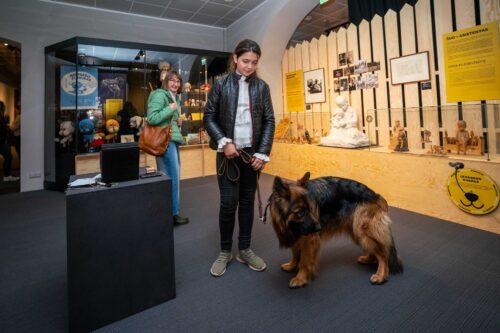
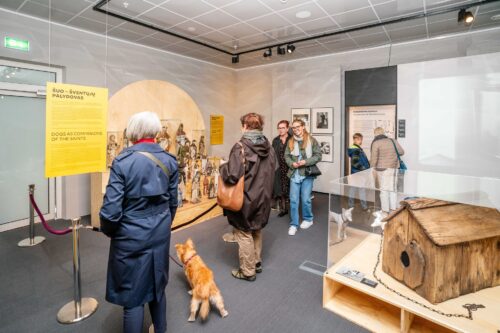
The talk is part of the exhibition “History Wags Its Tail” at the National Museum of Lithuania. The exhibition is open at the House of History (T. Kosciuškos g. 3, Vilnius) until October 26, 2025. The general sponsor of the exhibition is KIKA.
The speaker was Živilė Stadalytė (National Museum of Lithuania).