Defending Childhood in Ukraine: Exhibition “That Flower Looks Like a Drone” Opens at the Bastion
2026 05 13
On May 20 at 18:00, the National Museum of Lithuania will unveil “That Flower Looks Like a Drone”, an exhibition by Danish artist Eske Touborg at the Bastion of the Vilnius Defence Wall (Bokšto St. 20, Vilnius). The exhibition presents works rooted in painting workshops the artist organized with Ukrainian children rescued from Russian-occupied territories. Visitors wishing to support Ukrainian children will have the opportunity to purchase artwork, with all proceeds benefiting the organization Save Ukraine.
A Chance, If Only Briefly, to Simply Be Children
The exhibition “That Flower Looks Like a Drone” emerged after internationally recognized Danish artist Eske Touborg was deeply affected by the war in Ukraine and by the immediacy of the conflict. Wanting to help the people of Ukraine, the artist realized he could do so through the medium he knew best: creative expression.
While collaborating with the Denmark-based aid organization KOLO Nordic, Touborg connected with Save Ukraine, a charitable organization dedicated to returning children from Russian-occupied territories and providing broad support to children and families affected by war.
-
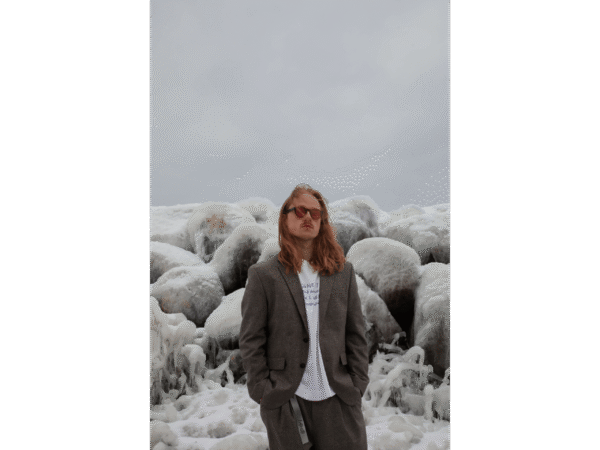
- Eske Touborg. Photo: personal archive

The artist traveled to Save Ukraine’s headquarters in Kyiv, where he organized painting workshops for children and teenagers whose lives had been disrupted by the conflict. During the sessions, a large-format canvas was rolled out, paints were distributed and participants were given complete freedom to create and experiment with spray paint and acrylics. After the workshops, Touborg brought the canvas back to Denmark, divided it into fragments and completed the paintings by combining the children’s painted backgrounds with faded portraits and imagery drawn from the realities of war.
A Childhood Fragmented by War
The workshops became a rare space where children could momentarily step away from the pressures of wartime life and release emotions that are often difficult to express in words. Touborg and the art therapists participating in the sessions observed visible changes in the children’s behavior over the course of the workshops. The artist recalls: “It made me happy to see how the children may have arrived a little shy at first, but once we started pouring paint, they began laughing, joking and smiling broadly. It moved me deeply.”
-
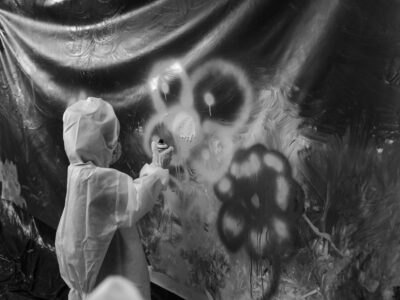
- Eske Touborg’s workshop for children at the Save Ukraine headquarters in Kyiv. Photo: artist’s personal archive

-
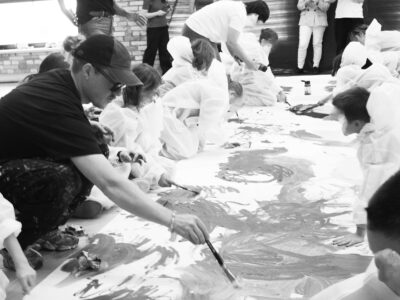
- Eske Touborg’s workshop for children at the Save Ukraine headquarters in Kyiv. Photo: artist’s personal archive

The contradictory imagery woven throughout the artworks reflects the reality faced by Ukrainian children, whose desires to explore the world, play and simply be children are overshadowed by Russia’s military invasion. The blurred faces evoke the systematic erasure of identity inflicted on abducted children: they are given new names, forced into another language and taught different loyalties and histories. Yet the children’s vivid brushstrokes also testify to resilience. Despite the traumas of war, there remains within them a childlike urge to play, create and be seen.
The exhibition’s title, That Flower Looks Like a Drone, comes from the spontaneous remark of one child commenting on a flower they had painted. As visitors move through the exhibition, they are invited to reflect on how war reshapes Ukrainian children’s everyday lives and their understanding of the world around them.
-
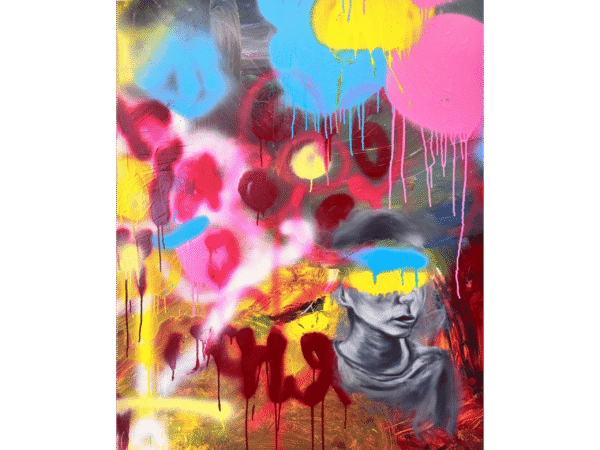
- Eske Touborg. Rescued. Donetsk region, 2025. May 10. Photo. artist’s personal archive

An Opportunity to Support Ukrainian Children
Visitors to the exhibition will be able to purchase the artworks on display, directly contributing to aid efforts for Ukrainian children. The project is non-profit, and all funds raised from sales will go to Save Ukraine.
The presentation of the exhibition at the Bastion of the Vilnius Defence Wall was initiated by Dr. Rūta Kačkutė, Director General of the National Museum of Lithuania. She emphasizes the importance of sustained support for Ukraine: “Ukrainian children’s understanding of the world is now being shaped within the distorted context of war, where they have no sense of safety. That is why comprehensive support for these children is vitally important. It shows them that the world sees what they are enduring and that they have not been abandoned or forgotten. We must not grow tired of helping Ukraine. We cannot grow tired of speaking about it. We must remain attentive to what is happening, respond to it and continue searching for ways each of us can contribute.”
-
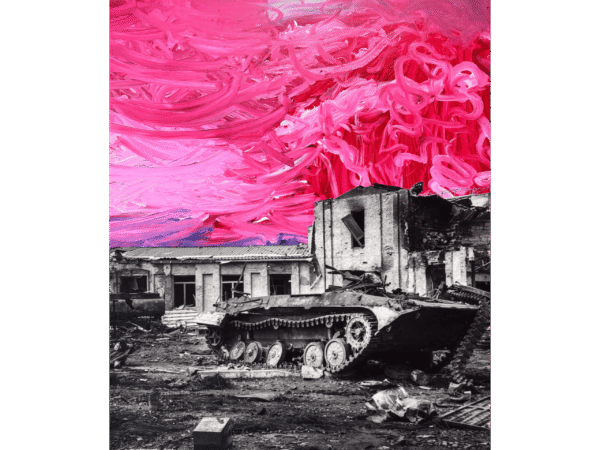
- Eske Touborg. Occupied. Dmytrivka, 2022. March 31. Photo. artist’s personal archive

Touborg also remembers one recurring image from the workshops: “Of course, many of the children painted the Ukrainian flag. And I think that is such a beautiful idea, such a beautiful gesture by the children—that instinctively they reached first for blue and yellow, and then simply began creating the flag. Even though later they painted over it and added everything else on top, underneath it all there are Ukrainian flags. And that … it still gives me chills, because it is such a powerful symbol. Beneath everything, regardless of what is layered over it and regardless of what happens—even if everything collapses—you still have the flag, you still have your home, you still have something worth fighting for. Of course, the children were not consciously thinking about it in those terms. But to me, it was incredibly beautiful.”
“That Flower Looks Like a Drone” opens at the Bastion of the Vilnius Defence Wall on May 20, 2026, at 6 p.m. and will remain on view through September 6, 2026. The exhibition is organized by the National Museum of Lithuania, with support from the Danish Cultural Institute in Estonia, Latvia and Lithuania. Media partner: JCDecaux Lietuva. More information is available at www.lnm.lt.