From Monday to Sunday: Photographer Arūnas Baltėnas Captures Lithuania at Work
2025 12 02
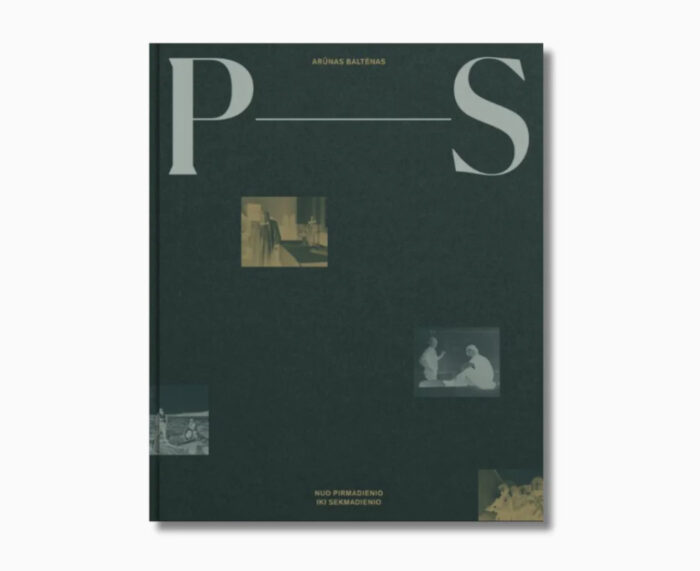
The National Museum of Lithuania, together with the “Baltėnas Archives,” has published a photography book by well-known Lithuanian photographer and Government Culture and Art Award laureate Arūnas Baltėnas titled From Monday to Sunday, which centers on the working Lithuania of today. It is a collection of portraits and short first-person stories featuring representatives of more than one hundred professions. The stories accompanying the photographs give the book intimacy and authenticity—the reader becomes almost like a conversation partner, sitting beside a person at work and listening to them talk about what they do.
Photographer Arūnas Baltėnas, the book’s author, talks about what portrait of working Lithuania this book reveals.
You are presenting the twelfth publication of your work. We are used to your cycles depicting Vilnius and other European cities, as well as the life of various Lithuanian ethnographic regions. So what is this book about?
It is a photography book about working people in Lithuania. In a figurative sense, I would call it a portrait of our working country. I wanted to capture professionals in their fields and reveal their work environments: to show tools, devices, equipment, and special clothing. Although this is not an exhaustive catalogue of Lithuanian professions, the book gives a fairly good impression of the working nation. It includes authentic testimonies from a wide range of professionals—from the simplest to modern, complex jobs requiring special skills.
-
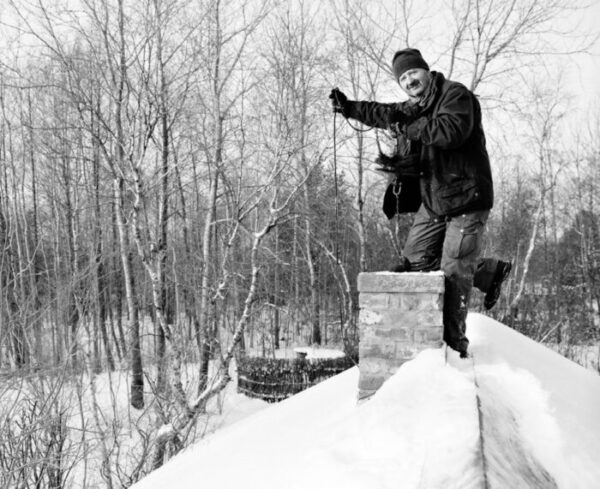
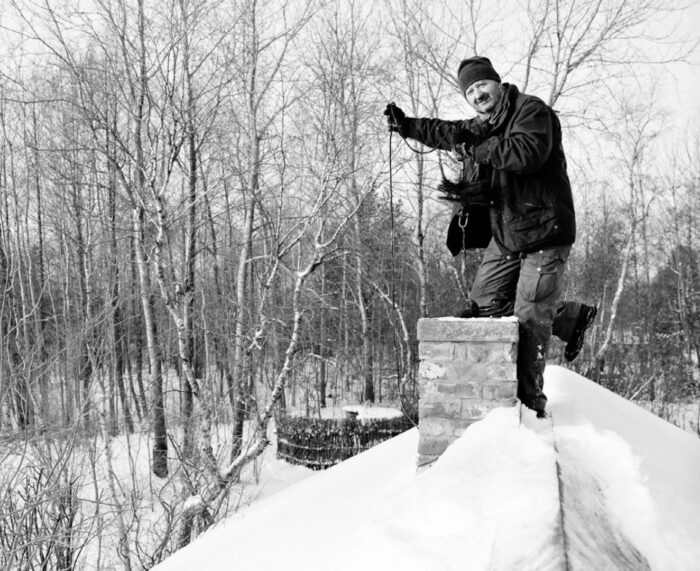
- Chimney sweep Audrius B. Palanga, 2018. Photo by A. Baltėnas
The book is titled From Monday to Sunday. What does that signify?
The title—and even the structure of the book—highlights the fact that some people work on holidays, at night, or on weekends. We are used to fixed working hours, but many work differently. For example, shop employees work continuously. If we go for a walk in town, cafés are open, concerts and performances are happening. Not to mention emergency services. All of them take care of us when we are not working.
But for a believer, Sunday is a holy day and one shouldn’t work…
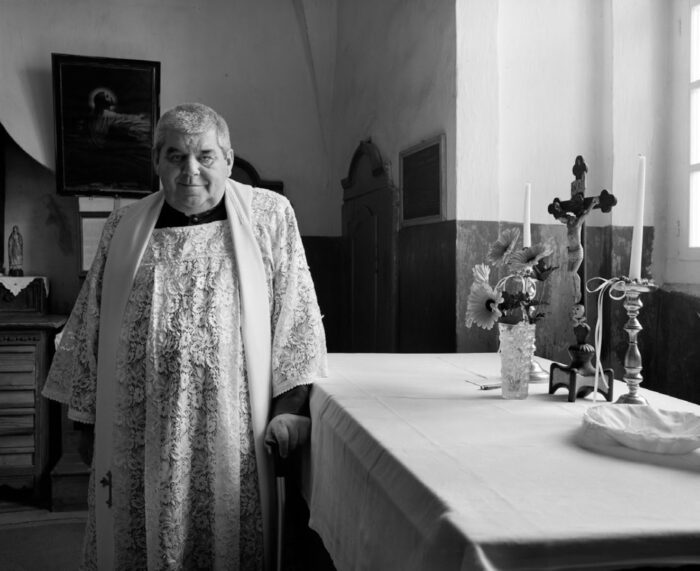
(laughs) In the part of the book devoted to Sunday, readers will find, among other professions without a traditional schedule, a priest and his story.
-
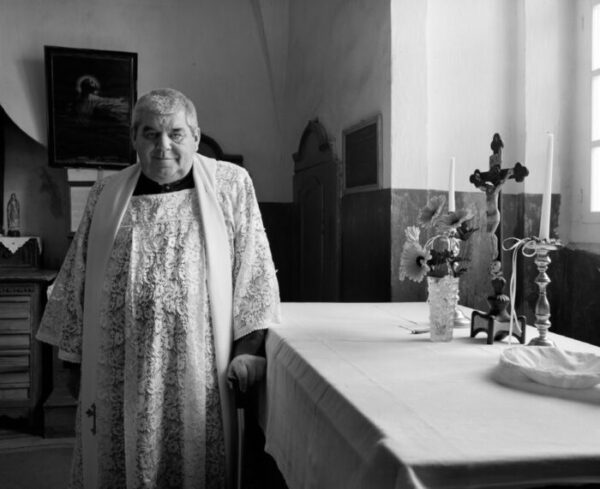
- Parish priest Leonas L. Rokiškis district, 2016. Photo by A. Baltėnas
It would be interesting to hear how this cycle began.
For many years I’ve worked on various social photography projects—I’ve photographed the lives of poor families, the daily life and festivities of different ethnographic regions. Meeting these people is important and fascinating for me, and through photographing I step into their lives, understand who they are, draw closer. I feel a strong inner need for that. Ideas for new projects seem to come out of nowhere; I don’t search for them—they arise by themselves. That’s what happened here: one morning I woke up and wondered, “Why am I not photographing working people?” And I immediately began doing it.
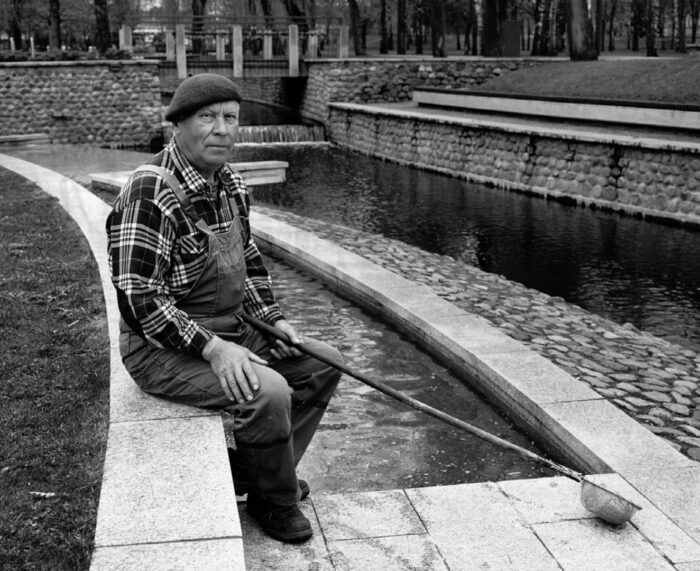
And how did you find the specific people? Leafing through the book, one gets the impression that you gathered the archive simply by walking around with a camera, letting moments find you. Take this photo, for example (points to a fountain attendant). I imagine you sitting, enjoying the view, and the attendant comes over to work—and you photograph him. Was that so?
It wasn’t nearly that spontaneous. First, I made lists—through acquaintances, what they do, whom they knew. The circle slowly expanded. I always try to approach people in advance, unless I already know them well. I first explain the idea, we agree on how to do it. If I know what I want to photograph but don’t know anyone in that profession, then I approach a service, municipality, or institution. I explain what I’m doing and usually get recommendations on whom to contact. That’s how I found quite a few people. I tried to photograph in as many places in Lithuania as possible, though most photos are from Vilnius and Vilnius district.
-
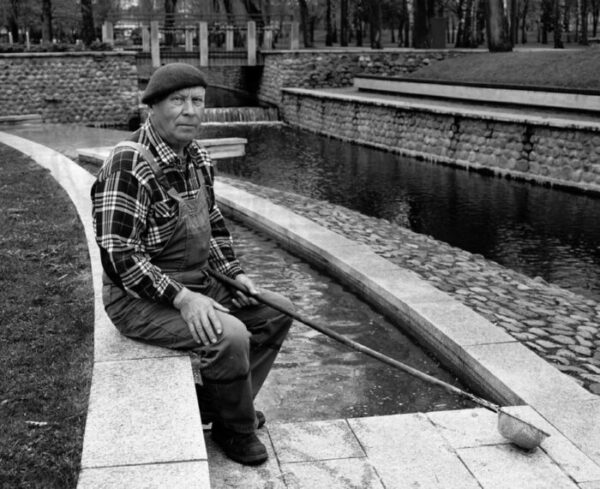
- Fountain attendant Albinas Marijampolė, 2017. Photo by A. Baltėnas
What was the most important criterion in choosing the subjects?
Professionalism. Everyone who appears in my archive is a professional who knows their work very well and performs it with great pleasure. Their work is extremely important to them, even if it seems mundane at first glance. I want to show that no matter what people do, they deserve respect because they approach their work responsibly. Some people become almost invisible—cleaners, cashiers—yet their work is important. We don’t think about that.
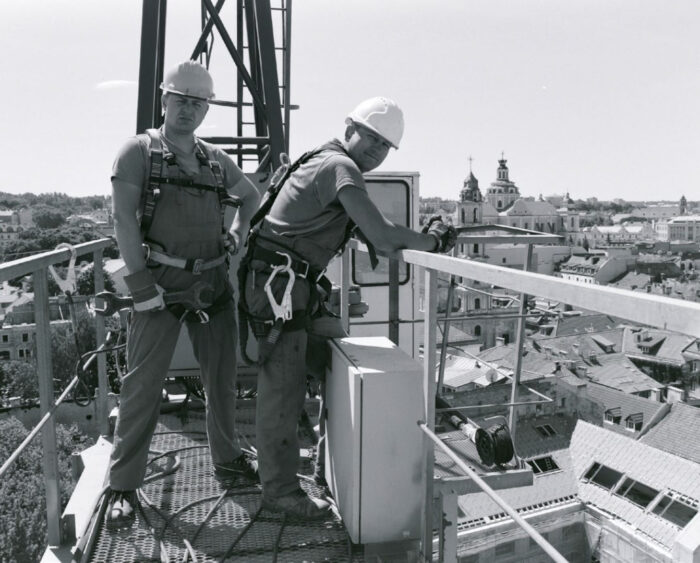
For one photo you even climbed onto a construction crane. Which shots required the most ingenuity or courage, and which surprised you the most?
The hardest to photograph were the Aro police unit and border guards—mostly because of procedural hurdles. I couldn’t manage to photograph the Special Operations Forces soldiers at all. As for surprises—it’s hard to surprise me. I’m a professional; everything is planned, nothing is accidental. What surprises me is the enthusiasm of the people I photograph—their dedication, professional knowledge, their thoughts and skills. That doesn’t always come through in the photos.
-
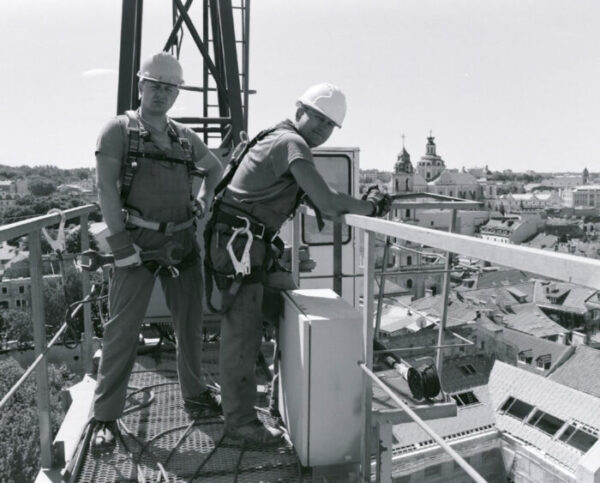
- Tower crane installers Ernestas G. and Rokas B. Vilnius, 2016. Photo by A. Baltėnas
Combining portraits with short first-person accounts gives the book intimacy and authenticity. How did you decide to pair image and text?
From the very beginning I knew the photographs needed to be accompanied by text. A photograph without text is mute—it feels like something is missing. A photograph already reveals a lot, but when building an archive, a short text adds crucial information—things the image alone cannot say. In a book, this can sometimes feel visually distracting, but I believe that as one looks, one should read as well. A short photographic sketch.
These stories indeed open another layer—they let us see familiar jobs differently, understand that we may not know everything, and discover those we seldom think about.
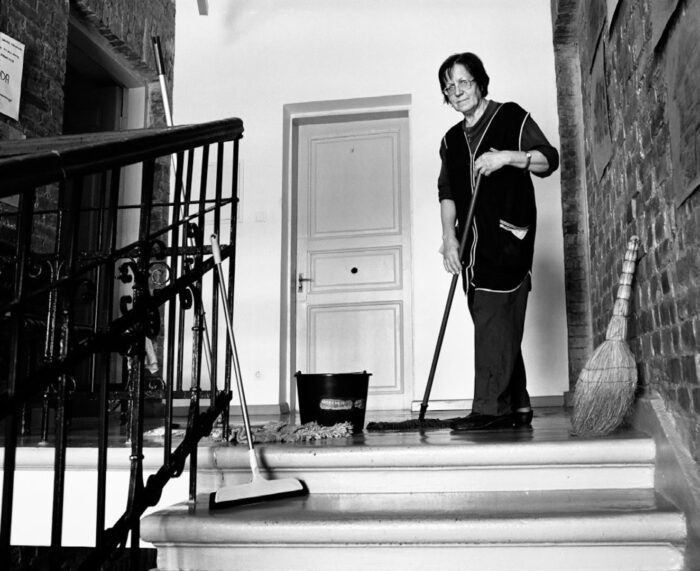
A good example is the cleaner at the Justinas Vienožinskis Art School in Vilnius. Her wonderful account describes how she prepares, how she cleans, how she thinks everything through. In a short text you see her attentiveness and attitude toward a job that is transient and unnoticed—after a few hours, children arrive and everything seems undone. Yet she returns again the next morning at six and starts over. Such examples surprise and inspire us to take our own work seriously.
-
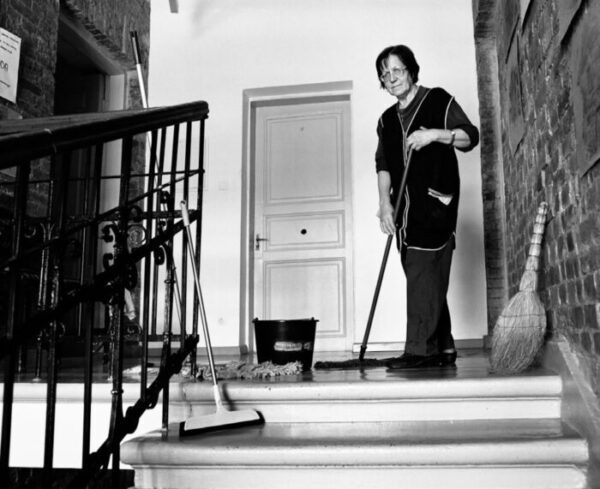
- Cleaner Regina Ž. Vilnius, 2016. Photo by A. Baltėnas
I would also single out the microsurgeon’s story. The photo shows only doctors in white coats, not even in their operating environment because the rooms are sterile and operations are constant. And what would we see there? Faces covered by masks? A few sentences reveal more than an image. In such cases, the text becomes almost more important than the photo.
How did these conversations happen? Were they written separately, or did they occur during the photographing?
From earlier projects, I learned that if you don’t record things immediately, you lose a lot. You can return later, but it won’t be the same—the authenticity disappears, and you waste time. So these are very real, in-the-moment testimonies. Sometimes just a sentence or two if a person isn’t talkative. Others explain more, and the text becomes longer. The book is not uniform; the texts vary greatly. After all, one could write much more about every profession, but when someone picks up a photo book, they look at the images first, and I don’t expect them to devote too much time to reading. Otherwise it would have to be a different kind of book—with fewer photos and longer stories.
It seems to me that today this book may not feel as important as it will be many years from now, when it will testify to our time for future generations. Some jobs may disappear or change drastically. After all, the photos taken by early 20th-century photographers like Fleury, Znamerovska-Priuferova, or Buračas captured everyday life then—but a century later, they provide invaluable knowledge about that era.
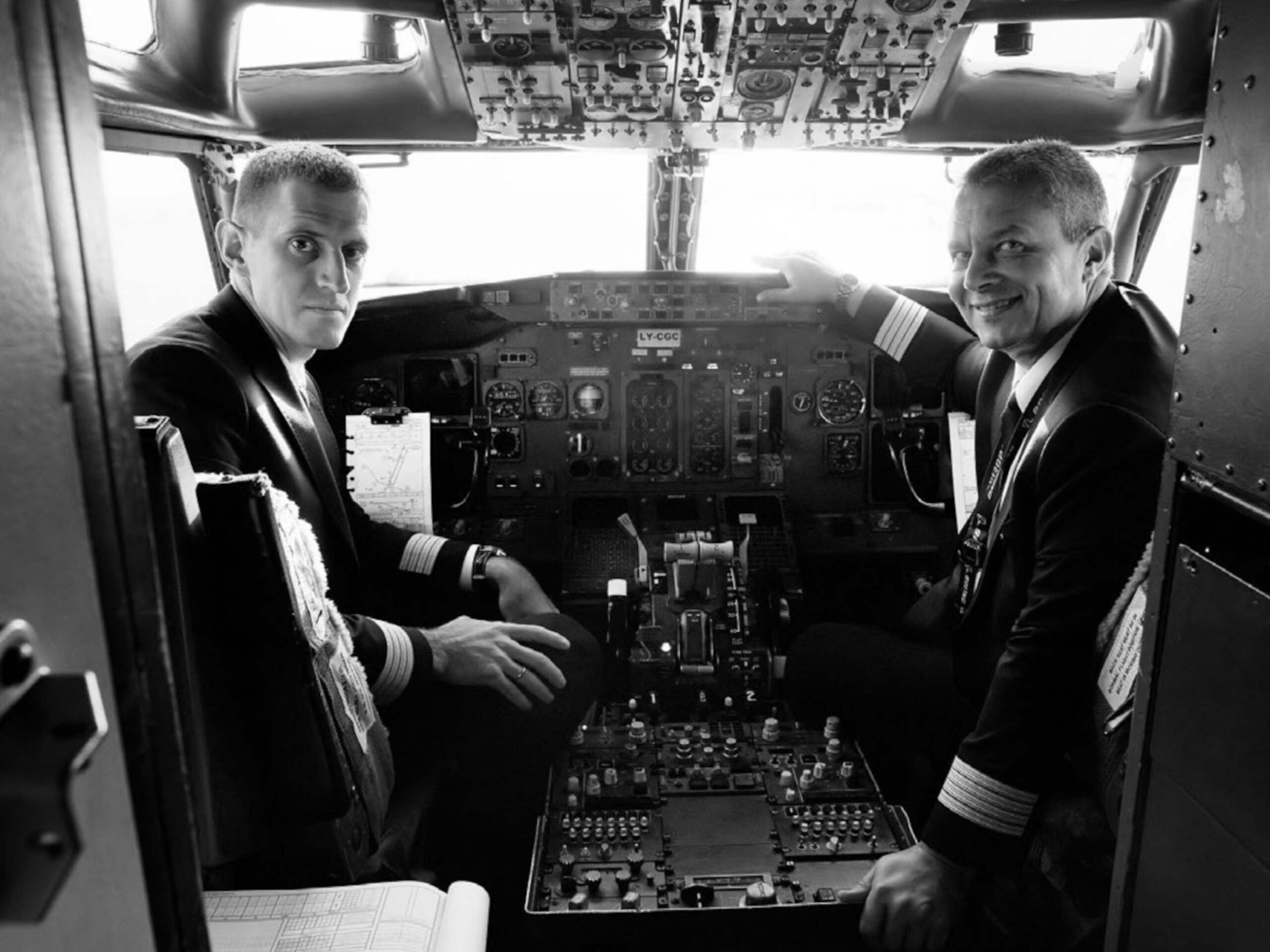
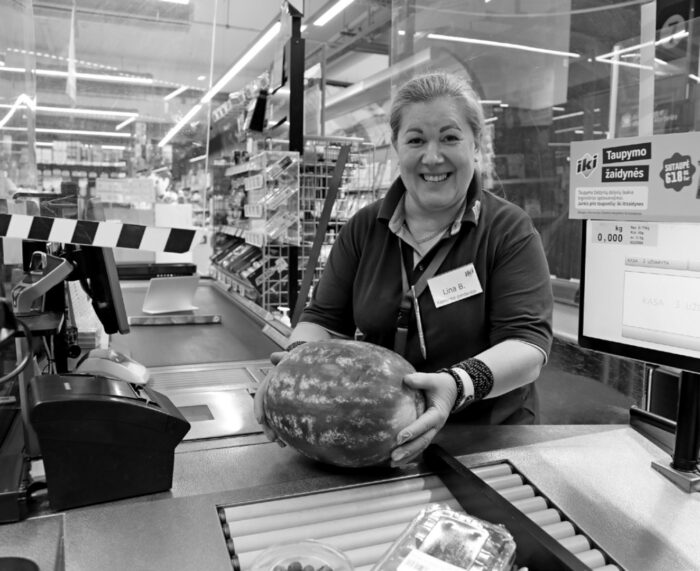
I hope so. And not only these photos—but the entire organized archive of working people’s portraits that I leave behind. It’s even more extensive. Some professions change, but others, strangely enough, hardly do. Blacksmiths, for example—their work hasn’t changed for hundreds of years. There are still many in Lithuania, and there will be for a long time. Aircraft equipment, on the other hand, has changed; the cockpits I photographed may no longer exist. But the chimney sweep will. Meanwhile, some jobs—like supermarket cashiers—may indeed disappear.
The cashier you photographed even expresses joy about interacting with people and asks that people “come to the checkout so there won’t be these robots.”
Yes, she says: “I want to serve people in person.”
-
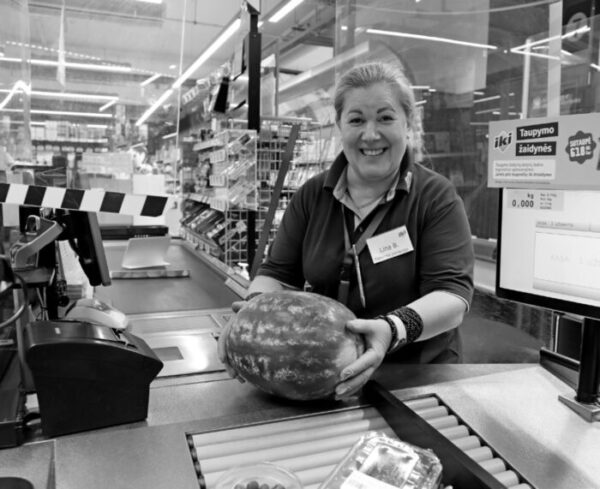
- Cashier-saleswoman Lina B. Druskininkai, 2024. Photo by A. Baltėnas
The documentary nature of the photos gives them lasting value, doesn’t it?
Yes, and beyond that—you inevitably see not only professions but lifestyles, clothing, since not everyone wears special work clothes; some are dressed in everyday wear. And the most important element is the faces. This is anthropology. The portrait of a society changes over time, though we don’t notice it. If we look at photos from the 1970s by Rakauskas, Baranauskas, Sutkus, Kunčius, we’ll see that people’s faces today are different. And even more so in older photos. Because of changes in lifestyle and worldview, new features appear. I think it’s important that after some time we’ll look at these portraits and see how we have changed.
And a final question: what has this cycle given you personally? Has it changed any of your beliefs or broadened your perspective? What do you take away from it?
I feel that I’ve done important work, and I thank Providence for allowing me to do it. Those encounters, the personal connection with the person being photographed, are extremely important to me. I met so many people and discovered many different worlds.
Interview by Živilė Stadalytė (National Museum of Lithuania)
The newest photography book by Arūnas Baltėnas, From Monday to Sunday, published by the National Museum of Lithuania and the “Baltėnas Archives,” is available in the museum’s online store and ticket offices. The book launch and meeting with the author will take place on December 3 at 6 p.m. at the National Museum of Lithuania’s House of Histories, T. Kosciuškos St. 3, Vilnius.
-
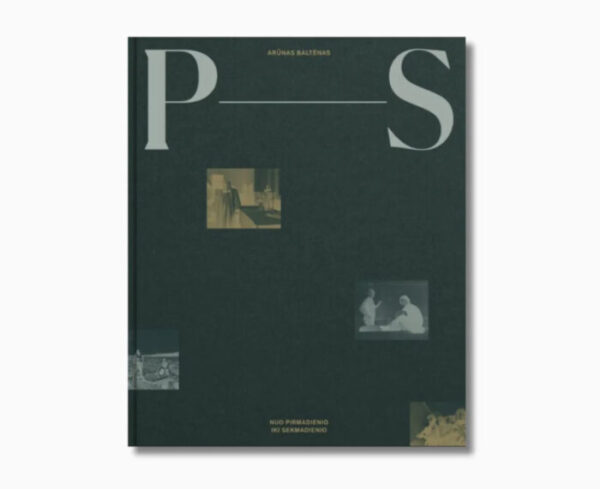
- Arūnas Baltėnas’ photography book “From Monday to Sunday”