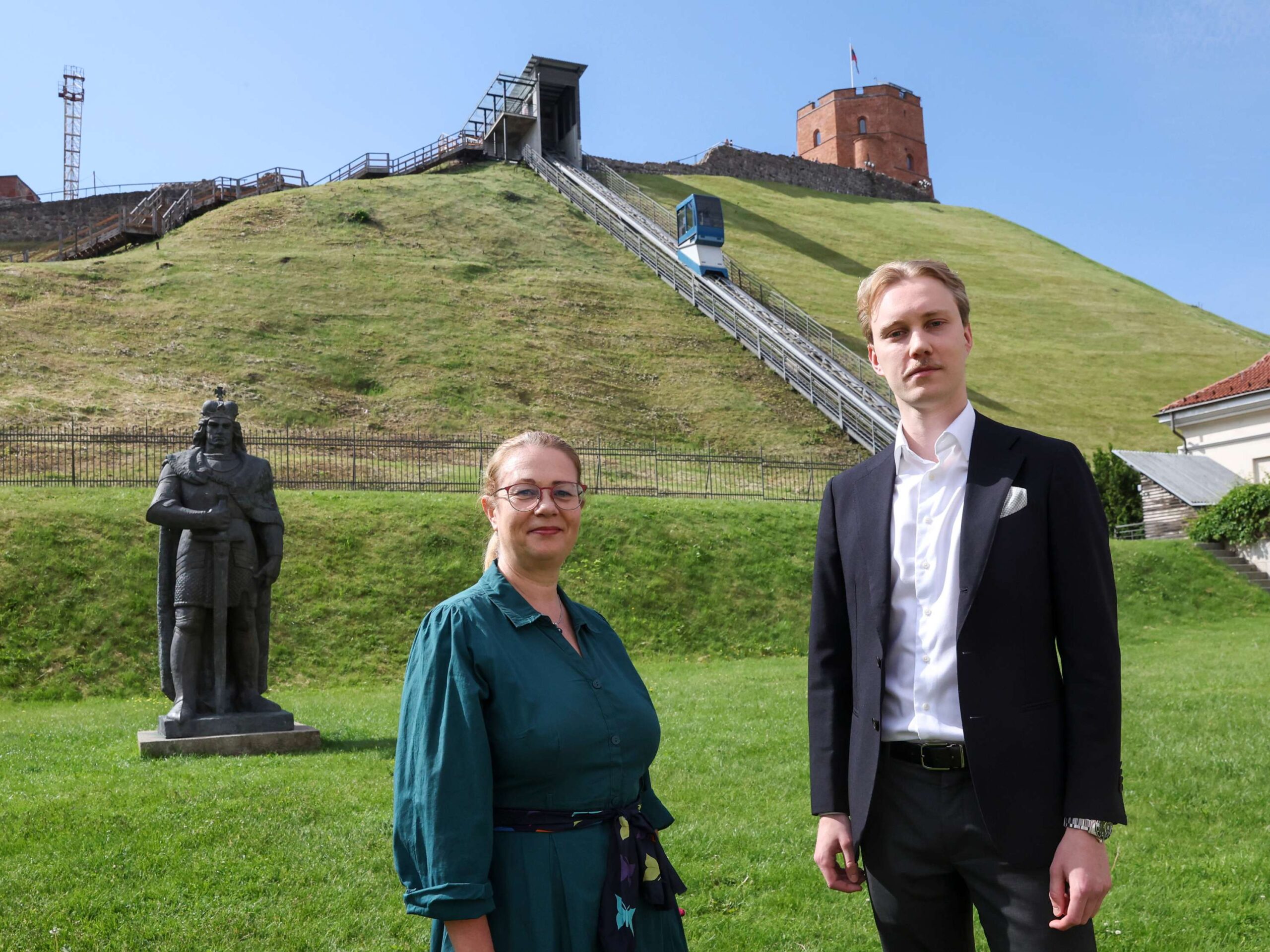
A “unique sensation” – the 15th-century Madonna of Laukžemė, exhibited at the Kazys Varnelis House-Museum of the Lithuanian National Museum
2025 09 09
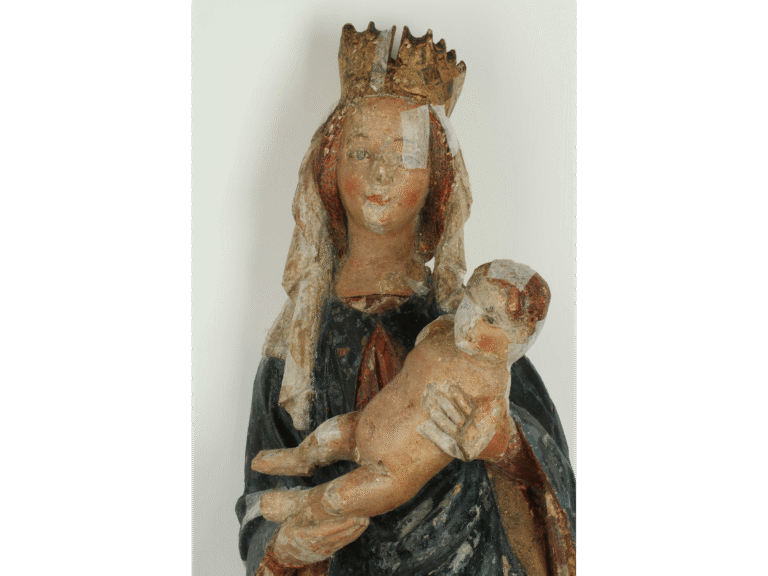
From September 10, visitors to the Kazys Varnelis House-Museum at the Lithuanian National Museum (LNM) will be able to see an extraordinary exhibit – the Gothic Madonna of Laukžemė, the oldest surviving wooden sculpture in Samogitia, dating from the early 15th century. There are only a few such old sculptures left in Lithuania, while there are more of them in Europe. Visitors to the exhibition will learn not only about the history of the sculpture’s discovery, but also about the specifics of the restorer’s work. The restoration process at the LNM took more than 10 years.
An exceptional sculpture
“Very few Gothic sculptures have survived in Lithuania after all the upheavals, wars, and disasters. And here we have a work whose existence was unknown, complete with authentic 15th-century polychromy. In the field of our culture, this is something of a sensation,” emphasizes one of the exhibition’s curators, art historian Dr. Lijana Birškytė-Klimienė. According to Dr. Rūta Kačkutė, Director General of the LNM, the exhibition of the Madonna of Laukžemė at the LNM Kazio Varnelis House-Museum is not only an extremely important historical event, but also proof of the meticulous work and dedication of the professionals at the museum’s Restoration Center. “I am extremely proud that the team at the Lithuanian National Museum has done such meticulous work. The opening of the exhibition will allow the public to see this unique exhibit, learn about the history of its discovery, become familiar with the features of Gothic wooden sculptures, and appreciate the importance of the team’s work,” says Dr. R. Kačkutė.
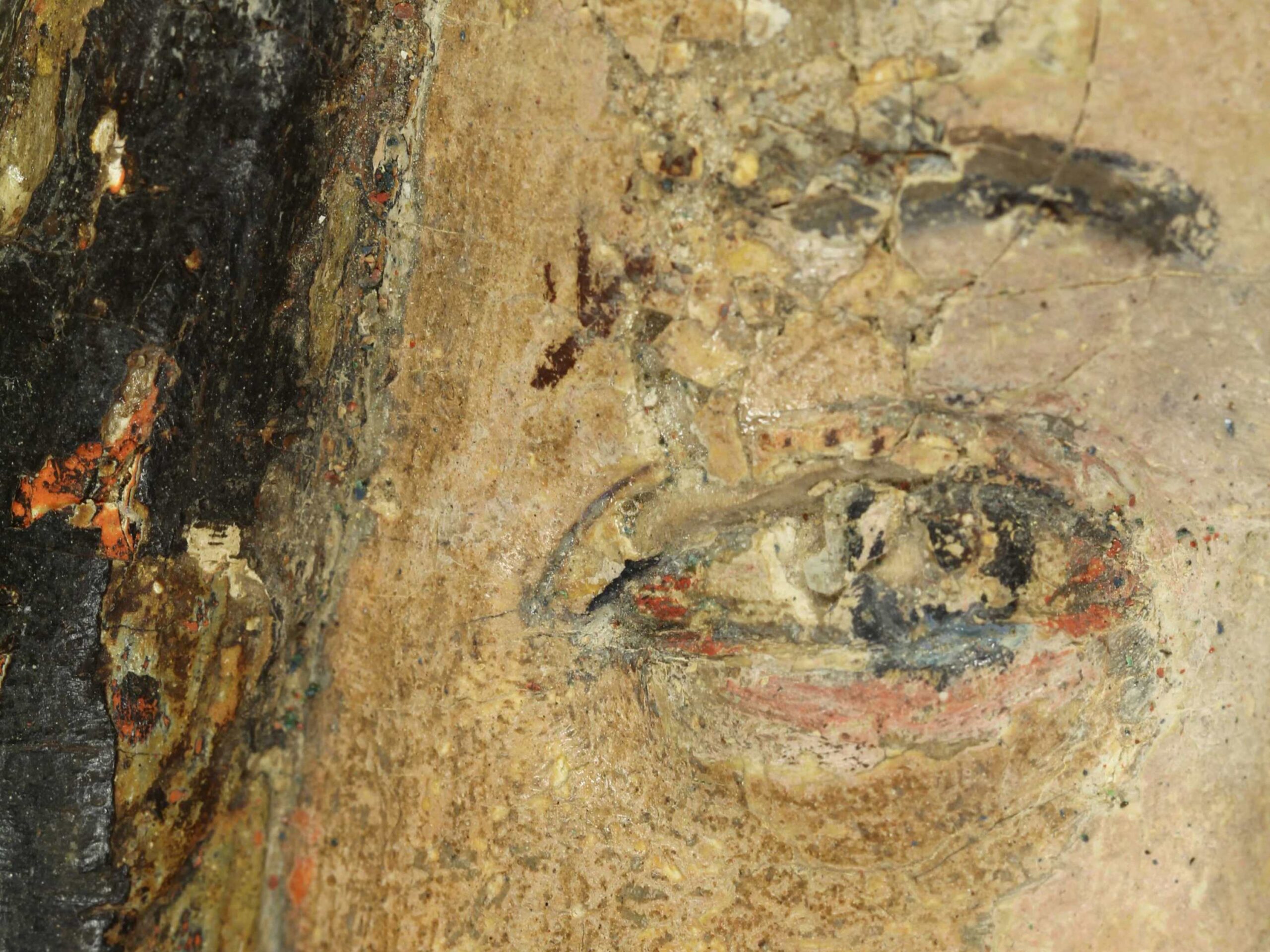
-
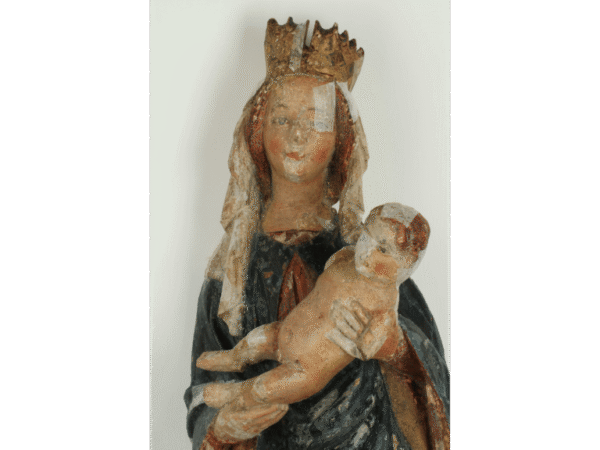
- The paint layer is reinforced with micaceous paper. Photo: LNM Restoration Center
A cinematic story of discovery
In the early 1990s, as Lithuania was preparing to restore its independence, research into sacred art finally became possible, so art historians Marija Matušakaitė, Ina Dringelytė, and Algė Gylienė, searching for valuable ecclesiastical heritage for a book they were preparing, went on expeditions around Samogitia. After stopping at the Church of St. Andrew the Apostle in Laukžemė and examining the altar, they saw a sculpture of the Madonna in a wall clock cabinet in the vestibule, covered with artificial flowers and draped with a curtain. The pointed toe of a Gothic shoe peeked out from under it – a detail that immediately aroused curiosity about the age of the sculpture. Art historian M. Matušakaitė realized that this sculpture was a unique discovery. “When the cloak was removed from the shoulders, the folds of the Gothic garment fell down in plastic cascades… The whole composition became clear – a gracefully standing Madonna with the Baby in her arms,” recalls art historian Ina Dringelytė.
The road to the Lithuanian National Museum
For many years, only a small circle of specialists knew about the discovery: M. Matušakaitė published articles in scientific journals and the cultural press. While preparing for an exhibition dedicated to the 600th anniversary of the baptism of Samogitia, L. Birškytė-Klimienė remembered this discovery and asked the then Bishop of Telšiai, Jonas Boruta, for help in borrowing the sculpture for the exhibition. “The bishop was surprised because he had never heard of the Madonna of Laukžemė. Finally, the Madonna of Laukžemė was brought to Vilnius. As it happened, we did not display it at the exhibition, but a photograph of it did end up in the exhibition book,” recalls L. Birškytė-Klimienė. According to the exhibition curator, who was working at the LNM at the time, the aesthetic appearance of the sculpture was poor.
“It was painted with oil floor paint, the colors of which did not quite match the canon of church art. There were also those who doubted whether it could be Gothic at all,” says L. Birškytė-Klimienė.
A meticulous restoration process
The restoration of the sculpture was undertaken by the LNM Restoration Center. At first, there was no shortage of skepticism. Although the features of Gothic sculpture were visible, according to restorer and one of the exhibition curators Vita Blažiūnienė, there were those who believed that this sculpture could be a copy of a Gothic sculpture.
-
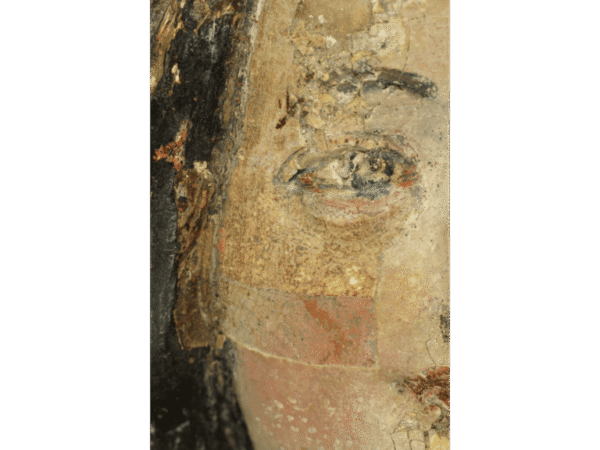
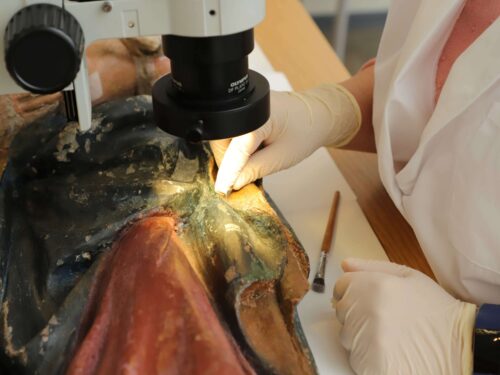
- Fragment of a sculpture undergoing restoration. Photo: LNM Restoration Center
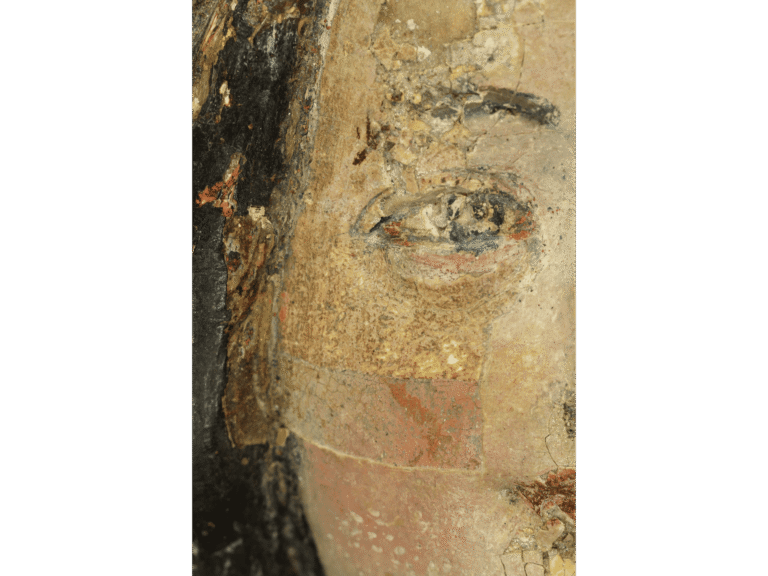
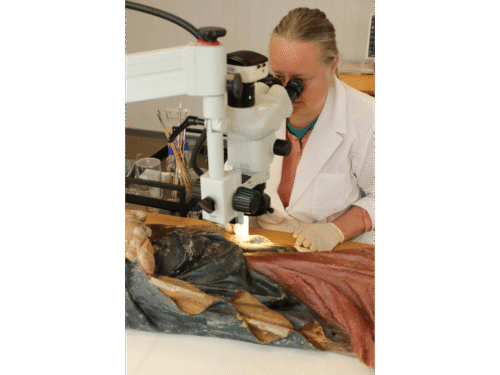
“We searched for Gothic elements millimeter by millimeter. Only as we worked did we gradually discover the bottom layer. When we saw it, our doubts about Gothic disappeared,” recalls V. Blažiūnienė. During the initial investigations, it was difficult to identify all the layers of paint, because, for example, the Madonna’s eyes were covered with as many as six layers, covering the finest details of the carving, and in some places on the sculpture, as many as 12 layers of paint were found. These layers were removed under a microscope using a needle scalpel. “Gradually, the authentic polychromy was revealed – the Madonna’s red cheeks, chin, and golden hair. Additional research confirmed the authenticity of the paint layer, allowing us to conclude that the sculpture is indeed from the 15th century. The restoration work, which took more than 10 years, is a process that requires meticulousness, attention to detail, and professional expertise, and restorer Ieva Stanionienė, with the help of her colleagues, has completed the work of her life,” says V. Blažiūnienė.
Artistic and historical value
Art historian L. Birškytė-Klimienė emphasizes that the sculpture is not only a work of high artistic value, but also an important testimony to the first steps of Western art in Lithuania after its conversion to Christianity. It is attributed to the Gothic style, which is presented in an exhibition at the Kazys Varnelis House-Museum of the National Museum of Lithuania. “Even in Western Europe, authentic polychromy is a rare find – it usually did not survive well and was repainted many times over the centuries, causing the original colors to disappear. They have been preserved in the Madonna of Laukžemė, and this is priceless,” says Dr. L. Birškytė-Klimienė.
Discover Gothic
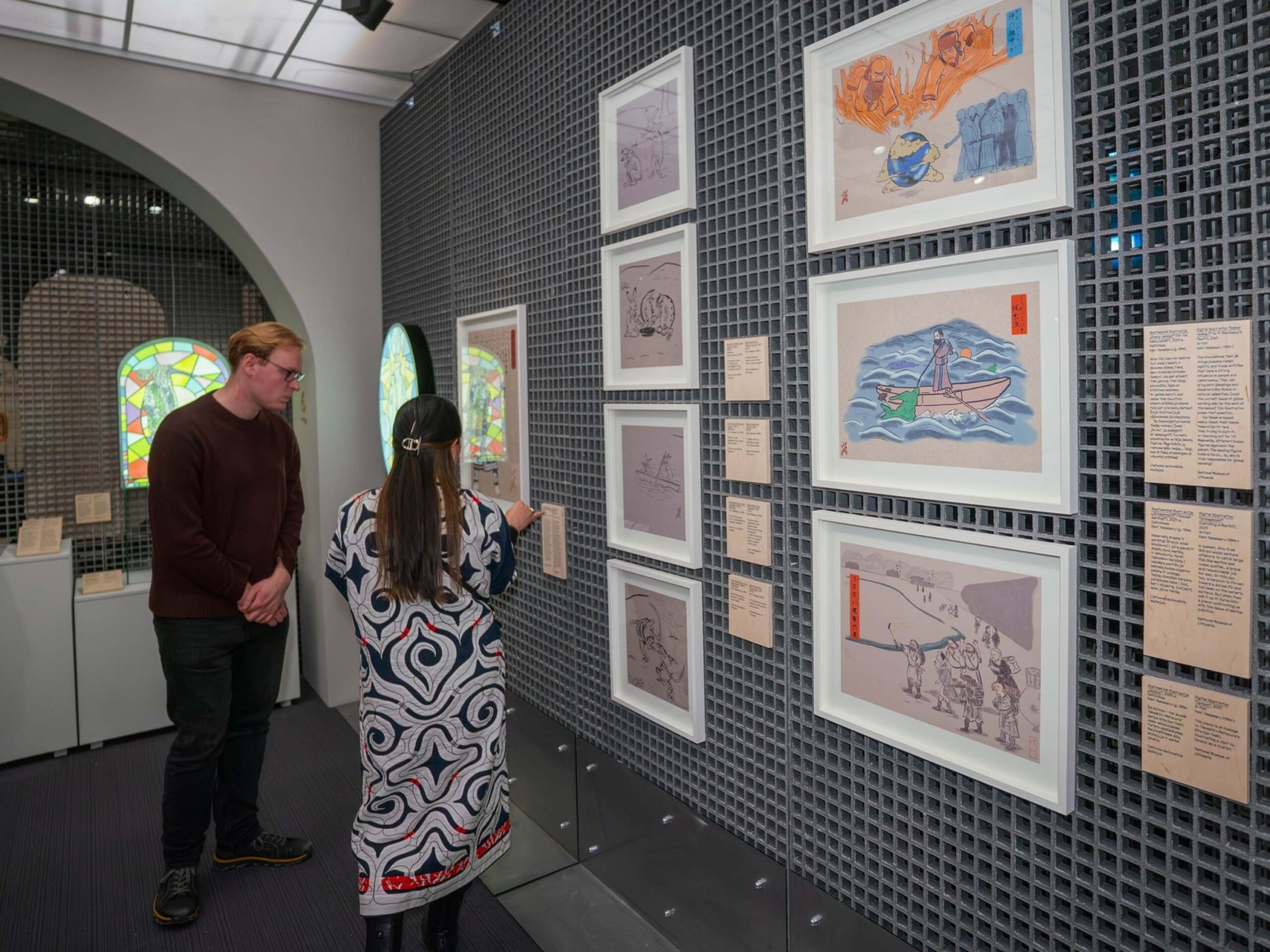
Visitors will not only see the Madonna of Laukžemė itself, but will also be able to learn the intriguing story of the sculpture’s discovery, learn to recognize Gothic sculpture, and get a feel for the specific work of art historians and restorers.
“In the context of such a discovery, not only restorers are involved, but also historians, chemists, art historians, and technologists. “In the context of such a discovery, not only restorers but also historians, chemists, art historians, and technologists are involved. We want visitors to feel like scientists when they sit in the restorer’s chair,” invites V. Blažiūnienė. One of the main goals of the exhibition is to help the public deepen their knowledge of art and Lithuanian cultural history.
The exhibition “Madonna of Laukžemė. Unveiling 600 Years of Secrets” will open on September 10 at 5 p.m. at the Kazys Varnelis House-Museum (Didžioji g. 26, Vilnius). The curators of the exhibition are art historian Dr. Lijana Birškytė-Klimienė, restorer Vita Blažiūnienė from the LNM Restoration Center, and exhibition architect and visual identity designer Justinas Dadonas. The exhibition is financially supported by the Ministry of Culture, in partnership with the Kretinga Museum and JCDECAUX Lietuva.
-
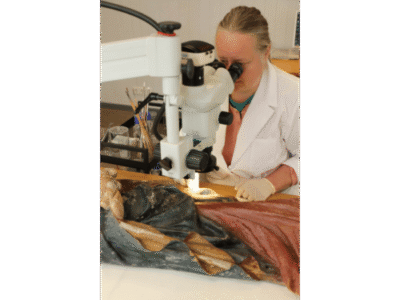
- The sculptures required detailed research. Photo: LNM Restoration Center
-
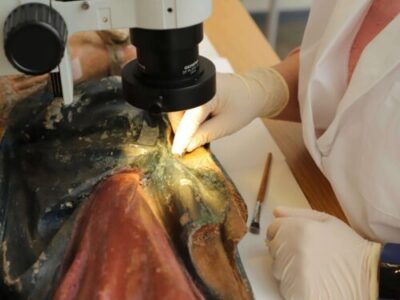
- A moment during the examination of the sculpture. Photo: LNM Restoration Center