Return After a Century: Academic Attire of Piotr Skarga Rediscovered
2025 02 04
At the end of last year, two Lithuanian museums received an extraordinary gift: research confirmed that a hooded cape housed at the Lithuanian National Museum of Art and a biretta (ceremonial cap) kept at the National Museum of Lithuania once belonged to the ceremonial academic attire of Piotr Skarga, the first rector of Vilnius University. These relics, preserved for more than 400 years despite the trials of history, were last seen together in 1936 before vanishing from public view for decades. Although the location of the third piece of the ensemble—the toga—remains unknown, the rediscovered garments are expected to be displayed to the public again this spring.
The groundbreaking research, which led to these revelations, was conducted by Dr. Miglė Lebednykaitė, Head of the Department of Ethnic Culture and Anthropology at the National Museum of Lithuania. Her work not only demonstrates the professionalism of Lithuanian scholars but also reminds us of the invaluable cultural treasures that have been preserved despite historical challenges.
The Rector’s Ceremonial Robe: Rich and Majestic
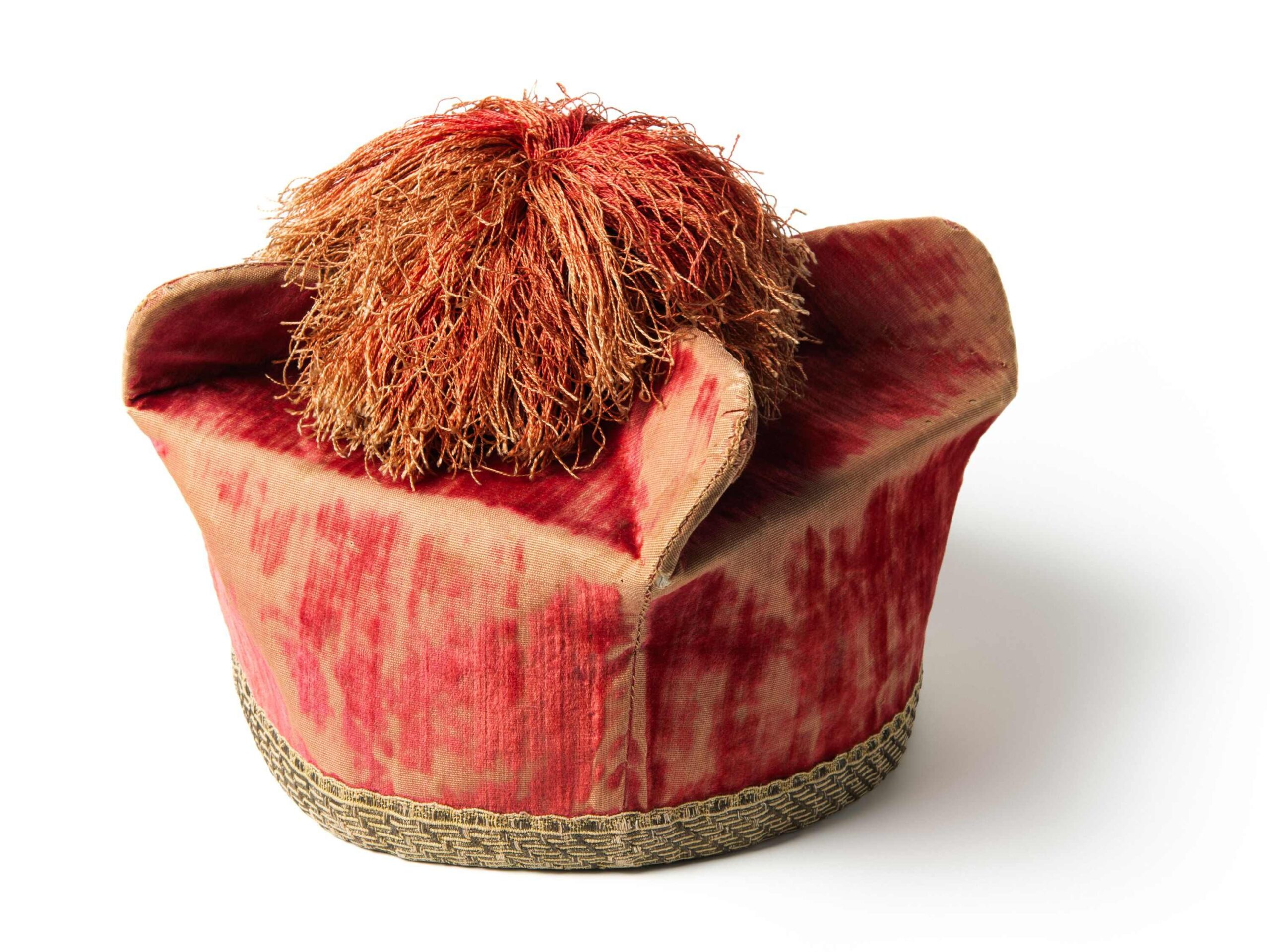
The ceremonial rector’s attire consists of three parts. The toga once worn by Skarga was made of red velvet. Draped over the shoulders down to the elbows was the hooded cape (worn over the toga), trimmed with golden braid, fastened with golden loops and clasps, and made from the same red velvet as the toga, with a white silk lining. Completing the outfit was the rector’s headwear—a small, “crowned” cap known as a biretta. This light red velvet cap is edged with golden braid and topped with a silk tassel of the same color.
-
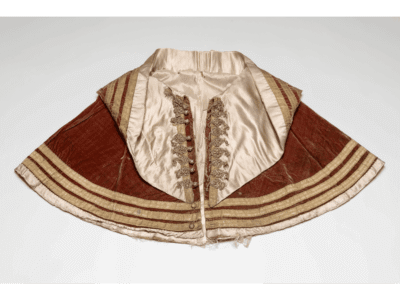
- Hooded Cape of Vilnius University Rector Piotr Skarga, Late 16th c. Photo by A. Lukšėnas, LNDM
-
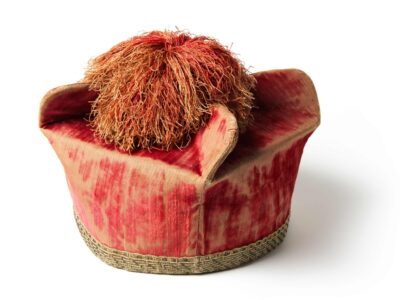
- Biretta of Vilnius University Rector Piotr Skarga, Late 16th c. Photo by G. Trečiokas, LNM
“Every element of the rector’s attire — its fabric, color, and detail — was deeply symbolic, emphasizing the rector’s high status and duty to honor the legacy of his distinguished predecessors. The cape represented his responsibility to diligently and attentively care for the entire university community, while the biretta symbolized his wisdom in fulfilling his duties and in representing the university with honor,” explains the author of the study, M. Lebednykaitė.
During academic ceremonies, such attire symbolized the inner structure of the university and the members of its community — the rector, professors, and doctors of science. The ceremonial rector’s garments were also worn on special occasions, such as when receiving kings and members of their families at the university, at the opening of a new academic year, or during doctoral conferment ceremonies.
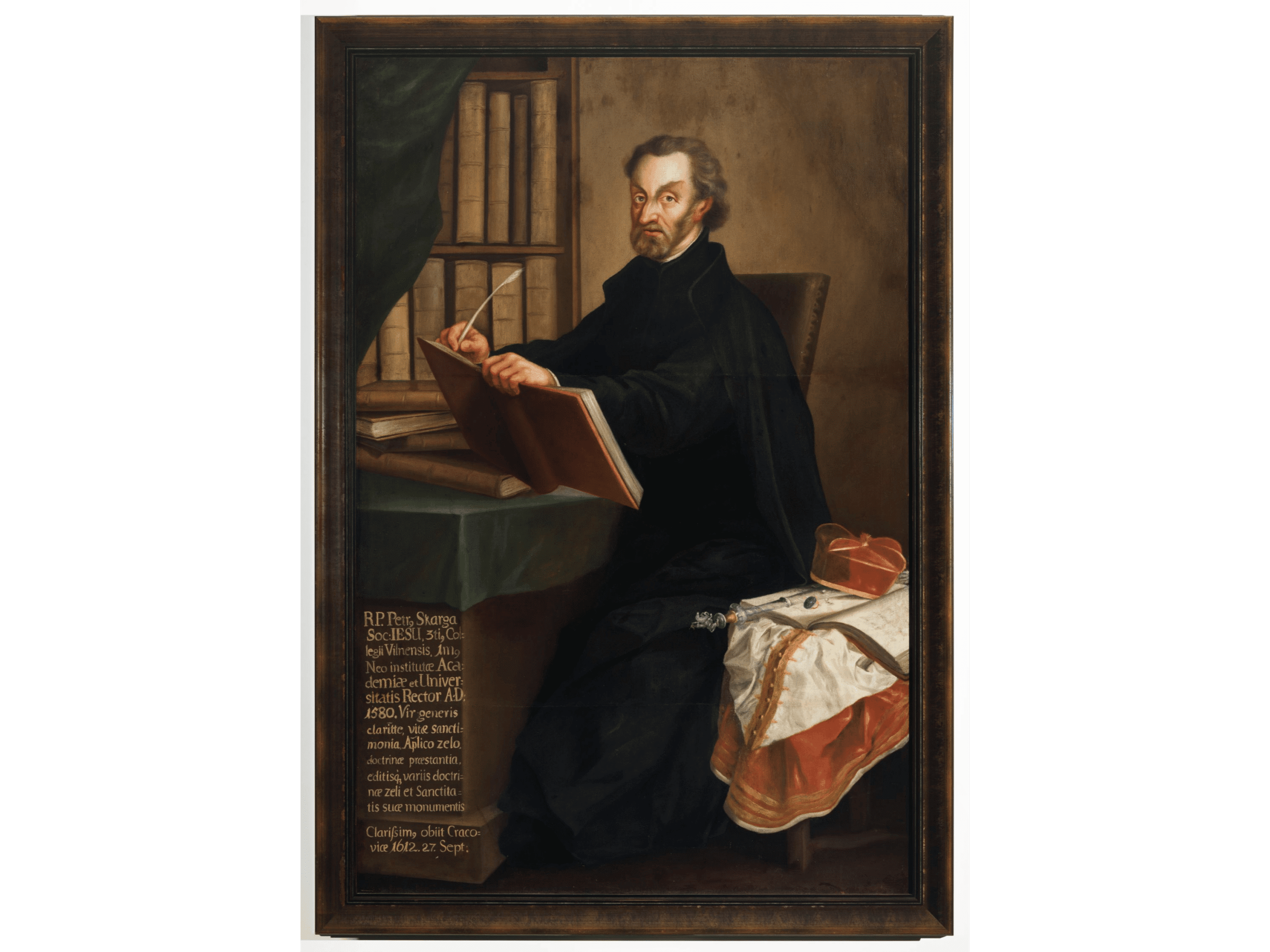
These garments can also be seen in a portrait of Piotr Skarga, painted by an unknown artist in the first half of the 17th century and preserved at the National Museum of Lithuania. Among the many insignia depicted — including the university scepter symbolizing its rights and freedoms, a signet, and an open book of Statutes — parts of the rector’s academic ceremonial attire, namely the cape and the four-cornered biretta, are shown resting on a stool.
“This is one of the earliest known iconographic depictions of Vilnius University’s insignia. The cape is rendered with striking precision — details of its fastenings and gold braid trim are clearly visible. The evident similarity in decoration and proportions between the painted garment and the authentic cape attributed to Skarga suggests the portrait was painted from life,” says M. Lebednykaitė.
It is assumed that the university’s scepter and the toga with cape for its first rector may have been gifted by the ruler Stephen Báthory. However, no historical documents confirming such a donation have survived. According to the researcher, the story of the first rector’s toga was embraced by the academic community of the interwar Stefan Batory University in Vilnius, and, together with the preserved artifacts, has reached us today.
FOTO
-
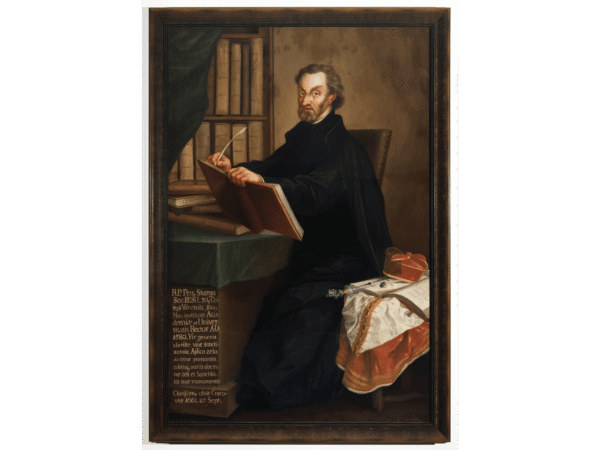
- Early 17th-century painting depicting the first rector of Vilnius University, Piotr Skarga, and elements of his academic attire. Photo by G. Trečiokas, LNM
Hidden from Deportation to Moscow
Until now, the fate of Piotr Skarga’s ceremonial academic attire following the closure of the university had not been thoroughly studied. The research conducted by M. Lebednykaitė helped trace the lost threads from turbulent times and recover the missing—but never truly lost—parts of the rector’s outfit.
“According to tradition, ceremonial academic garments were passed down from one rector to the next. However, after the suppression of a two-year uprising, Vilnius University was closed in 1832, and the dismantling of its library, archives, museum, and academic collections began. Nonetheless, analysis of the gathered data shows that, unlike the scepter and signet which were taken to Saint Petersburg, P. Skarga’s ceremonial academic attire remained in Vilnius and was preserved as a relic in the treasury of Vilnius Cathedral,” says M. Lebednykaitė.
The university remained closed until 1919, when, after the annexation of the Vilnius region by Poland, it was reestablished as Stefan Batory University (Uniwersytet Stefana Batorego). During the interwar period, Skarga’s ceremonial attire was once again remembered and exhibited during major university celebrations—in 1919, 1929, and 1936.
By studying iconographic and historical sources, researchers were able to trace the relics’ history up until 1936—the last time they were known to have been seen together.
According to the researcher, the trail likely went cold with the outbreak of World War II. As church assets were nationalized, the garments found their way into museum collections, where their provenance was not clearly identified:
“It was a time of upheaval—many things were misplaced or forgotten. But today, we can confidently identify two of the three parts of Skarga’s ceremonial academic attire. With the discovery of new iconographic sources and detailed descriptions from historical records, it’s evident that the surviving items match precisely what we now have. Until recently, this certainty was lacking,” she explains.
From Cowl to Cape, from “Confederatka” to Biretta
The researcher sent the Lithuanian National Museum of Art the earliest known photograph of Skarga’s toga, cape, and biretta, published in 1912 in the Vilnius-based periodical Litwa i Ruś. This helped identify one exhibit as remarkably similar to the most ornate part of the rector’s ensemble—the cape.
Upon closer investigation, it was found that this item had entered the collection of the then Vilnius State Art Museum in 1953 as part of a transfer of liturgical garments from the treasury of Vilnius Cathedral. In the initial inventory records, the item had been listed as a “head covering – cowl.”
“After examining the item, it became clear that it was indeed a surviving part of Skarga’s ceremonial academic attire—a cape dating to the late 16th century. Based on the recovered iconographic material, a near-complete match was confirmed in terms of fabric and ornamentation. Even a missing button is the same one not visible in the 1912 photograph, when the garment was still kept in the cathedral treasury,” explains M. Lebednykaitė.
The other item whose provenance was confirmed during the investigation is the rector’s biretta. For a long time, this biretta had been preserved at the National Museum of Lithuania and displayed in the New Arsenal, alongside the aforementioned portrait of Piotr Skarga.
“This cap entered the museum under the label ‘confederatka’ and for a long time was exhibited as the ‘biretta of the rector of Vilnius University’. It had long been suspected that it could be Piotr Skarga’s own cap, but only now can we say so with certainty, thanks to a thorough analysis of historical sources and iconography,” says M. Lebednykaitė.
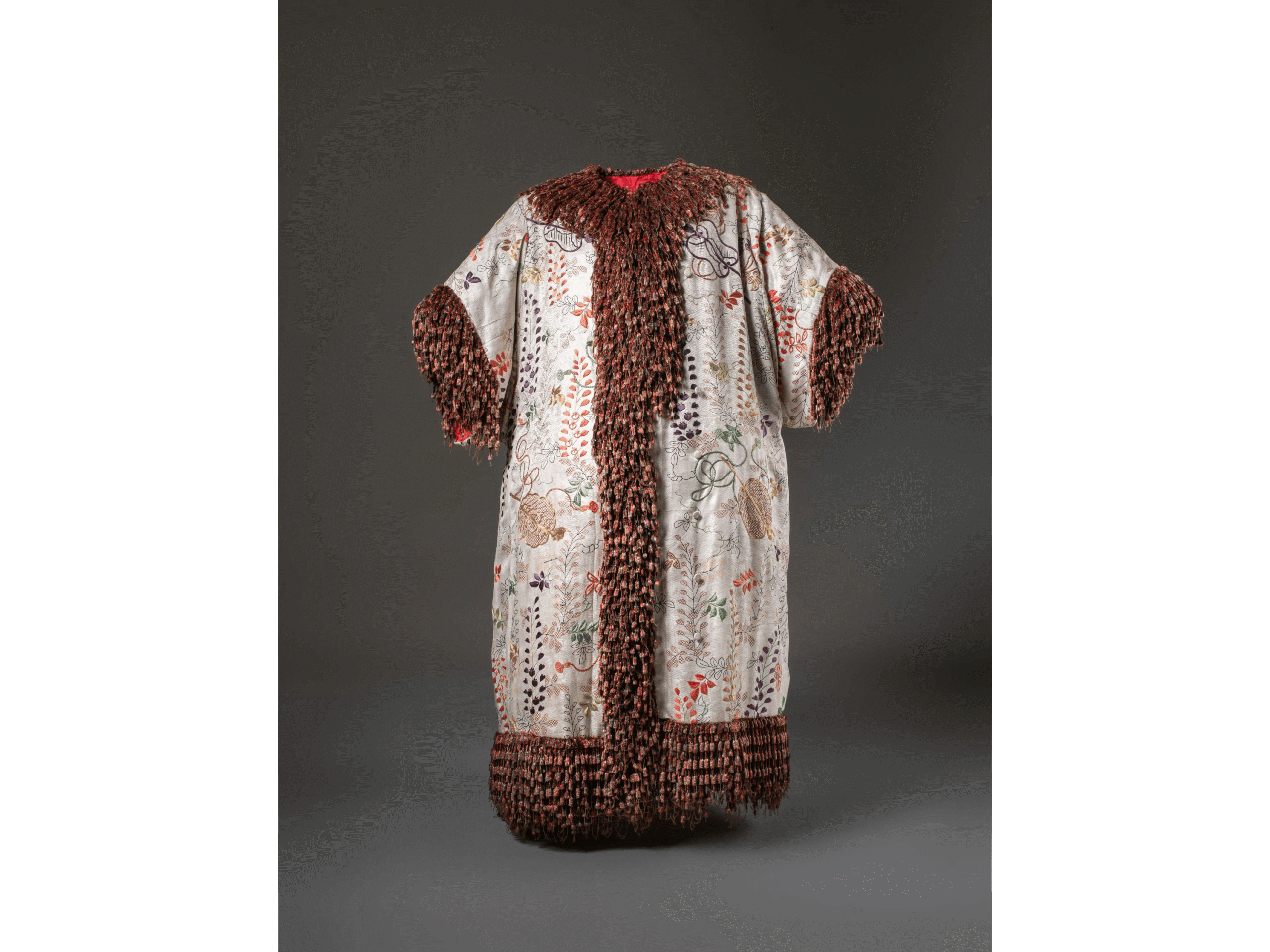
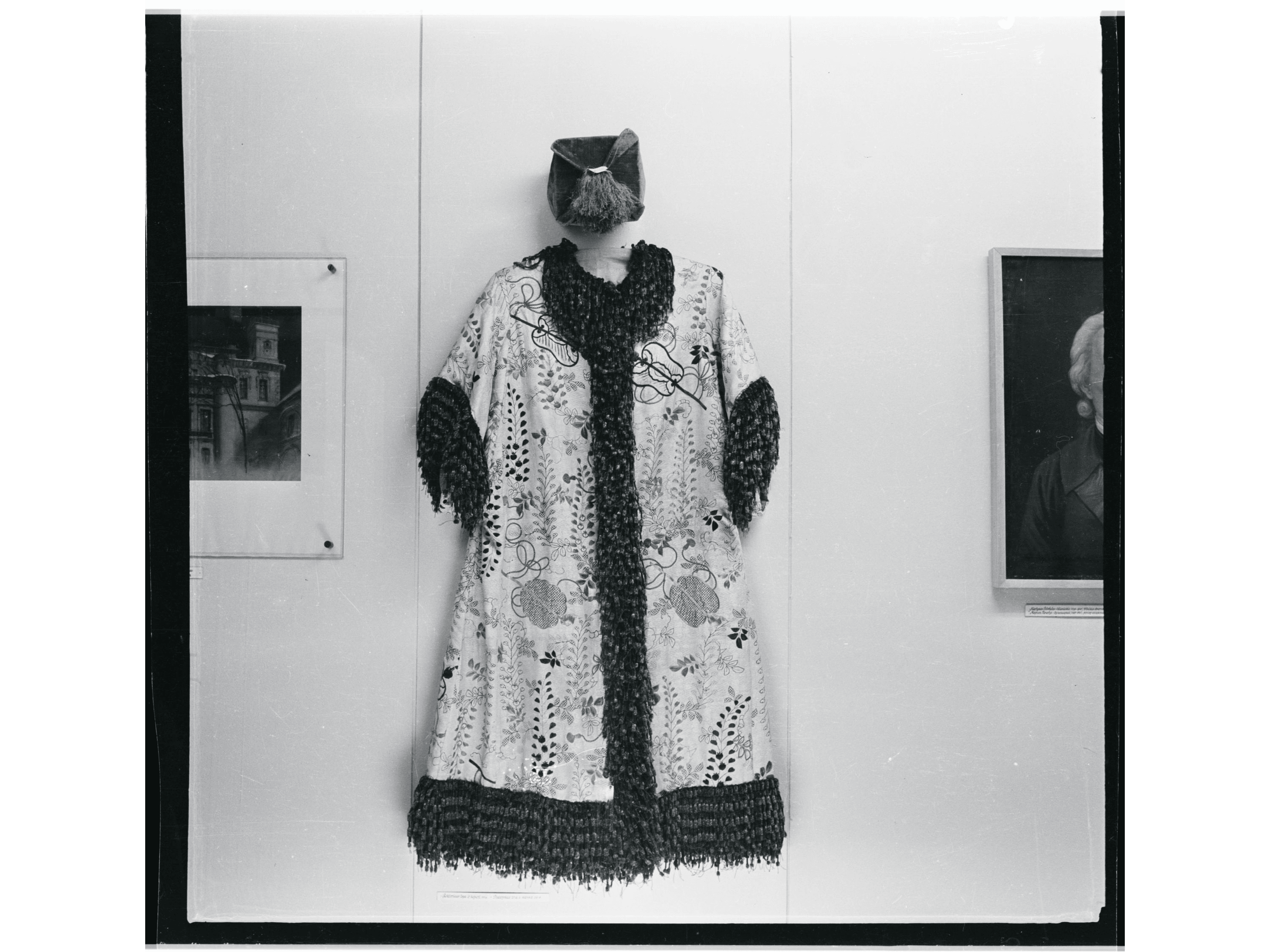
The study also definitively refuted the origin of a robe previously believed to be the rector’s toga, which had been kept at the National Museum of Lithuania and associated with Vilnius University in the 1950s and 1960s. It was identified as a women’s garment in the Japonisme style. Thus, the current location of Skarga’s toga remains unknown.
M. Lebednykaitė acknowledges that the study did not uncover any clues explaining why the trail of the garments was lost once they entered the museums:
“We have no answers. Perhaps they’re still waiting somewhere to be rediscovered. But I wouldn’t rule out the possibility that the true origin of these items was deliberately concealed. The person who handed them over may have kept silent in order to suppress national identity. Or perhaps the museum staff who accepted them intentionally chose not to describe them in detail, providing added protection through secrecy in uncertain times. It’s hard to say what exactly happened.”
The Role of Museums in Academic Research
According to Dr. Rūta Kačkutė, Director General of the National Museum of Lithuania, the rediscovery and reintroduction of Piotr Skarga’s academic attire to the public eye is a significant event that underscores the continuity and resilience of Lithuanian culture in the face of historical upheavals: “This discovery reminds us not only of the museum’s role in safeguarding and researching our cultural history but also of the importance of inter-institutional collaboration. The four national museums in Lithuania together house around 2.3 million artifacts, with the National Museum of Lithuania holding nearly 1.5 million. These collections are not only a reflection of our shared history but also a source of countless undiscovered mysteries. Researching them continually brings new insights into our past.”
She adds that simplifying conditions for academic recognition would open the door to more discoveries, including a continued search for Skarga’s missing toga: “Museums have the unique ability not only to conduct academic research but also to effectively present its results to the public in engaging ways. We’ve proven this through several projects — last year, for instance, we presented the ‘Vilnius 200 Years Ago’ pavilion, based on five years of research. The rediscovery of Skarga’s attire will also be introduced to the public soon.”
To Be Displayed Again
The National Museum of Lithuania, the Lithuanian National Museum of Art, and Vilnius University have agreed that this rediscovery is a fitting opportunity to revive the tradition of exhibiting the rector’s academic garments.
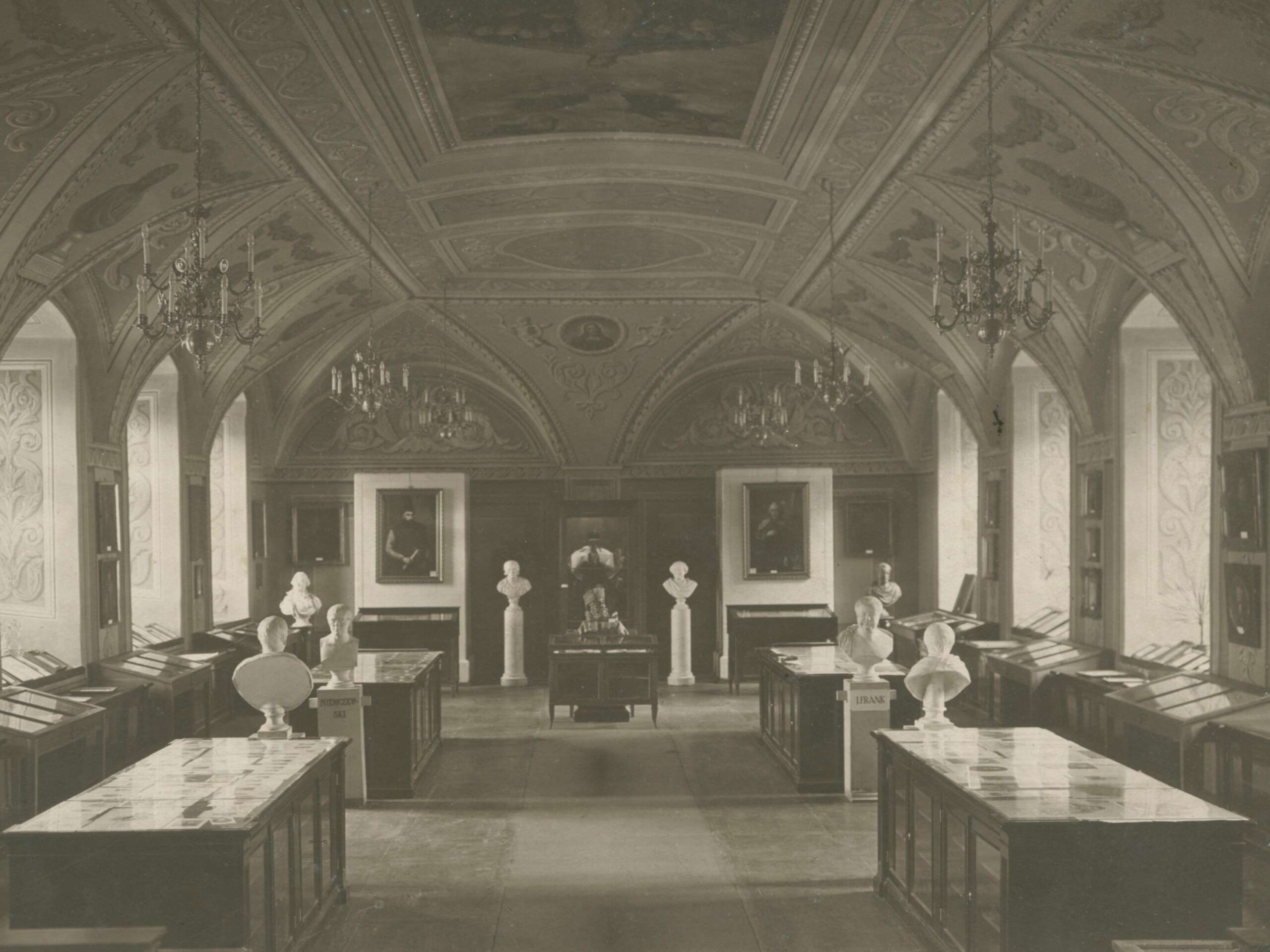
Piotr Skarga’s ceremonial attire was previously displayed in 1929 during the celebration of the 350th anniversary of the university’s founding and the 10th anniversary of its reestablishment. At that time, the reconstructed Franciszek Smuglewicz Hall was also opened to the public. In 1936, during the celebration of Skarga’s 400th birth anniversary, the rector’s attire was again displayed in the same hall at Stefan Batory University.
“Due to various historical upheavals and the resulting losses, the heritage of Vilnius University is widely dispersed. We strive to understand it better and, in this way, reclaim it in our collective memory. Discoveries of this nature are incredibly valuable, as very few artifacts have survived from the earliest period of the university’s history. The identification and exhibition of the first rector’s authentic attire is a powerful testimony to the university’s historical legacy — especially relevant as we approach its 450th anniversary,” says Prof. Dr. Rimvydas Petrauskas, Rector of Vilnius University.
The rediscovered garments will be restored by specialists at the Pranas Gudynas Restoration Centre of the Lithuanian National Museum of Art and the Restoration Centre of the National Museum of Lithuania.
“Although this important discovery is a joyful milestone in the history of Lithuanian culture, higher education, and museology, it also reminds us of the painful events our country has endured. It compels us to view the preservation of our cultural assets with greater responsibility in today’s unsettled world. Once again, we are reminded of the essential role played by our professional restorers, who bring back to life the heritage damaged by time and occupation,” says Dr. Arūnas Gelūnas, Director General of the Lithuanian National Museum of Art.
The public will be able to view the surviving elements of the first rector of Vilnius University’s academic attire — the cape and biretta — in April 2025, during the inauguration of the new rector of Vilnius University.
-
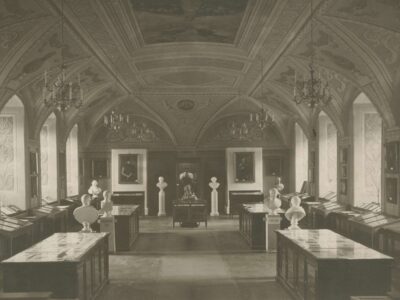
- Piotr Skarga’s Toga and Biretta at the 350th Anniversary Exhibition of Vilnius University in the Franciszek Smuglewicz Hall. Photo by J. Bulhak, LNM
-

- Silk Cloak Formerly Identified as the Rector’s Toga. Photo by G. Trečiokas, NML