Historian Aistė Petrauskienė on Living Partisan History, the Impact of Soviet Propaganda, and Discoveries in Bunkers
2025 05 08
“None of those people wanted to become freedom fighters bearing arms. Not a single one.
I’m almost certain that every one of those thousands of people would have chosen to raise children, farm the land, finish university, or pursue some other kind of work,”says Dr. Aistė Petrauskienė, historian at the National Museum of Lithuania, speaking about Lithuania’s freedom fighters.
On May 14, the Day of Remembrance for Partisans and the Unity of the Army and Society, Aistė will lead a hands-on experience at the House of Signatories, titled “Unearthing to Make Them Speak.” During this session, participants will have the chance to excavate artifacts related to the partisan resistance, objects that, according to the historian, help forge a living connection to this period in history. The House of Signatories, a branch of the National Museum of Lithuania, is dedicated to preserving the idea of Lithuanian statehood and freedom—an idea deeply connected to the legacy of the freedom struggles.
In this conversation, Dr. Petrauskienė shares insights not only about this unexpected educational activity, but also about her first archaeological encounter with a partisan bunker, the values behind the freedom fighters’ choices, and the living relevance of this historical period.
On May 14, you’re inviting the public to the educational session “Unearthing to Make Them Speak” at the House of Signatories to mark the Day of Remembrance for Partisans. What can participants expect from this experience, both historically and educationally?
“This is the third time we are marking the occasion in this way. This year, we decided to step away from the traditional discussion format—we’re seeking a more vivid and personal relationship with history.
Together with the Director of the House of Signatories, Dr. Dalia Strimaitytė, we designed an evening where stories are told through objects—symbolic items reminiscent of the partisan struggle. Participants will ‘excavate’ these items from the ground using tools borrowed from archaeology—trowels and brushes.
Each discovered item becomes a starting point for a story about the people, their struggles, and their destinies. While the items being unearthed are replicas, authentic artifacts will also be on display.
For me, this will also be a playful experience—I won’t know which item will be found first, so the narrative will unfold together with the participants. Behind each object lies a real story—and we invite everyone to discover those stories with us.”
-
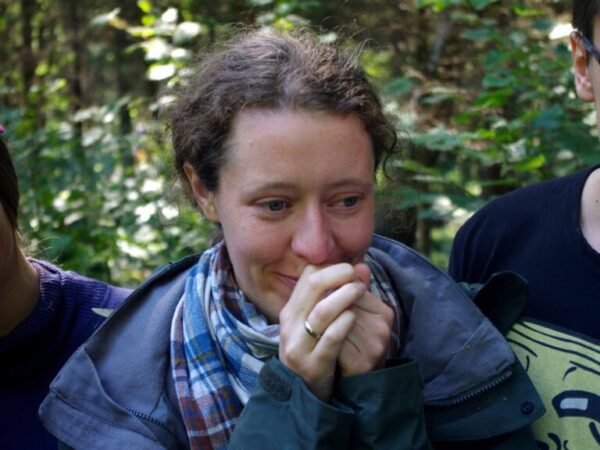
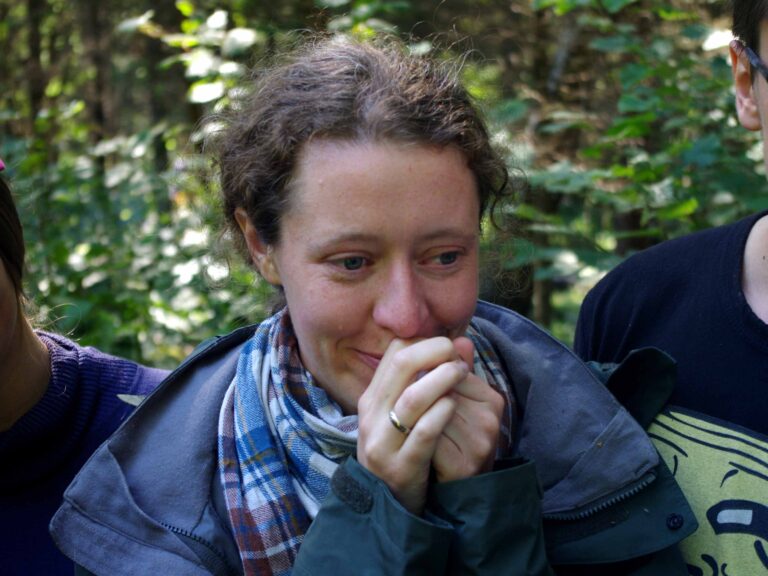
- **Aistė Petrauskienė. An emotional moment during the youth camp *“Memory of the Freedom Fights”* in the Užpelkiai Forest (Radviliškis district), when a partisan ring was discovered. 2016. Photo by G. Petrauskas.**
What can archaeologists find when they begin to investigate the partisan war? What did those people leave behind? I honestly can’t imagine what kind of objects might be found.
“In 2009, together with my future husband, archaeologist Gediminas Petrauskas, we began wondering whether archaeology could contribute to the study of the partisan resistance. At the time, it was a bold and somewhat unexpected idea, as no professional archaeological research had been conducted in this field in Lithuania. Support from our international colleagues strengthened our belief that archaeological methods can reveal things that are not recorded by witnesses or written sources. For example, one myth we debunked was the idea that you could stand upright in a partisan bunker. In reality, most were only about 150 cm tall.
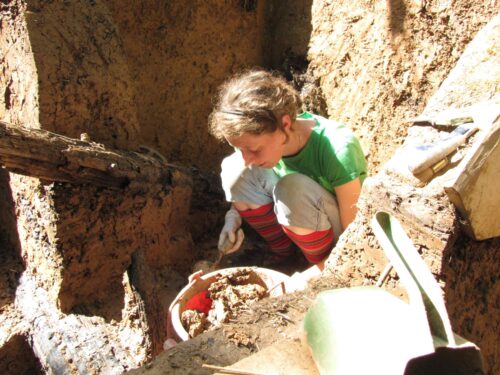
In the spring of 2010, while scouting a partisan camp site, we visited the Raseiniai Regional History Museum. We met the staff, and two weeks later they informed us that a history teacher and his students were planning to excavate a partisan bunker in the Daugėliškiai forest. Together with Gediminas Petrauskas and Vykintas Vaitkevičius, we decided to go check it out. With the help of demining specialists, we inspected the site and chose to carry out archaeological research—it felt like the place had chosen us.
We thought the excavation would take three or four days—it ended up lasting 34 days. That was our first excavation of a partisan war site, so—like first love—there’s inevitably a bit of romance in it (smiles).
We were lucky. We discovered a bunker full not just of objects but of living stories. A surviving courier, Albinas Kęstutis Bersėnas–Stirniukas (now 97 years old), helped us understand the context. Among those killed at the site was Leonardas Vilhelmas Grigonis–Užpalis, one of the signatories of the February 16, 1949 Declaration.
We found a wealth of items: Pillars of Gediminas, buttons with the Vytis emblem, a bayonet engraved with a partisan pseudonym, even a pot recognized by the same courier. These discoveries were deeply moving—they erased the distance between past and present.From interrogation records, we later learned that the courier had brought them food that same evening. In those 34 days, we uncovered over 1,000 artifacts. Many survived because a fire had broken out in the bunker, disrupting the Soviet search. Time had stood still, waiting for someone to speak again on their behalf.
One find brought us to a halt. A colleague, thinking he had unearthed a ceramic shard, unexpectedly found a fragment of a human skull.
During the shootout, when the partisans were down to their last bullets and realized they couldn’t hold out, they recited their oaths and used the final bullets on themselves. Fragments of two skulls were torn apart by the force of the explosion. We knew it was a death site, but physically touching the moment of death changes everything. The bodies were taken to Kaunas, and to this day it is unknown where they were buried. That’s why those few bones, later buried with honor in Ariogala, became a symbolic grave—a sign that their fight was not forgotten.
One of the fallen partisans, known by the pseudonym Banga, was long listed as an unknown fighter—like many others.
Through determined archival research, we discovered he was Romualdas Misevičius from Geručiai village.
We contacted a local resident and soon visited his 90-year-old sister, who had not heard anything about her brother since 1948.
Moments like that take you outside the traditional historian’s role—they give a human face to history and deepen the meaning of our work.
Every site tied to the partisan war—whether a bunker or a battlefield—holds unexpected discoveries. They bear traces of frozen time: the moment of death, the instant of abandonment. Through the eyes of a researcher, these places can be given voice again. We were taught that history should be objective, but over time I’ve realized—history is ultimately subjective.
Could you tell us how many bunkers have been excavated and studied so far, and how many remain?
“As of last summer, we had studied the ninth partisan bunker.We don’t know the total number. But if we consider the full range—from the smallest to the largest—there were likely more than 10,000.”
-
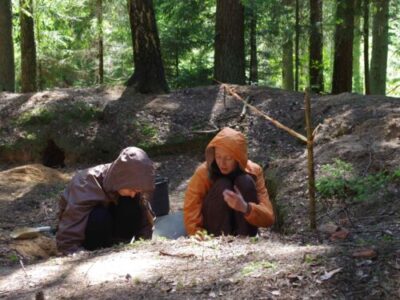
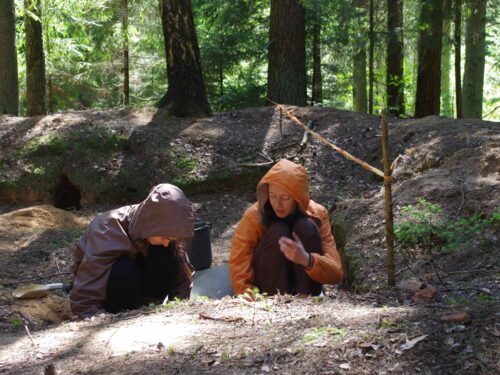
- A moment from exploratory research at the Blinstrubiškiai Forest (Raseiniai district) bunker site. 2017. Photo by G. Petrauskas.
-
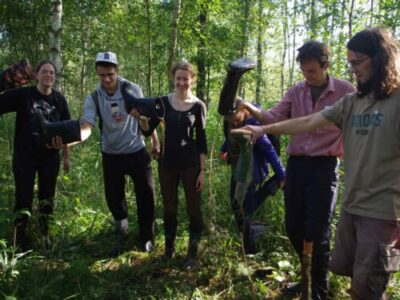
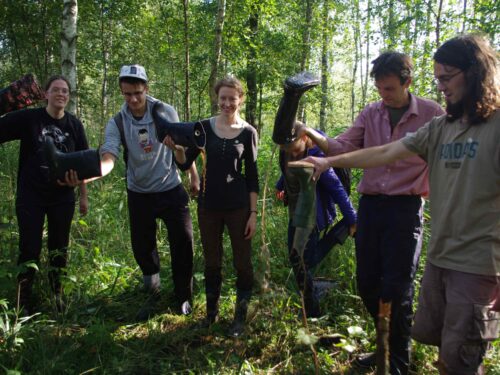
- Participants of the youth camp *“Memory of the Freedom Fights”* after overcoming the swamp challenge. 2016. Photo by Ž. Montvydas
– Only nine have been studied?
“That’s how many bunkers have been researched by archaeologists—far more have been excavated.In the early years of independence, driven by the desire to honor partisans’ memory, bunkers were widely uncovered and reconstructed as a form of commemoration. The idea was to create spaces where young people could enter the bunkers and feel their atmosphere.
It took time to realize that bunkers shouldn’t be unearthed carelessly, and that they hold significant historical value.
Fortunately, this is now regulated—no bunker in its original location may be excavated without archaeologists.
About 30 bunkers were dug up without any professional archaeological oversight. One such example is the bunker of Jonas Žemaitis-Vytautas in the Šimkaičiai Forest.”
– You said every object tells a person’s story. Why is it important for us to know those stories? Why isn’t it enough to just know the dates or dry facts to understand the freedom struggle?
“The history of this period is about values.It’s not about warfare, weapons, or fortifications—it’s about human choices.
I often say: none of those people wanted to become armed freedom fighters. Not a single one. I’m almost certain that each one of those thousands would have chosen to raise children, farm the land, finish university, or take up other kinds of work. But circumstances forced them to choose another life.
In this history, we can grasp people with their fates, choices, and lives. We can see their faces, learn more about who they were before they became partisans, and connect that with their fate during the resistance. Bunkers hide stories not found in textbooks—from the experiences of women to entire families who fought together. When we enrich those familiar black-and-white photographs of partisans with emotions and personal narratives, we get a fuller, more vivid, more complex and colorful picture.”
– It seems that now more than ever, we need to identify with those difficult, firm, and dignified choices people made. It’s much easier for a modern person to connect with another person from the past than with just historical facts.
“Absolutely. It would be naïve to expect freedom fighters to inspire everyone. But for those who care about civic values, these people are examples—riflemen, soldiers, citizens driven by ideals.The current geopolitical events definitely prompt us to revisit the origins of the idea of freedom and fighting for it.
Even after three decades of independence, the evaluation of the partisans remains complex.
We’ve all heard narratives with the undertone ‘there were all kinds of people.’ But I believe the war in Ukraine has strengthened the story of our partisans. We’re starting to speak more confidently and appreciate them.
We’re also beginning to understand the difficulty of certain decisions—that judging them from the comfort of our sofas isn’t so simple.
– How have partisans been viewed differently in our history?
“The story of the partisans will remain alive for some time. We’ve discussed this with colleagues—that it takes about 100 years after a historical event for its narrative to stabilize, when living memory, direct descendants, and eyewitnesses are no longer around.
The Soviet era and its state-sponsored propaganda deeply influenced the narrative of the partisan movement.
During the war, there was a great deal of military propaganda, but once the resistance ended, ideological propaganda took over.
The Lithuanian National Museum preserves materials from the former Museum of the Revolution, which reveal how much attention was given to this topic from a propaganda angle in the 1960s. They held exhibitions with telling titles like “Bourgeois Nationalists – the Fiercest Enemies of the Lithuanian People,” along with publications such as “Be Cursed by Mothers for the Innocent Blood.”The topic was not forgotten—it was actively shaped. And unfortunately, it had a lasting effect. A generation had to grow up in independent Lithuania before people began to question their parents’ narratives, asking whether they might have been shaped by propaganda.
Of course, there are other cases as well—such as families whose relatives were executed by partisans under martial law.
In such cases, the narrative of ‘banditry’ is passed down from generation to generation.
When I speak about the impact of propaganda, I’m referring to those who were not directly involved with either side, but who internalized the Soviet message that the partisans were ‘bandits.’ These people, often without ill will, continue to repeat that story.
After independence was restored, counter-propaganda efforts emerged—not necessarily to create a new narrative of a heroic Lithuania, but primarily to disprove what had been promoted during Soviet times. And disproving something—even if it’s false—is always more difficult.
Thankfully, many freedom fighters were still alive. Efforts began to commemorate, memorialize, and reclaim lost memory. For the first time, people could grieve openly. That phase was especially strong during the first decade of independence, but later, a deep lull followed.
Since around 2010, we’ve seen the return of ideas and events linked to partisan memory—like the long-running Trakiniai partisans’ event, the “Memory of the Freedom Fights” youth camp, now entering its 14th year, and creative works like “Broliai,” a musical album by Skylė and Aistė Smilgevičiūtė. What’s happening now is a shift—from a purely historical narrative to an artistic and civic space, where this topic can become something more than textbook material.
In writing my PhD dissertation, I also tried to look at the partisan war from a different angle.
Later, together with Vykintas Vaitkevičius, we published the book “The State of Lithuanian Partisans.”
We wanted to understand partisans at the leadership level, based on their documents and how they themselves understood their mission.
At the time, this was just a hypothesis, but today it seems obvious: they had their own state, leadership, laws, and cared for and defended their people.
Now, we can speak of the partisan state as a concept. But that doesn’t mean a new interpretation won’t emerge in 20 years.
History may tell us about the past, but it is a living entity. And I hope that the evening I’m inviting people to join will be about exactly that.
More information about the hands-on lecture “Unearthing to Make Them Speak” can be found here.
-
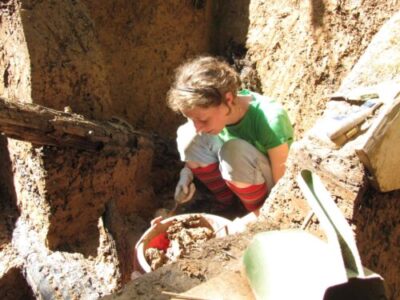
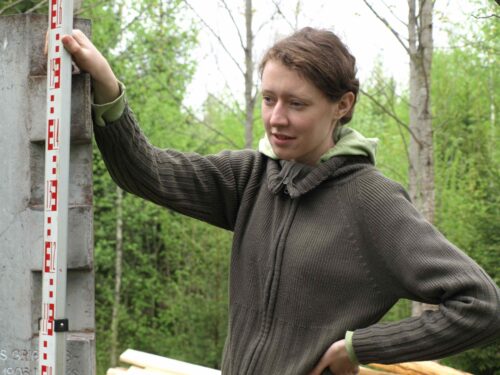
- Aistė Petrauskienė during the investigation of a partisan bunker in the Daugėliškiai Forest (Raseiniai district). 2010. Photo by G. Petrauskas.
-
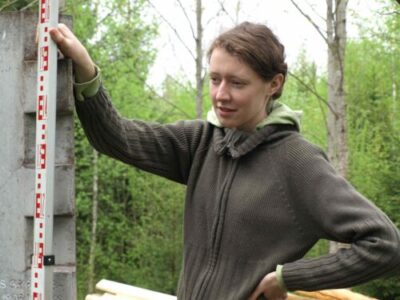
- Aistė Petrauskienė during the investigation of a partisan bunker in the Daugėliškiai Forest (Raseiniai district). 2010. Photo by G. Petrauskas.