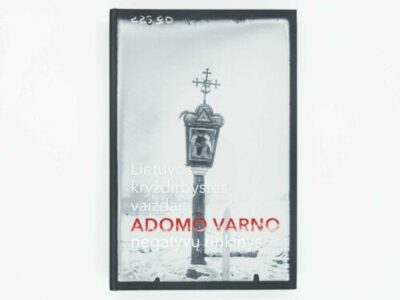
Adomas Varnas’ Priceless Archive of Negatives Released, Depicting the Cross-crafting Tradition
2024 02 06
The National Museum of Lithuania has published a set of negatives collected by the artist Adomas Varnas in the 1930s, which captures the images of the Lithuanian Cross-crafters. Already then, the artist saw the potential of cross-crafting as a unique field of folk art, and after realizing the rate of its decline, he began to record it. Although he himself admitted that he was “sick of the disease of the crosses”, his titanic efforts undoubtedly contributed to the preservation of the cross-crafting tradition.
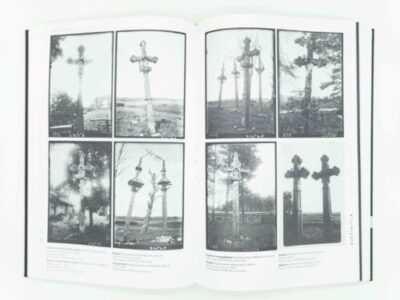
The entire collection of Adomas Varnas consists of 1988 negatives, which capture the small sacred monuments standing in various corners of Lithuania – crosses, roof pillars, chapels.
Prophesized Fate of Cross-crafting
It can be said that A. Varnas as early as 1925 predicted the place of the Lithuanian cross-crafting tradition in the honorable list of UNESCO’s intangible cultural heritage. At that time, he wrote that he sensed the Lithuanian crosses as having “priceless value not only for Lithuanian art, not only for Lithuanian history, ethnography and archaeology” and believed that a complete collection of them “could have an indisputable significance”. At the same time, the artist suffered painfully, after noticing the arts decline – the disappearing, crooked, fallen crosses, roof pillars, chapels.
According to the author of the publication, art critic Dr. Skaidrė Urbonienė, cross-crafting experienced its rise at the beginning of the last century, but modernization brought changes in people’s lifestyle and worldview, which did not encourage the continuation of this tradition. Wooden crosses began to disappear. Adomas Varnas realized that it was practically impossible to prevent this, so he tried to save at least the images of this spiritually rich landmarks as quickly as possible.
Without his massive archival input, knowledge of the cross-crafting tradition would be much scarcer today: many physical examples of this tradition have perished. The archive accumulated by Varnas not only preserved them, but also visualized the spread, forms, and scope of the tradition.
“For A. Varnas, photography was primarily a means of documenting the existing heritage, creating a visual memory of the cross-crafting tradition. The negatives reflect the broad chronology of the construction of wooden monuments from the 19th century up to the mid-20th century in the ethnographic regions of Aukštaitija, Žemaitija, Suvalkija, Dzūkija at the end of the 1930s”, says S. Urbonienė. She adds that the monuments of the Lithuanian cross-crafting stood in various environments: in homesteads, on the outskirts of villages or towns or in squares, crossroads, roadsides, fields, forests, near rivers, streams or springs, cemeteries, or churchyards.
-
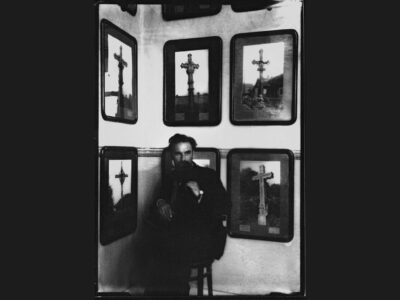
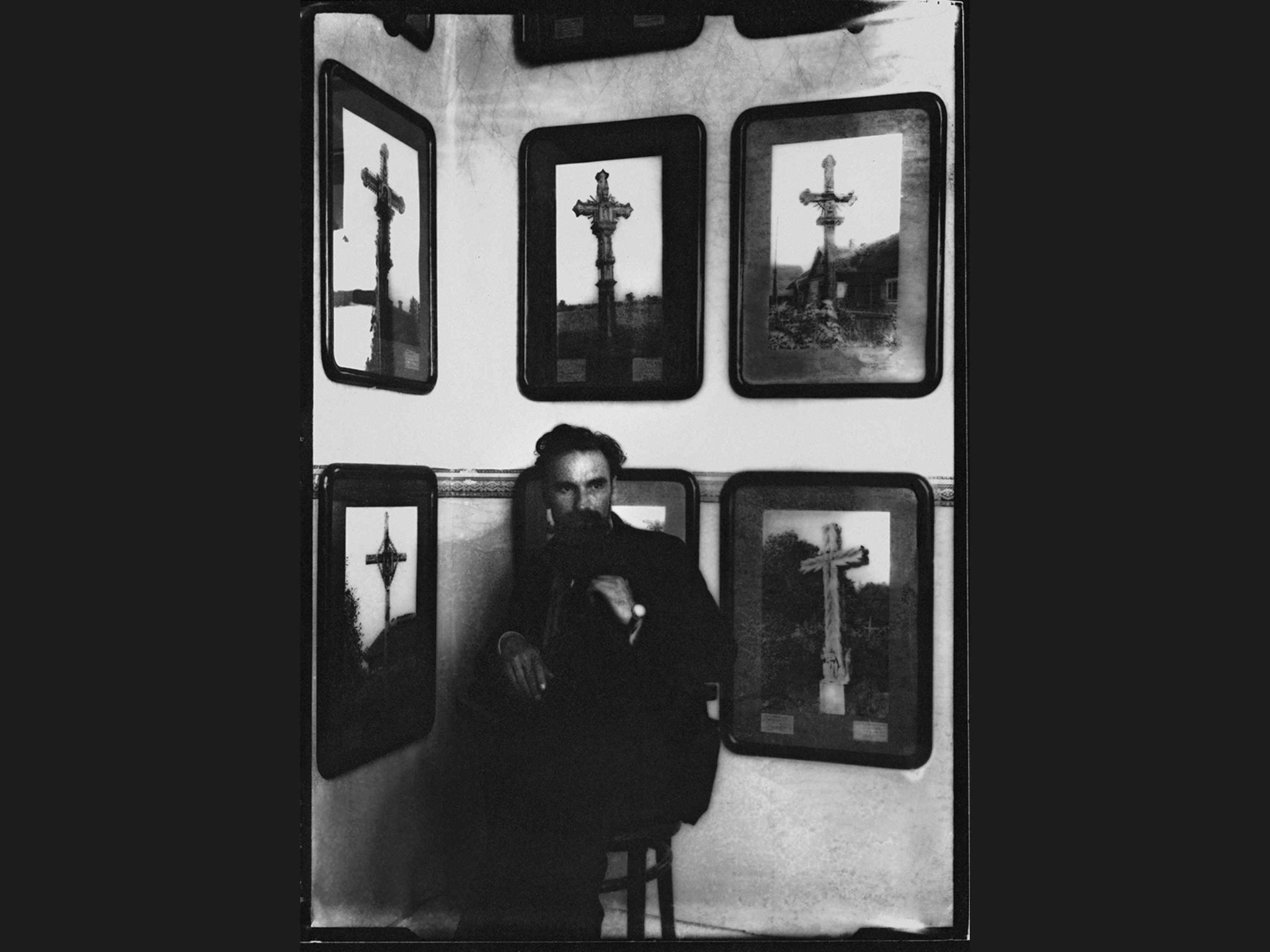
- A. Varnas at the Lithuanian Crosses Photographic Exhibition at the 3rd Lithuanian Agricultural and Industrial Exhibition. Kaunas, 1924. Photographer unknown
-
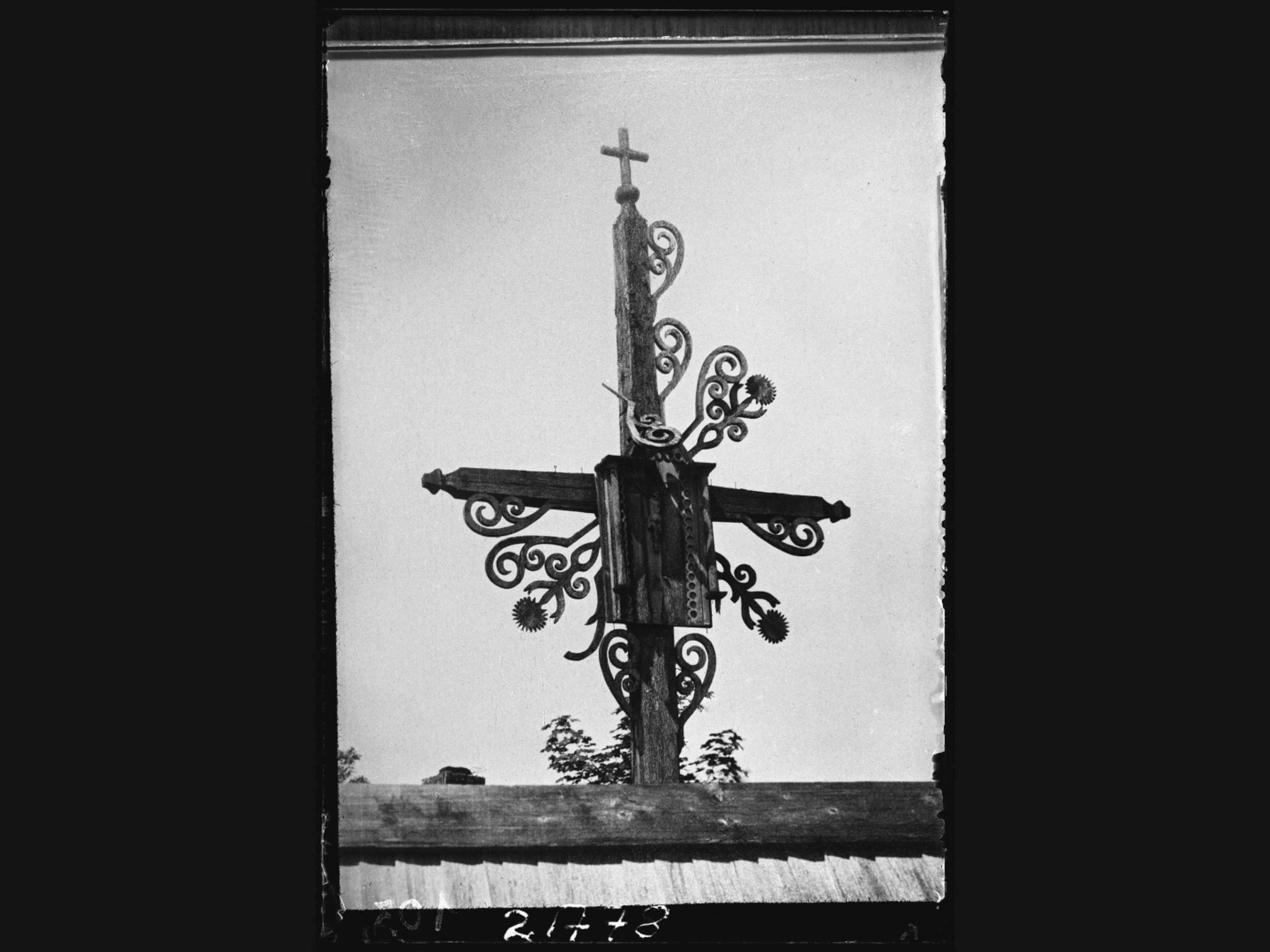
- Cross in the graveyard of Erzvilka town 1924 built in 1884. NCDM
-
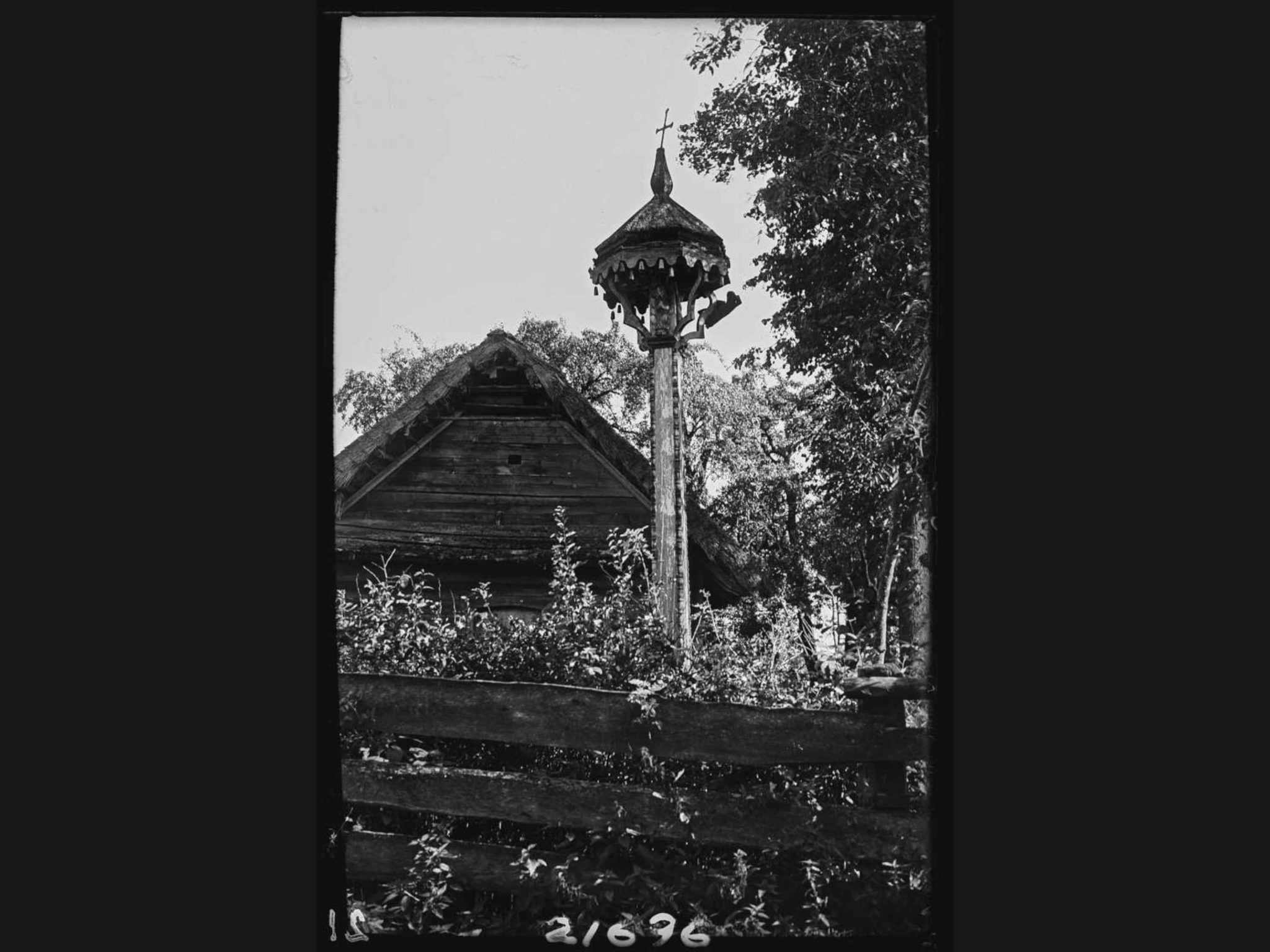
- Bataic’s work, roof pole, in the yard of farmer Antanas Svegzda, Lazu village, 1924. NCDM
-
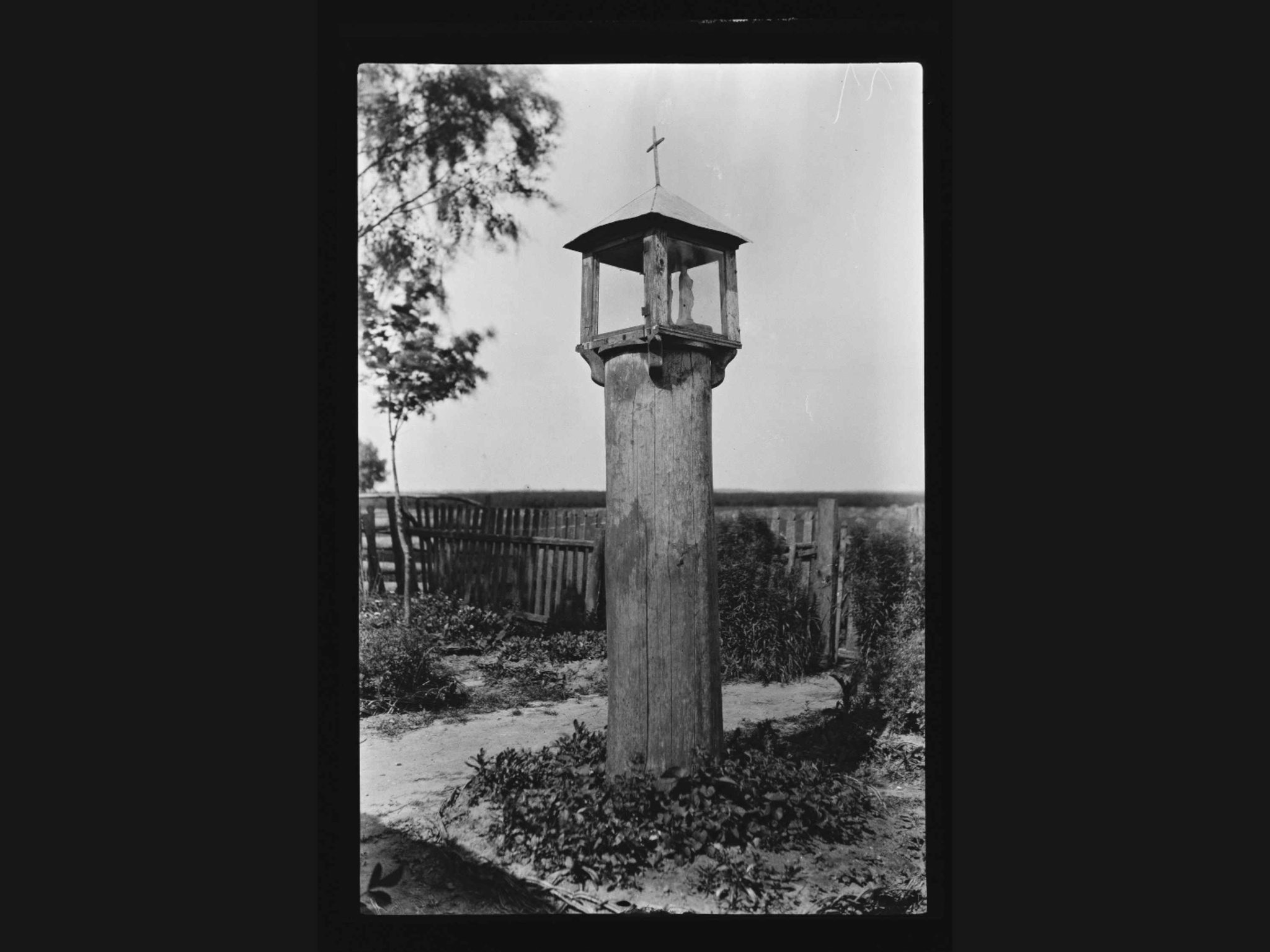
- Chapel pole in a farmer’s yard in-Dirvonu village 1926 Photographer alys Buracas. LNM
-

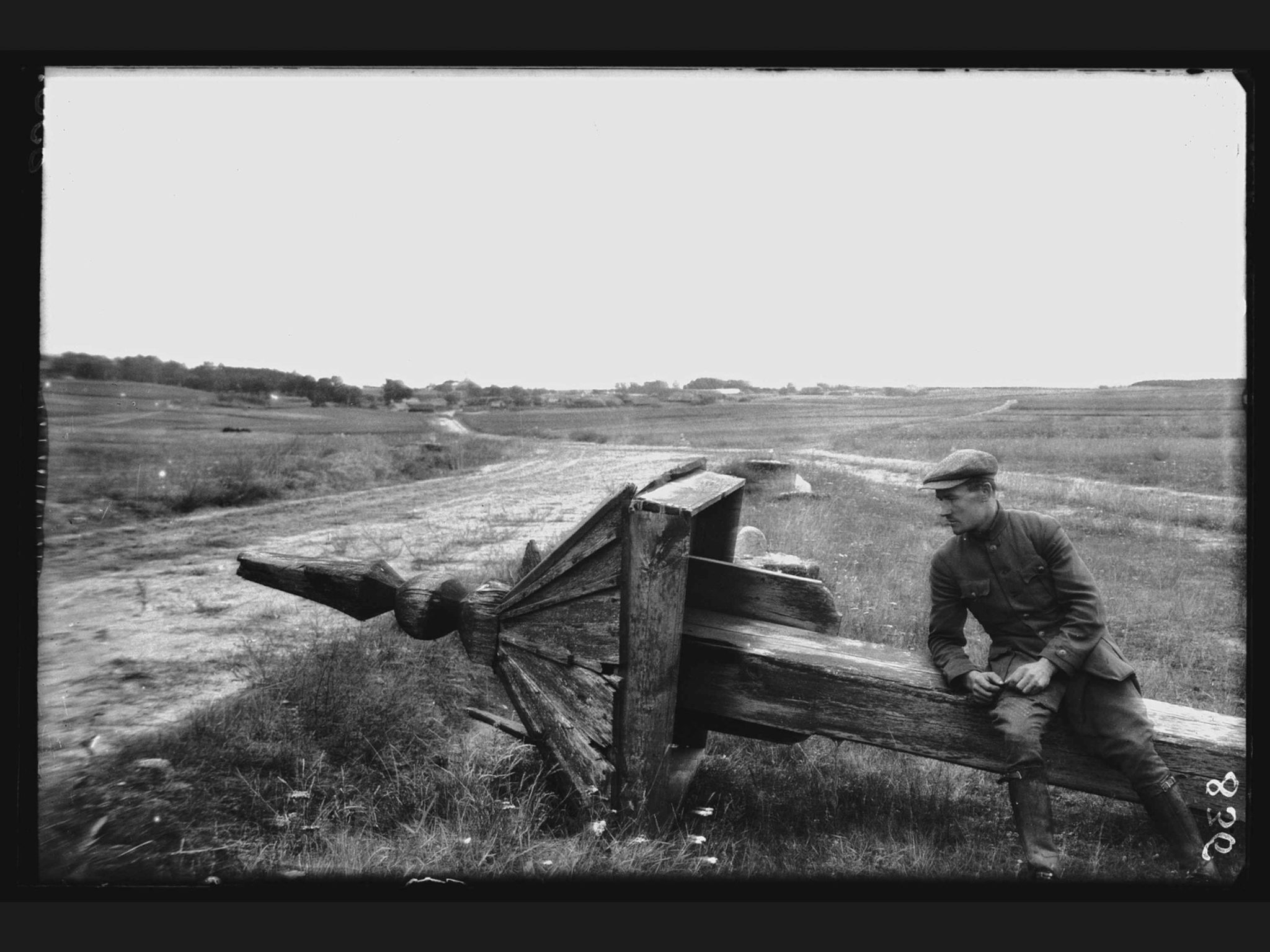
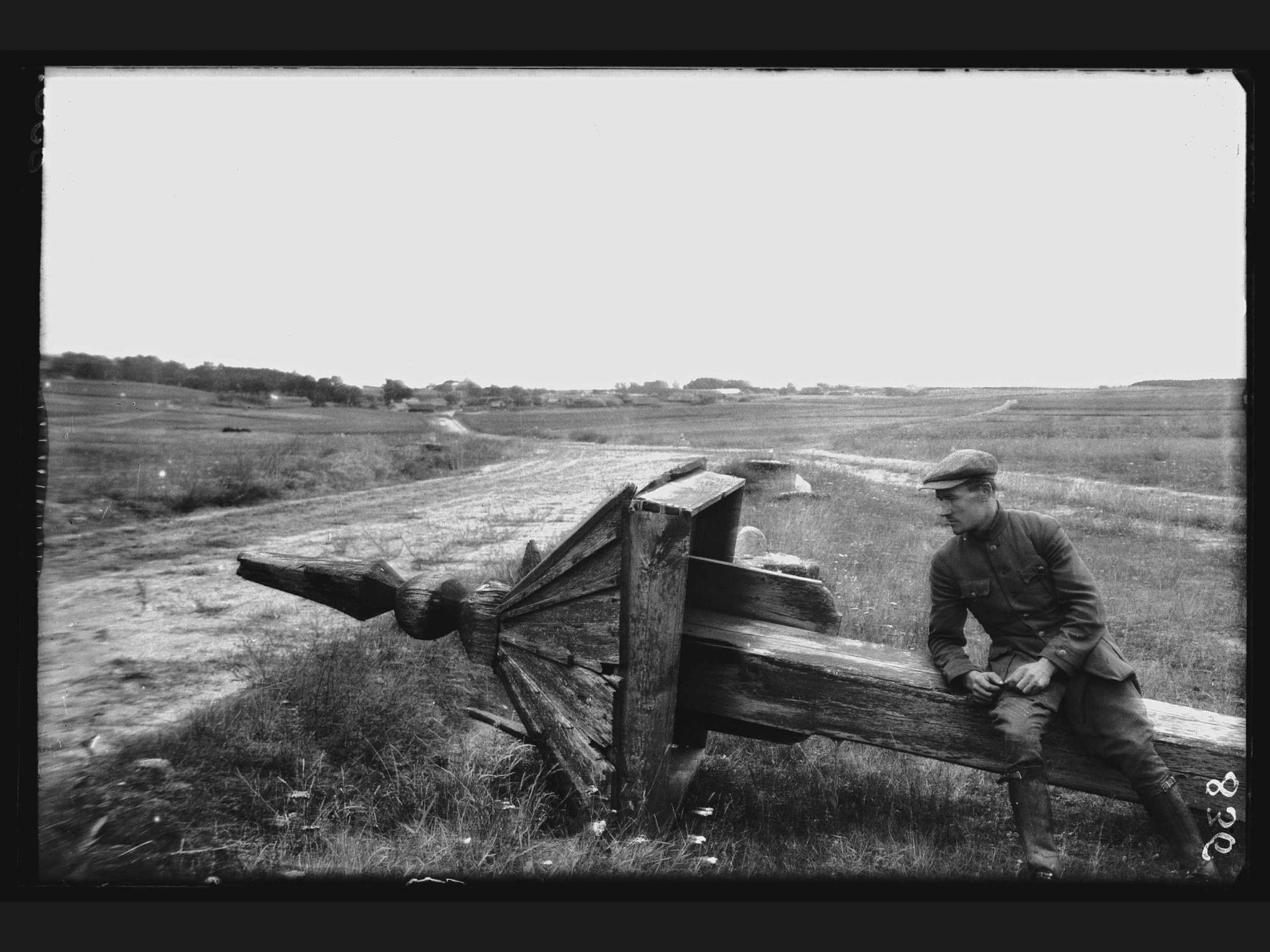
- Fallen roof pole near Utena Kuktiskius city road in the fields of Kuktiskius town 1925. NCDM
-
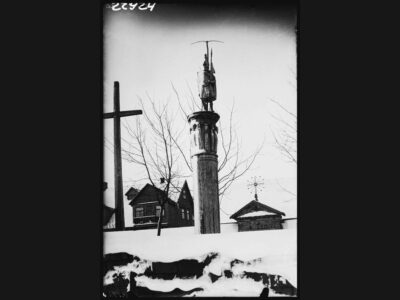
- St. Florian’s chapel pillar in Kvedarna parish in 1928. NCDM
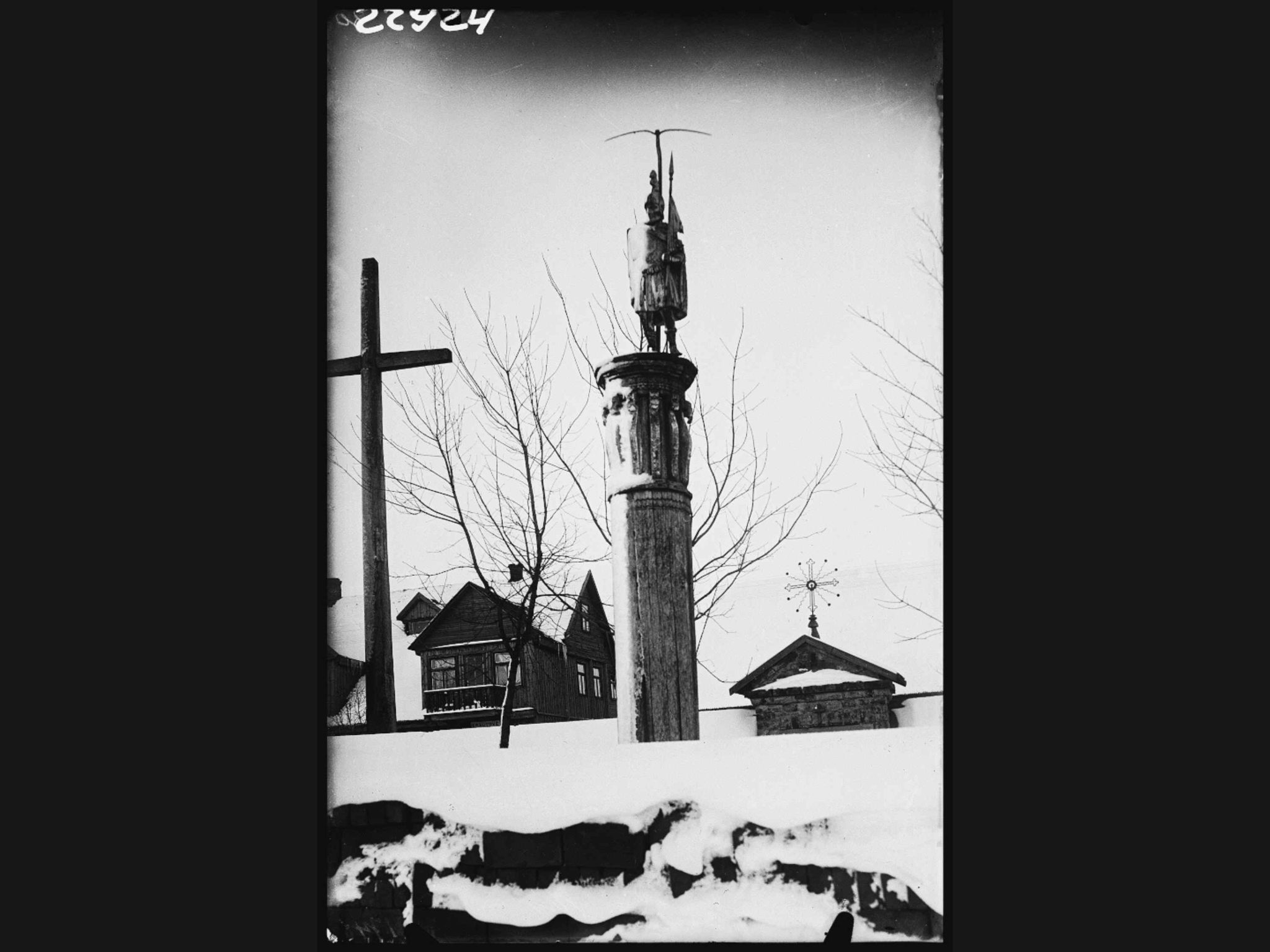
The artist did not collect images of well-preserved monuments only; the set also includes disappearing, abandoned, fallen monuments. He classified and stored all the collected images so that they could later be used in the restoration of old crosses or in the construction of new ones in the place of already decayed ones.
An Archiver of a Declining Spiritual Culture
The images of A. Varnas’ collection are characterized by a documentary-like quality. They clearly show not only the monument, but also its authentic surroundings. The year of construction is engraved on the photographed object and is sometimes highlighted, most likely with white chalk, to make it more visible in the photograph.
The artist paid great attention to the description of the photographs, in 1925 in the press, he even specified the necessary metrics such sources should have. The most important thing is to record the place of origin of the cross – village, township, county and to indicate specifically where it stands: in a cemetery, churchyard, near a stream, near a spring, on a roadside or at a crossroads. It is important to indicate both the age of the cross and the year of its rebuilding. He considered the people living around the monument to be an irreplaceable source, that can tell how many times the cross has been re-buried in the ground after its bottom part has rotted away, who is the author of the cross, what is the purpose of its construction, what legends are told about the cross.
-
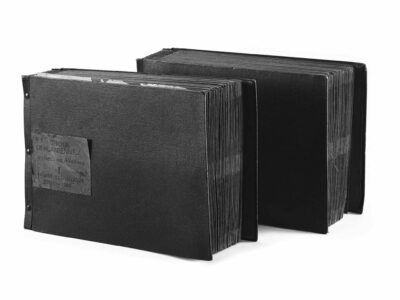
- Catalogue of the collection of negatives of the Lithuanian cross of Adamas Varnas.-LNM
-
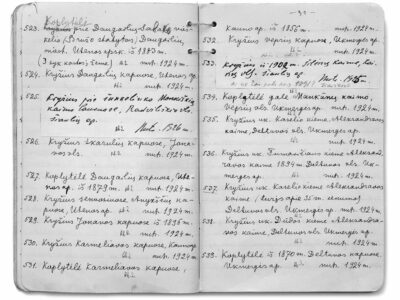
- Adam Varna’s negative collections metric embroidery stored LNM scaled
Excerpts from A. Varnas’ memoirs inserted between the images in the catalog describe the features of the cross-crafting monuments of certain regions or areas, which he observed while traveling throughout Lithuania.
“After assessing the scope of the work of fixing the crosses, A. Varnas bought a Ford car and hired a driver, because he did not know how to drive himself. He also bought an “architectural” camera, with which he could more easily photograph tall objects from up close, several lenses and other photo materials, so the financial investment for this task was not small”, says museum curator Žydrė Petrauskaitė, who wrote one of the introductory articles.
What is even more important is that the artist did not limit himself to just capturing crosses. He also became an active ambassador for them: he made efforts to have his collection taken over by the state, and in 1925, when the Second International Exhibition of Applied Art was approaching in Italy, an exhibition of Lithuanian crosses was also organized there.
“Lithuanian crosses were shown to the international community in the Royal Palace of Monza. The two designated halls were decorated with compositions of stylized ornaments according to the project of A. Varnas. They exhibit wooden sculptures, fabrics and 80 large-format photos of a set of framed crosses,” says Ž. Petrauskaitė.
-
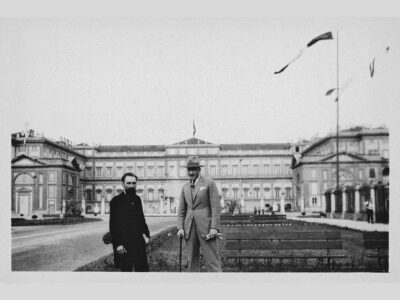
- Adam Varnas with an unrecognizedperson at the Royal Rome in Monza 1925 Photographerunknown.NCDM
-
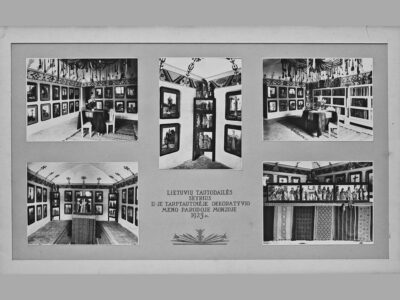
- Lithuanian folk arts department stand. Monza1925. NCDM
About The Book
In the publication “Images of Cross-crafting in Lithuania: A collection of negatives by Adomas Varnas” the entire collection of glass and celluloid negatives collected by the artist, which has survived to this day, is currently being kept in the Lithuanian National and M.K. Čiurlionis National Art Museums.
The main collections of photographs and negatives accumulated in the interwar period are today an important resource for the study of the 19th and 20th century cross-crafting tradition. They provide iconographic and empirical data for the study of art, historical and ethnological research, restoration or rebuilding of monuments, and offer ideas for today’s cross-crafting tradition.
Before being admitted to the museum collection, the negatives were withered by passing time and unsuitable storage conditions, as a result some of them faded, lost contrast, and various stains appeared. The publication’s artist Vida Ona Kuraitė, cleaned some stains, dirt, scratches, highlighted the contrast or faded details. However, some of the negatives are irreversibly damaged, and the images in them are not preserved.
The publication was compiled by Skaidrė Urbonienė. The introductory article was written by Skaidrė Urbonienė, Žydrė Petrauskaitė presented the history of the collection of negatives of Adomas Varnas crosses, Monika Gineikienė reviewed the part of the collection kept in the National M. K. Čiurlionis Art Museum, and Vitalija Jočytė – the part of the collection kept in the National Museum of Lithuania. The publication can already be purchased in the e-shop of the Lithuanian National Museum and at the museum’s cash desks. It will be presented at the Vilnius Book Fair on February 24. 12 o’clock (in conference room 1.2).