Culture as the Voice of the State: An Exhibition About How Lithuania Spoke to the World
2025 11 25
Today, as the cultural field again becomes a focal point of public attention and value-based discussions, the National Museum of Lithuania invites us to turn to history. The newly opened international exhibition “Riding the Wave of Paris Exhibitions: Ethnography, Cultural Diplomacy, and Identity” tells the story of how Lithuania presented itself to the world through culture—art, traditions, and symbols. The exhibition was prepared in collaboration with an international partner—the Museum of European and Mediterranean Civilisations (Mucem) in Marseille.
The exhibition reconstructs three historical presentations in Paris: at the 1900 and 1937 World’s Fairs and at the 1935 exhibition of Baltic folk art. Each historical presentation reflects a different stage of Lithuanian statehood, but all share a single idea: that cultural diplomacy through ethnic culture and art is one of the most important ways to represent oneself, shape identity, and affirm Lithuania’s place in Europe.
-
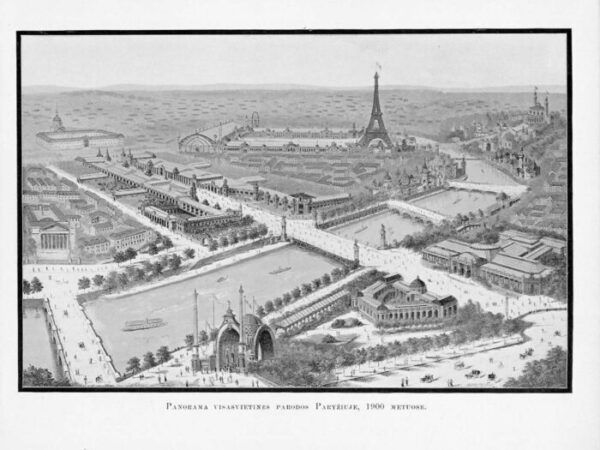
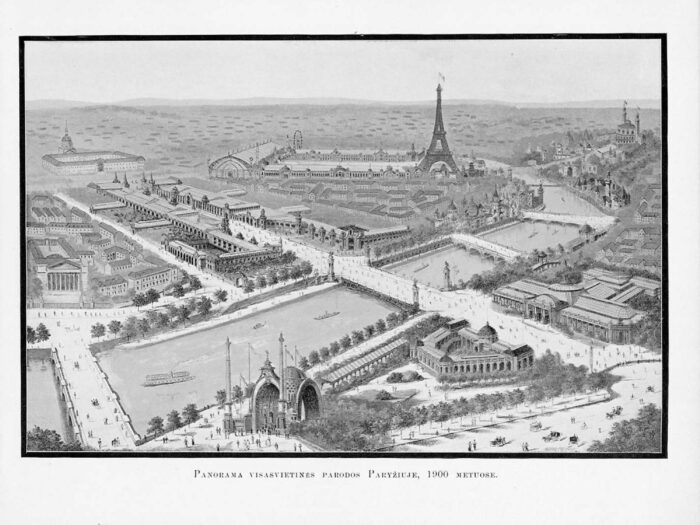
- Panorama of the Universal Exhibition in Paris, 1900. LNM
The exhibition brings together, for the first time in decades, artifacts, documents, and photographs from these historical presentations, now preserved in museums in France, Lithuania, Latvia, and Estonia.
1900: Culture as Protest
In 1900, Lithuania was still the western periphery of the Russian Empire, yet during the Paris World’s Fair, a small Lithuanian display with the inscription “Lithuanie” appeared in the lobby of the Trocadéro Ethnography Museum.
“Lithuania’s name did not exist on the official political map at that time, so such an appearance became a bold political declaration—a kind of protest, an act of resistance to Tsarist rule, proclaiming: we exist, we create, we have our own language, culture, and traditions,” says exhibition curator Dr. Miglė Lebednykaitė, head of the Ethnography and Anthropology Department at the National Museum of Lithuania.
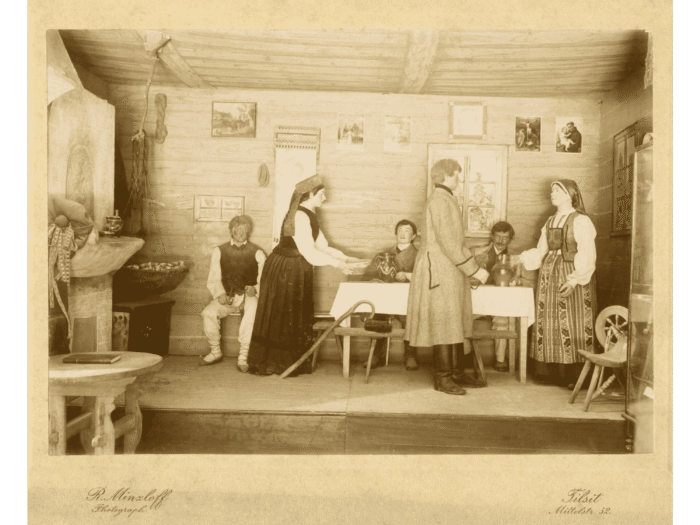
The display was arranged according to ethnographic principles, with the main feature being a reconstructed traditional Lithuanian gryčia (peasant dwelling). It exhibited furniture, textiles, and mannequins dressed in festive garments, depicting traditional matchmaking rituals.
-
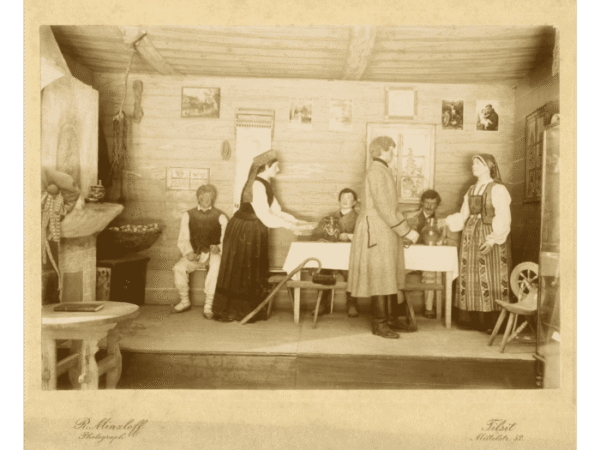
- The Farmer’s Return. Lithuanian section at the 1900 World Exhibition in Paris. Photo: Robertas Minzlofs, LNM
Because Lithuania lacked established museum traditions at the time, the artifacts were collected directly from villages. Exhibition organizing committees were formed in the United States—where the idea originated among the Lithuanian immigrant community—as well as in Europe and East Prussia. Despite distance and political restrictions, the organizers worked meticulously: searching for and selecting artifacts, preparing detailed lists, and secretly transporting the items to the exhibition by smuggling them out.
Lithuania’s participation at the 1900 World’s Fair did not go unnoticed: the Lithuanian section received 12 awards. More importantly, some of the artifacts were donated afterward to the Trocadéro Ethnography Museum—one of Europe’s most renowned and oldest institutions.
“To enter its collections was not only an honor but also a political achievement: the heritage of an oppressed nation was inscribed on the cultural map of Europe with the label ‘Lithuanie’. It was a symbolic gesture showing that even without statehood, Lithuania could speak about itself in a way that led its culture to be accepted, preserved, and valued internationally,” says Dr. Lebednykaitė.
-
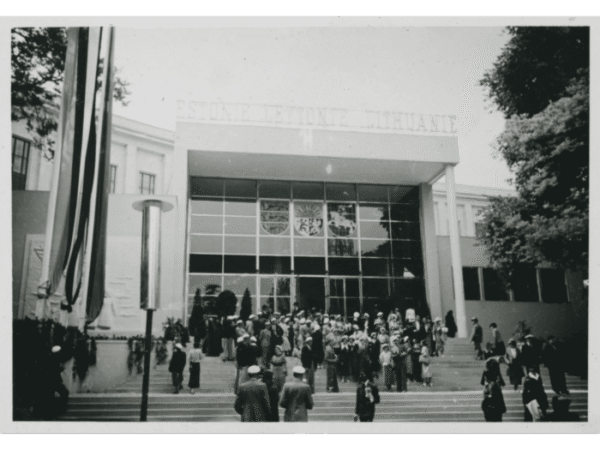
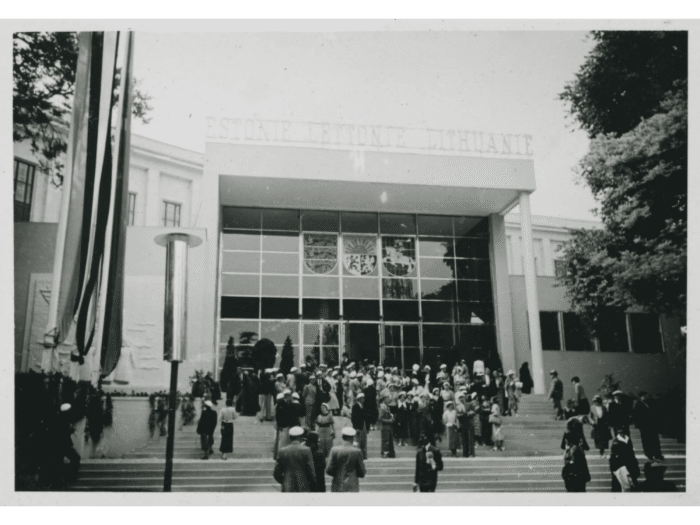
- VDU choir members at the World Exhibition at the Baltic States Pavilion. Paris, 1937. LCVA
1935: Culture as an Expression of Unity
Thirty-five years after the 1900 exhibition, Lithuania—as well as Latvia and Estonia—had changed fundamentally: all three had gained independence and built their own states. Paris remained an international cultural center, making it the ideal place to present themselves as sovereign nations.
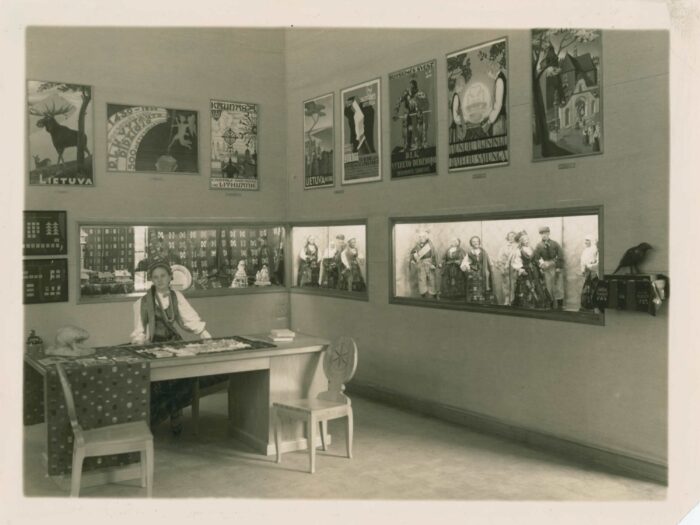
This happened in 1935, at the Trocadéro Ethnography Museum, with the exhibition “Folk Art of the Baltic States”, which showcased the finest examples of folk art. As societies modernized, old artifacts were disappearing from everyday life but were preserved in museums.
“These were no longer household objects brought directly from villages, but selected museum pieces demonstrating craftsmanship and cultural uniqueness. The exhibition highlighted both the similarities and differences among the Baltic countries, while also emphasizing their unity. Lithuania’s distinctiveness was represented by cross-crafting; Latvia focused on jewelry; Estonians presented wooden items and wedding ale tankards. Textiles reflected the shared heritage of all three countries, especially the ornate wedding crowns,” explains Dr. Lebednykaitė.
-
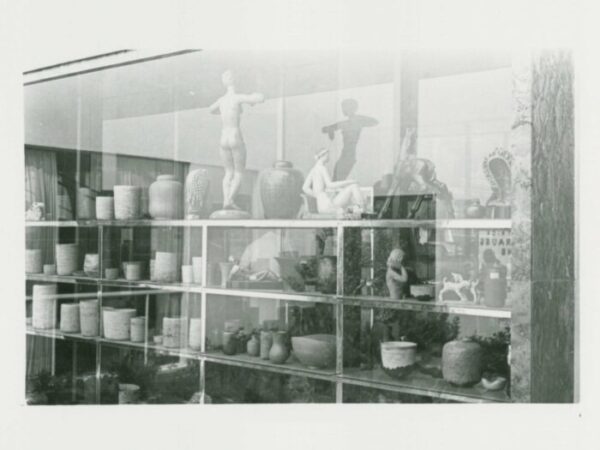
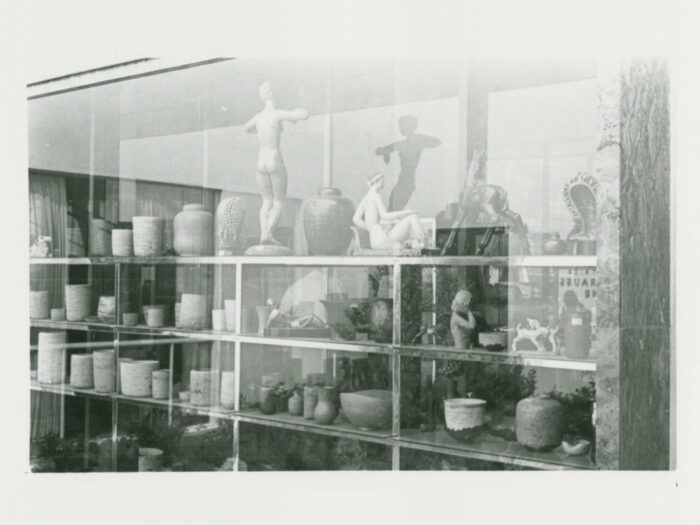
- Ceramics exhibition at the World Exhibition in Paris, 1937. Photo: L. Strolis. NMKČDM
1937: Culture as the Language of Modernity
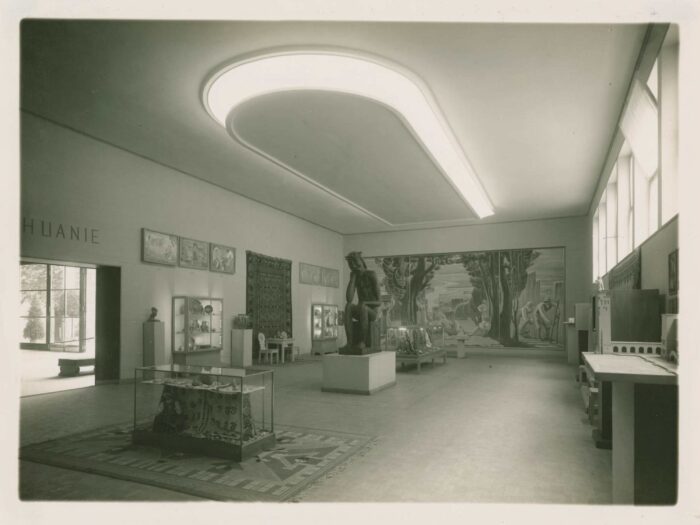
At the 1937 World’s Fair “Art and Technology in Modern Life”, the Baltic states again chose to participate together in a joint pavilion, demonstrating cultural and political solidarity. For Lithuania, it was another opportunity to present its culture internationally—now with the participation of professional artists.
“In preparing for this presentation, ethnic culture gained a new dimension, becoming a source of inspiration for contemporary artists. Thus a new layer appeared in the narrative: creator, tradition, and dialogue with the past,” says Dr. Lebednykaitė.
Lithuania’s display featured modern reinterpretations of traditional folk crafts—ceramics, textiles, furniture, and other works—by artists such as Liudvikas Strolis, Vytautas Kazimieras Jonynas, Jonas Prapuolenis, Adomas Galdikas, and Liudas Truikys.
-
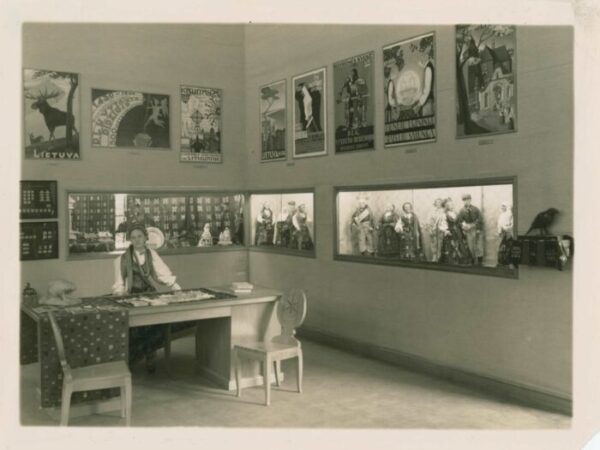
- Exhibition at the World Exhibition “Art and Technology in Modern Life”. Paris, 1937. Photographer Henri Baranger. NMKČDM
Contemporary Art Interventions
One of the exhibition’s distinctive features is its contemporary art interventions, woven into the dense, multi-layered curatorial narrative by art historian Jolanta Marcišauskytė-Jurašienė.
Alongside historical and ethnographic objects, visitors will see works by well-known contemporary Lithuanian artists: Andrius Erminas, Laura Garbštienė, Morta Jonynaitė, Žilvinas Landzbergas, Lina Lapelytė, and Laura Stasiulytė.
“These interventions create imaginative bridges between past and present, between imagined antiquity and an unpredictable future, between political representation and individuality, globality and locality, stable identity and its fluid forms. Identity becomes more complex, shaped by local traditions, international trends, and technologies. Contemporary artists reflect on how history influences today’s self-awareness—critically questioning norms and stereotypes, and nostalgically expressing longing for lost or transformed pasts,” says Marcišauskytė-Jurašienė.
The international exhibition by the National Museum of Lithuania, “Riding the Wave of Paris Exhibitions: Ethnography, Cultural Diplomacy, and Identity”, organized with Mucem in Marseille and the M. K. Čiurlionis National Museum of Art, opens on November 26, 2025, at 18:00 and will run until September 13, 2026, at the House of Histories, T. Kosciuška St. 3, Vilnius.
Guests at the opening event will be greeted by Damos, a performance created by Lina Lapelytė. Later the exhibition will be complemented by a series of events, tours, and educational activities for schoolchildren.
-
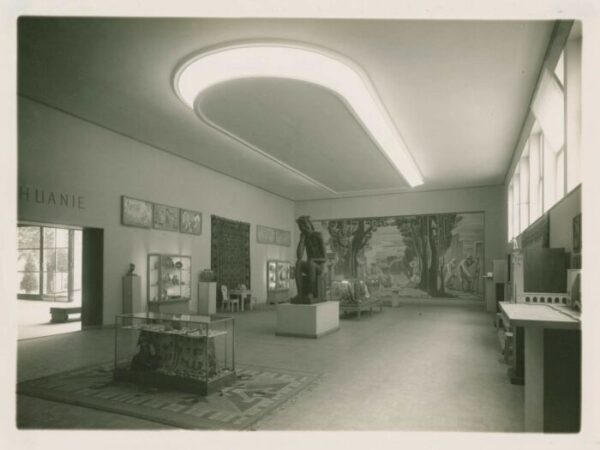
- The patron saint of Mycenae and Kashubia, in the background – Galdikas’ triptych. Lithuanian exposition at the World Exhibition in Paris, 1937. Photo: H. Baranger. NMKČDM