Lost for more than a century: a Lithuanian dowry chest and its unexpected return from France
2025 10 07
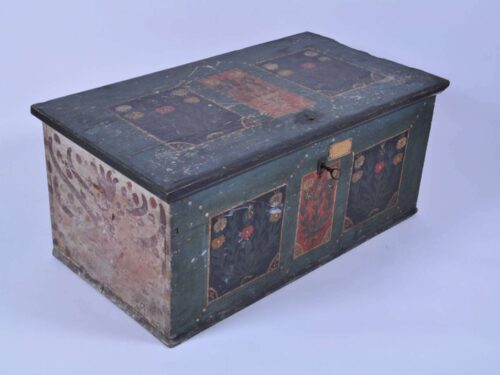
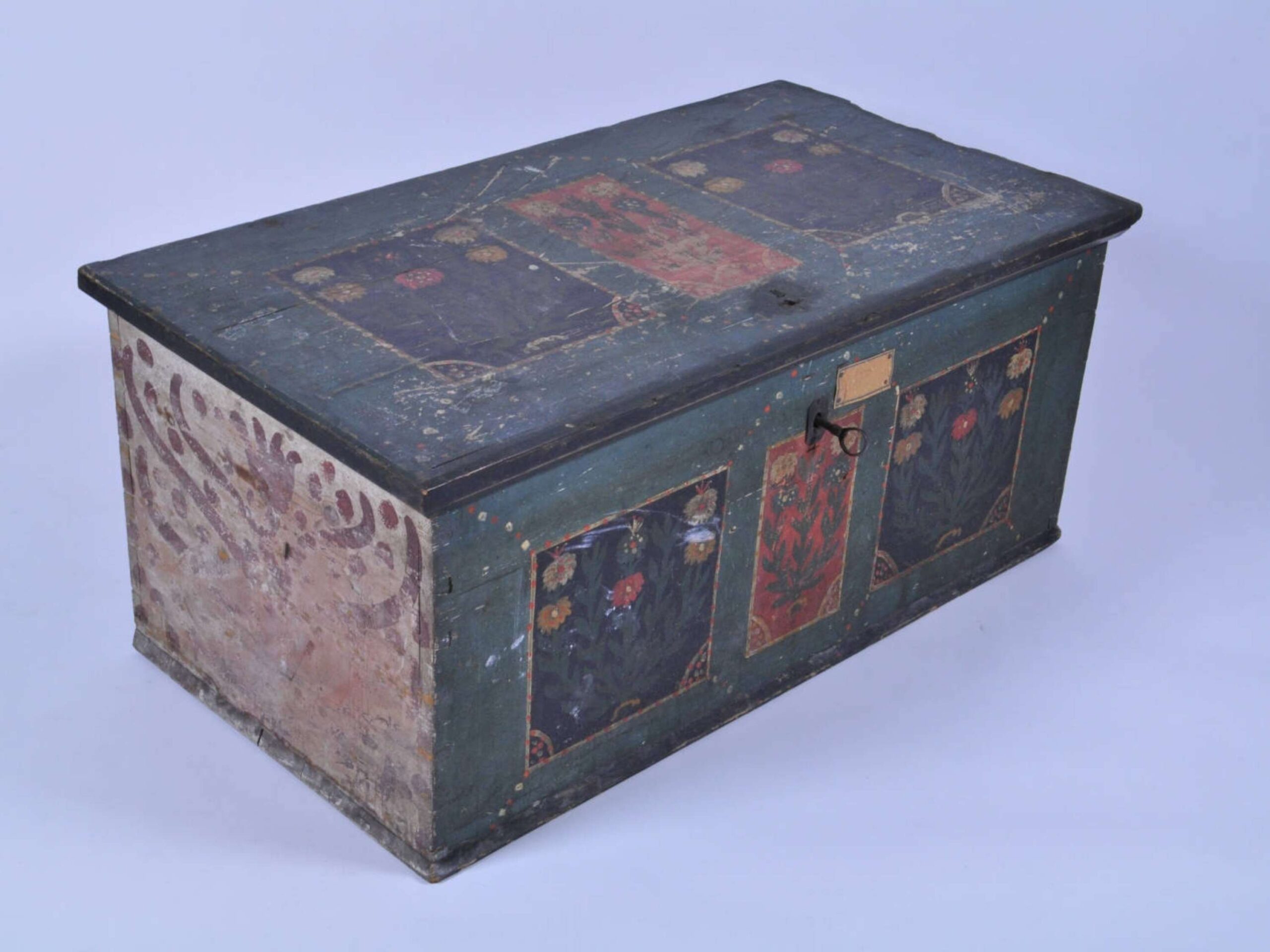
In Marseille, among the collections of the Museum of European and Mediterranean Civilizations (Mucem), a Lithuanian dowry chest was discovered among hundreds of pieces of furniture from different European nations — the very same exhibit that was presented at the 1900 Paris World’s Fair. Left in France after the exhibition, it was later mistakenly classified as part of the Russian collection and became separated from the other Lithuanian exhibits that had represented our country in one of the most prestigious museums of the time — the Trocadéro Museum of Ethnography. This important artifact was rediscovered while preparing for the upcoming Lithuanian National Museum’s (LNM) international exhibition “On the Wave of Paris Exhibitions: Ethnography, Cultural Diplomacy and Identity”, and this autumn it will once again become part of Lithuania’s historical narrative.
Opening in November at the House of Histories, the exhibition will tell the story of Lithuania’s participation in international exhibitions held in Paris in 1900, 1935, and 1937. Although Lithuania was part of the Russian Empire during the 1900 World’s Fair, it was the first time the nation presented itself as a distinct cultural entity. The exhibition will reconstruct the 1900 display, bringing together exhibits preserved at both the LNM and Mucem.
Lithuania at the 1900 Paris World’s Fair
At the turn of the 20th century, Lithuania, subjugated since the late 18th century, was still part of the Russian Empire’s western frontier. Yet at the 1900 World’s Fair, the Lithuanian intelligentsia managed to organize a small exhibition marked by one word — Lithuanie. Though most visitors didn’t recognize the name, it was Lithuania’s first step onto the international stage.
-
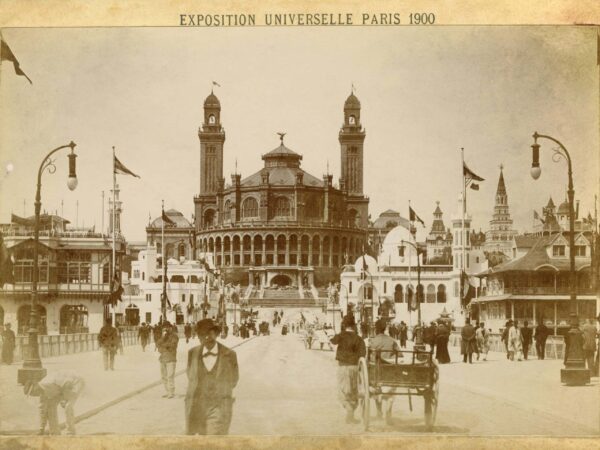
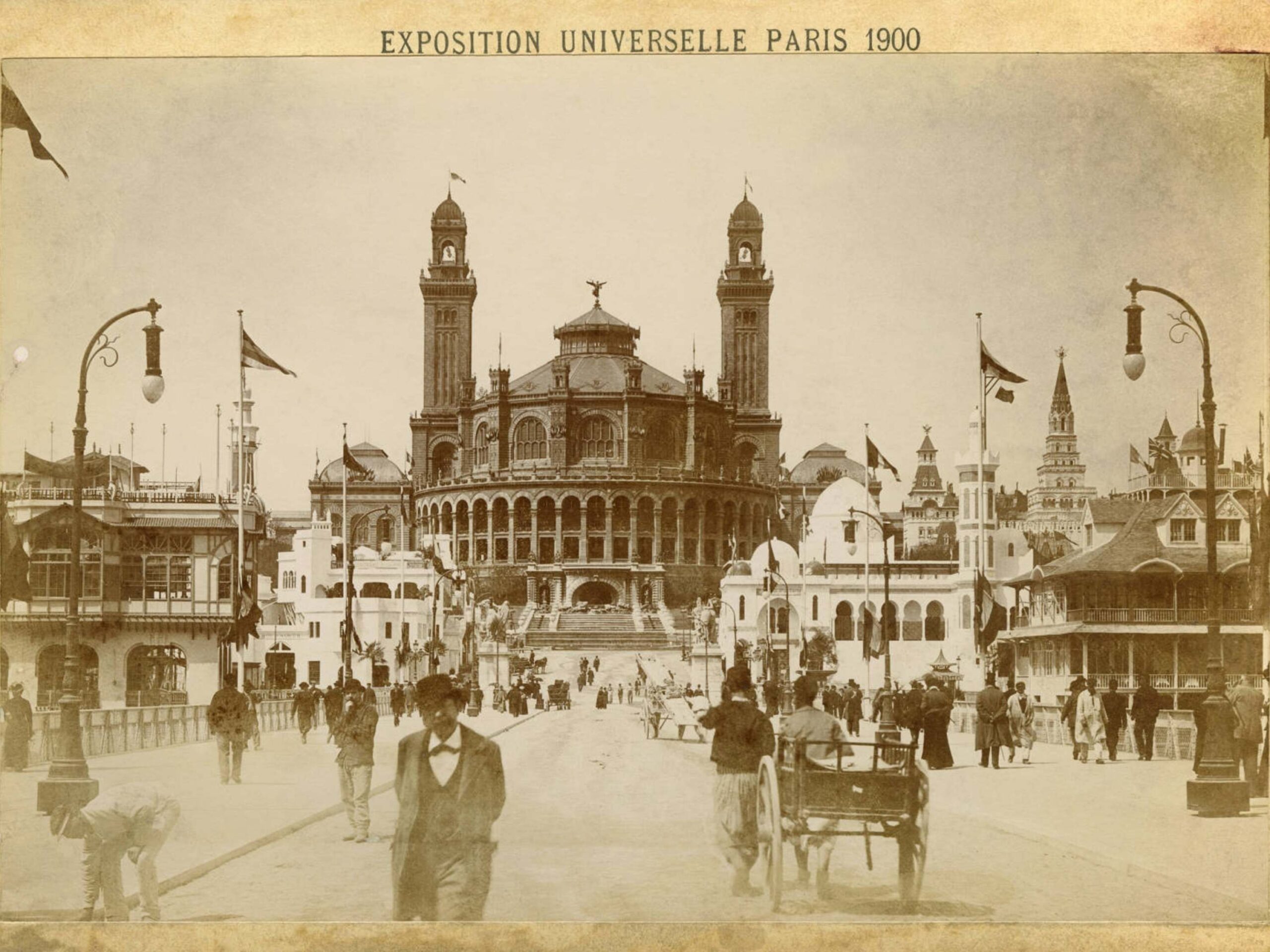
- The Trocadero Palace, where the Lithuanian section’s exhibition was held at the World’s Fair in Paris in 1900. Pranas Razmukas’ collection, LNM
“The first Lithuanian appearance at the Paris World’s Fair was more than a cultural event — it was a political declaration made through exhibits, boldly showing our nation’s vitality even under efforts to suppress our statehood. The 1935 and 1937 exhibitions later reflected the ambitions of an independent Lithuanian state. Today, by reconstructing these exhibitions and returning the rediscovered dowry chest after more than a century, we can appreciate how far we’ve come — and remember that culture has always been, and remains, the foundation of our diplomacy, identity, and survival,” says Dr. Rūta Kačkutė, Director General of the Lithuanian National Museum.
The organizing committee of the 1900 exhibition faced persecution, as such a presentation had clear political overtones — it was an act of resistance against Tsarist rule. Nevertheless, the Lithuanian section was successful, earning 12 awards at the exhibition.
The journey of the exhibits to Paris
The Lithuanian display featured about 150 items — agricultural tools, household utensils, textiles, and folk art. Among them was the flower-patterned dowry chest from Suvalkija, placed in the most prominent spot — in a reconstructed “respectable Lithuanian peasant’s house,” depicting a wedding scene.
The chest was not only a beautiful piece of furniture but also a clever means of smuggling other exhibition items into France.
“Lithuania couldn’t send items directly to France, so they were secretly transported to Prussia and only then shipped to Paris. Since there were no special crates, the exhibits were packed into dowry chests — it drew less attention and made crossing the border easier. Naturally, every inch of space was used. We can relate even today when conducting evacuation drills — every crate is packed full to save as many exhibits as possible,” notes exhibition curator Dr. Miglė Lebednykaitė, head of LNM’s Ethnography and Anthropology Department.
Letters between organizers Juozas Lozoraitis and Juozas Bagdonas mention the practical idea:
“By the way, would it be all right if I sent the items in an old chest (flower-patterned), made for a dowry about 70 years ago and still quite beautiful?”
This suggests that the rediscovered chest was made in the first half of the 19th century.
The packing process was full of creativity — and humor. In one letter, Lozoraitis wrote to Bagdonas:
“The scapulars and rosaries are tucked into the trousers’ pockets — perhaps you didn’t find them? In the clog, I put a white cloth and two photographs — did you find those?”
He also wondered about some missing table legs:
“I’m surprised where the table legs disappeared! I put them into the flowered chest’s legs… Perhaps you didn’t think to turn the chest upside down? If so, you’d make a poor policeman!”
Despite the challenges and lack of museum traditions, the 1900 exhibition was prepared with remarkable professionalism.
“Today we organize exhibitions with insurance, contracts, loan forms, and export permits for cultural property, but even then, they kept itemized lists, exchanged letters, documented shipments, sources, and valuations,” says Lebednykaitė.
-
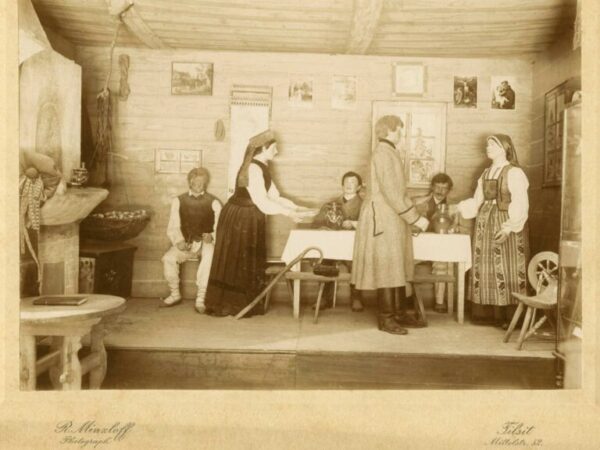
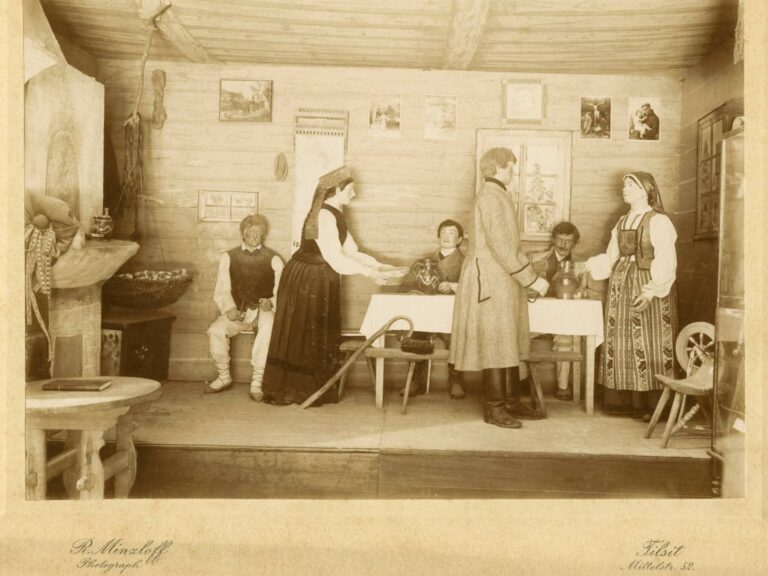
- A farmer’s cottage room with a chest on the left at the 1900 World’s Fair in Paris. Photo by Robertas Minzlofas, LNM
Lost and found
Even before the 1900 exhibition, it was decided that some Lithuanian items would be donated to the Trocadéro Museum of Ethnography in Paris.
“Trocadéro was a famous and old European museum, so to have our items in their collection was an honor. It also served as a kind of recognition for a nation oppressed by the Russian Empire — Lithuania became part of the Trocadéro collection under the name Lithuanie,” explains Lebednykaitė.
These exhibits stayed together for decades, but as the museum system evolved, the Trocadéro collection was moved from one institution to another, eventually becoming part of Mucem in Marseille.
Although the chest remained in France, Lithuanian researchers couldn’t locate it in Mucem’s current records or storage collections.
“The chest is large, so we hoped it couldn’t simply vanish. But finding it among hundreds of pieces of furniture from different nations wasn’t easy,” recalls Lebednykaitė.
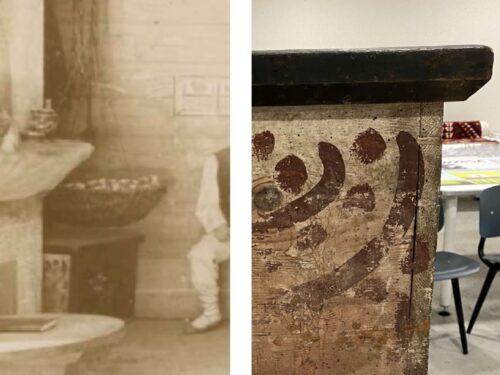
A key moment came through collaboration with Raphaël Bories, a Mucem collections curator. After several research visits to Marseille, he showed a chest that, according to an archival photograph from 1900, might be the missing Lithuanian one — though it bore a label reading “Russie” (Russia) and was listed as “unidentified.”
“Its patterns, colors, and painting immediately revealed its Lithuanian origin. The wrong labeling might have happened after the original tag fell off, or it may have been misattributed from the start as part of the Russian collection — not surprising given that Lithuania had lost its statehood at the time,” says Lebednykaitė.
The identification was confirmed by the 1900 photograph, showing the same chest prominently displayed next to a stove, with a cradle hanging above it, draped with colorful woven fabrics and ribbons.
“Artist and textile specialist Antanas Tamošaitis once said that chests were the first Lithuanian museums — they held items no longer used in daily life but too valuable to discard. Fabrics, garments, ribbons — preserved with love and memory. So today, this chest tells not only a story about Paris but also about how we preserve our culture. The rediscovered chest is more than a museum artifact — it’s a symbol of Lithuania’s first step into the world, a story of an object that crossed borders, got lost among labels and collections, but after a century, speaks Lithuanian again,” says Lebednykaitė.
Mucem has since corrected the chest’s description, reclassified it properly, and restoration work is nearing completion. It will be exhibited together with other 1900 World’s Fair items at the House of Histories from November 26, in the show “On the Wave of Paris Exhibitions: Ethnography, Cultural Diplomacy and Identity.” This time, the chest will return to Lithuania not as smuggled contraband — but as one of the centerpiece exhibits of the forthcoming exhibition.
-
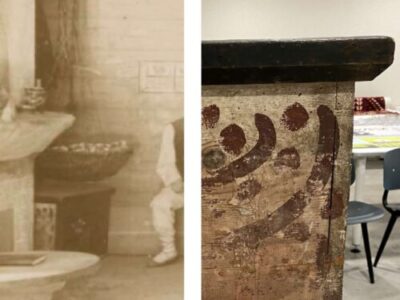
- Comparison of a fragment of the chest with a historical photograph. Mucem
-
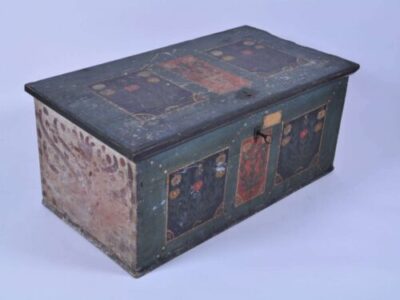
- Chest. ~1830. Suvalkija, Lithuania. Exhibited at the 1900 World’s Fair in Paris. Mucem